 Andrew J. Flanagin
 Miriam Metzger
Key Claims
Students' Internet Use
- Nearly all students (97%) are online by age 8; average use 14 hours/week (8 hours for 11-year-olds, 16 hours for 18-year-olds)
- Students regard internet as most credible source for schoolwork and entertainment; second most credible for health; third for news
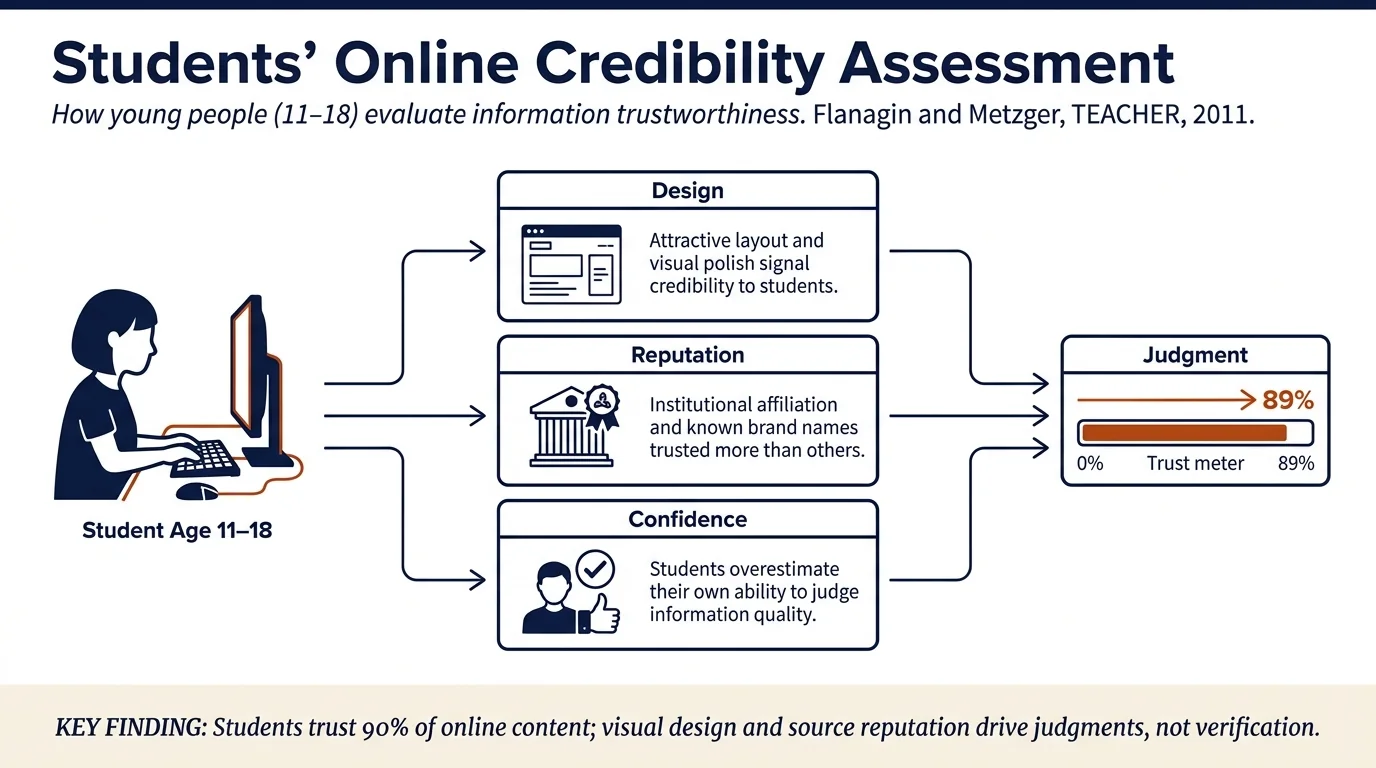
- Students overestimate their own technical skill, search skill, and internet knowledge relative to other users (even 11-year-olds exhibit this bias)
- 75% of parents control children's internet access through placement, site-limiting, time-limiting, or other methods; control decreases sharply with age
Credibility Perceptions
- 89% of students report "some" to "a lot" of online information is believable
- Students differentiate reasonably between entertainment, health, news, commercial, and school information types
- Students are skeptical of blogs but find Wikipedia "somewhat believable"—yet many report trusting Wikipedia substantially more than they think others should
- Students view encyclopedia entries attributed to Britannica as significantly more credible than identical entries attributed to Wikipedia or Citizendium
- Wikipedia entries appearing on Citizendium's page are perceived more credible than when appearing on Wikipedia's own page
- 10% of students still believed hoax websites "a lot" or "a whole lot"
- Students found product ratings highly credible; average rating influenced credibility judgments more than the number of ratings
Credibility Concerns and Training
- 73% of students received formal information literacy training
- 1/3 of students reported personally experiencing or knowing someone who had a bad experience due to false online information
- Nearly 2/3 had heard news reports about false information harms
- These experiences increase skepticism about online information
Child-Parent Comparisons
- Parents believe they are better at assessing online credibility than their children; children almost universally agree
- Gap narrows with age
- Both exhibit "optimistic bias"—belief that they are better than the typical internet user at identifying credible information
- Optimistic bias present even among children as young as 11
Age and Development
- Older students show greater diversity and rigor in credibility assessment
- Younger, less analytical students more likely to trust strangers online and be fooled by false information
Sources Cited in the Article
The article draws substantially on the authors' larger research project, particularly:
- Flanagin, A., Metzger, M., Hartsell, E., Markov, A., Medders, R., Pure, R., & Choi, E. (2010). Kids and Credibility: An empirical examination of youth, digital media use and information credibility. MIT Press (supported by MacArthur Foundation grant on Digital Media and Learning)
Notes
Strength: This is a rare popular-press summary of large-scale empirical research on youth credibility assessment, making the findings accessible to educators and policymakers. The breadth of coverage (age ranges, information types, parental involvement) is valuable for understanding the landscape of youth digital literacy.
Scope and limitations: The article summarizes findings from a 2,747-student survey in a 3-page magazine format, so it necessarily omits methodological details and nuance. For the full analysis, readers should consult the companion peer-reviewed article (From Encyclopædia Britannica to Wikipedia: Generational differences in the perceived credibility of online encyclopedia information) and the MIT Press monograph. The article's framing emphasizes concerns (overconfidence, heuristic reliance) without deeply exploring how credibility judgment is adaptive in many everyday contexts.
Implications for education: The article argues that information literacy training, while widespread (73% of students), is not translating into sophisticated credibility judgment. It suggests that educators should focus on building understanding of how information sources operate (Wikipedia's editorial model, design cues, institutional affiliations) rather than generic "critical thinking" skills.