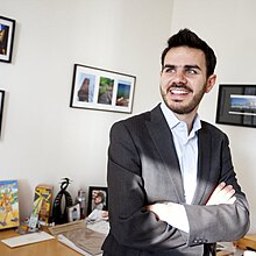
 David Rand
Key Themes
1. The Misinformation Problem and Its Scope
Rand frames misinformation as a global challenge affecting election integrity, public health (COVID-19 infodemic), and trust in institutions. He emphasizes that social media is not the only or even the primary source of misinformation — traditional media and political elites also generate and amplify false claims. This sets up the practical focus: on social media, platforms have direct intervention capacity because they control the presentation layer, making it a high-leverage target for research and intervention.
2. Crowdsourced Fact-Checking: Wisdom of Crowds
The core finding: Lay evaluators are surprisingly effective at assessing article accuracy if they pay attention to the task.
Rand presents evidence that:
- With 15–20 lay evaluators rating a headline (for accuracy, trustworthiness, and bias) on a 7-point Likert scale, the crowd's average rating correlates at r=0.62 with professional fact-checkers' detailed research — matching inter-rater reliability among the fact-checkers themselves.
- This holds regardless of political framing — the crowd performs as well on politically-charged headlines as on neutral ones.
- Results generalize cross-culturally: a study with 32,000 participants across 16 countries shows that crowd ratings achieve AUC > 0.85 (often > 0.90) for discriminating true from false COVID statements.
Practical implementations:
- Facebook Community Review (formerly Oversight Board interaction): Scales crowdsourcing by having users rate content directly on the platform, reducing platform moderation burden.
- Twitter Birdwatch/Community Notes: Volunteer-based fact-checking where users can flag potentially misleading content and write explanations. Rand's team analyzed Birdwatch data and found that while users disproportionately flag content from opposing political camps, the flagged content is actually misleading at high rates — partisanship solves the public-goods problem of motivating participation without undermining accuracy.
Challenges: Tyranny of the majority in non-polarized contexts; scale and cost of payment-based systems; coordinated bad-faith flagging in volunteer systems.
3. Accuracy Nudges: Shifting Attention to Accuracy
The cognitive mechanism Rand emphasizes: people often know the difference between truth and falsehood but forget to apply that knowledge when sharing. Misinformation spreads not necessarily because people are deceived, but because they fail to stop and think about accuracy.
Experimental evidence (meta-analysis across 20 experiments, N=26,000):
- Simply asking people to rate the accuracy of one random headline before they share articles reduces false-content sharing by ~10%.
- The effect holds for partisan content, neutral content, COVID-related claims, and across conservative and liberal populations.
- Importantly, the effect is driven by accuracy — not by dishonesty or motivated reasoning. Honest people who are prompted to think about accuracy share less false content and more true content.
Mechanisms tested:
- Accuracy priming (rating one headline)
- Digital literacy tips (e.g., "Consider the source")
- Social norms ("Most people think it's important to share accurate content")
- Direct prompts about personal values
- All activate the concept of accuracy and reduce false sharing.
Field experiments:
Twitter bot study: Cooking bots followed 130,000 Twitter users who had shared Breitbart/InfoWars links. ~5,000 users (after filtering out bots and inactive accounts) received a private message asking them to rate the accuracy of a non-political headline. Despite <10% response rate, the treatment reduced subsequent sharing of low-quality news domains (Breitbart, Daily Caller) and increased sharing of higher-quality outlets (e.g., mainstream news). Causal inference confirmed via stepped-wedge design.
Ad-based experiment: Three randomized trials (total N=75,000) where accuracy-nudge ads were shown to users on Twitter. A Bayesian meta-analysis found significant reduction in links to low-quality news sites (~2.5% reduction). Effect size is modest in absolute terms but reflects measurement error and selection challenges in the field environment.
Why accuracy nudges work:
- Repetition, consistency with prior beliefs, and trusted sources make people believe content regardless of truth.
- Lack of critical reasoning makes people more likely to believe false claims.
- But most people do care about truth and don't want to spread falsehoods — they just forget to think about accuracy in the moment.
- Nudges don't change motivations; they redirect attention to an existing motivation.
4. Cognitive Science of Misinformation Sharing
Rand grounds the work in cognitive science models of judgment and decision-making, particularly the tension between intuitive (System 1) and deliberative (System 2) thinking.
Key findings:
- Cognitive reflection: Individuals' scores on the Cognitive Reflection Test (a measure of reflective thinking ability) predict resistance to false-content sharing across political alignments.
- Lazy, not biased: The primary driver of misinformation sharing is not partisan bias or motivated reasoning, but rather intuitive, "lazy" thinking — skimming headlines without reflection.
- Intentionality is rare: Studies show no correlation between self-reported dishonesty (e.g., whether participants cheat in a coin-flip task) and false-content sharing, suggesting people do not intentionally spread falsehoods for personal gain.
- Political differences in sharing volume reflect exposure, not integrity: While Republicans are observed to share more misinformation in surveys, this reflects differences in what they encounter and share, not differences in willingness to be dishonest.
5. Systemic Challenges and Limitations
Rand acknowledges that individual interventions address symptoms, not root causes:
- Social media platforms have optimized for engagement, not accuracy, creating an attention environment where accuracy is a low priority.
- Platforms have a responsibility to redirect user attention toward accuracy (e.g., through nudges, ranking, or labeling).
- Repeated nudges may suffer from banner blindness unless varied and refreshed.
- No single intervention is a silver bullet; a multi-pronged toolkit is needed.
- Large language models add capacity to generate misinformation, but supply is not the limiting factor — demand and distribution are.
Methods and Evidence
- Meta-analysis: 20 survey experiments across 26,000 participants testing accuracy nudges.
- Cross-cultural study: 32,000 participants in 16 countries assessing crowdsourced fact-checking on COVID claims.
- Field experiments: Twitter bot study (5,000 users, stepped-wedge design); ad-based experiments on Twitter (75,000 users, Bayesian meta-analysis).
- Data analysis: Birdwatch data analysis examining partisan patterns in volunteer fact-checking; survey experiments on critical thinking and sharing behavior.
Notes
This keynote represents a mature synthesis of Rand's work on misinformation from roughly 2015–2023. The talk is technically rigorous (effect sizes, multiple study designs, cross-cultural validation) while remaining accessible. Key strengths include the candid acknowledgment that effect sizes in field experiments are modest (~2.5%) and the emphasis on multiple complementary interventions rather than a single solution. The cognitive science framing — lazy thinking rather than partisan bias or malice — is both theoretically grounded and practically important for intervention design.
The Twitter field experiments are particularly valuable because they use causal inference methods (stepped-wedge, randomization) in a realistic context, addressing the long-standing gap between lab experiments and real-world efficacy. The cross-cultural crowdsourcing work demonstrates generalizability beyond the US, an important check on Western-centric misinformation research.
Limitations and open questions Rand raises: the duration of nudge effects under repeated exposure, the scalability of crowdsourced systems when payment is required, handling adversarial flagging in volunteer systems, and the applicability of these findings as generative AI reduces the cost of misinformation production.