Contributions
-
Four systematic misperceptions. Identifies how public discourse distorts exposure statistics: (1) quoting aggregate numbers without appropriate denominators (e.g., "17 million views" ignoring platform scale), (2) reporting individual exposure without denominators for total consumption, (3) presenting averages skewed by extreme consumers, and (4) conflating engagement metrics (public shares) with exposure (private consumption).
-
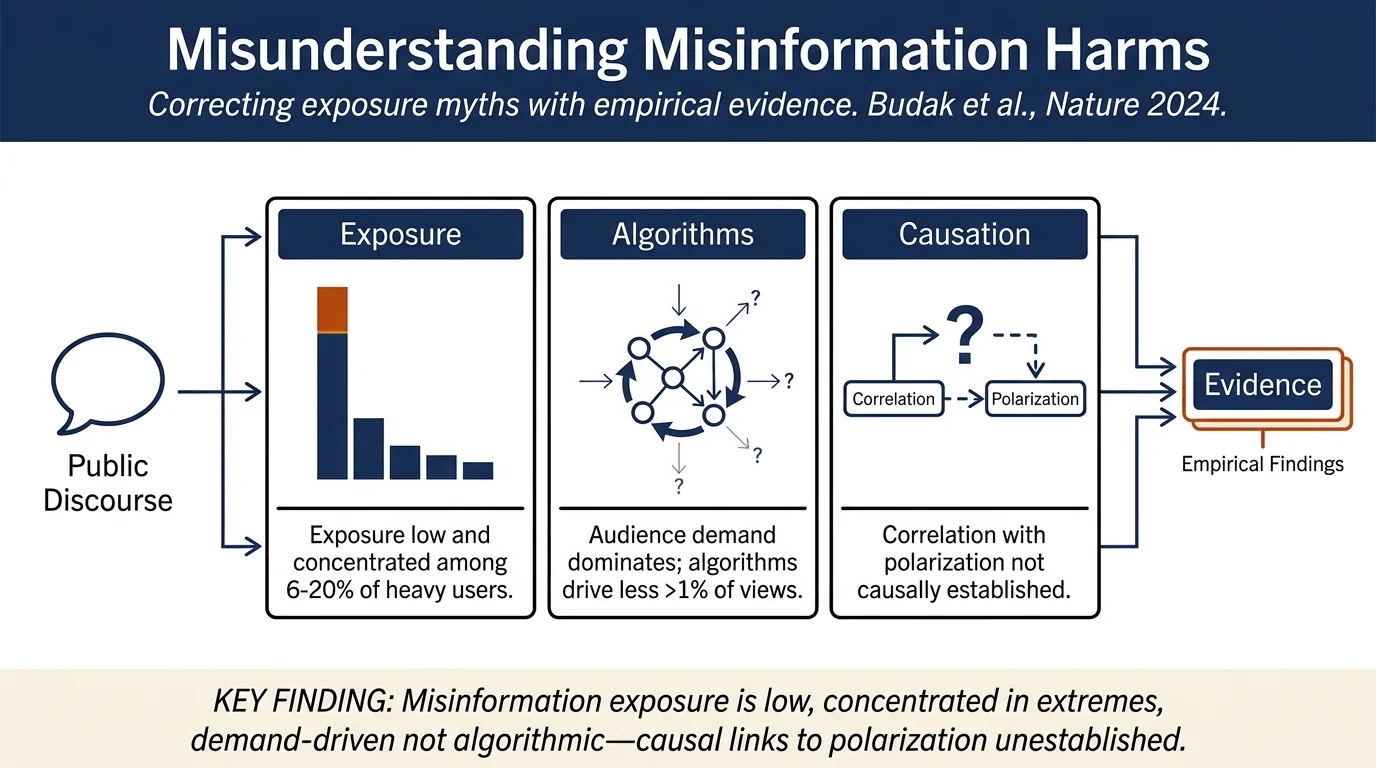
Exposure is low and concentrated. Empirical review shows untrustworthy websites represent 0.1–4.4% of web traffic across Western democracies, far-right sources <0.5% of YouTube watch time, and 6.3% of YouTube users account for 79.8% of extremist channel exposure.
-
Audience demand exceeds algorithmic effects. Evidence from reverse-chronological feed experiments, deplatforming case studies, and consumption pattern analysis suggests people actively seek fringe content; algorithmic recommendations drive <1% of extremist video views on YouTube.
-
Causal claims rest on weak foundations. Correlations between social media use and polarization are not established as causal; deactivation studies find null or opposite effects; the gilets jaunes and anti-vaccine movements predate social media, limiting counterfactual inference.
-
Research is geographically skewed. Most evidence comes from USA and Western Europe; non-Western contexts may face higher exposure due to fewer reliable news outlets, weaker content moderation, and platform underinvestment.
Method
Systematic synthesis of published behavioral science research on online misinformation exposure and effects, organized around three public claims: (1) average exposure is high, (2) algorithms drive exposure, (3) social media causes polarization and social harms. For each claim, the authors review empirical evidence, identify methodological limitations, and articulate open questions.
Results
-
Exposure statistics. Articles from 490 untrustworthy websites made up 5.9% of US citizens' news site visits (2016 US election); NewsGuard-assessed untrustworthy sites 0.1–4.4% of web traffic (USA, UK, France, Germany, 2017–2021); fake news just 0.1% of total media diet when TV included.
-
Concentration. 20% of US citizens with most conservative information diets responsible for 62% of visits to untrustworthy websites; 1% of Twitter users responsible for 80% of exposures to dubious content links; <1% of US citizens consumed 85% of vaccine-skeptical content (2016–2019).
-
Algorithmic effects. Large-sample reverse-chronological feed experiment (Facebook/Instagram) showed algorithms actually supplied less untrustworthy content than reverse-chronological ordering; zero measurable effect on political attitudes after 3-month switch; YouTube extremism driven primarily by subscriptions and external links (41% from external URLs, 36% from related videos), not recommendations (0.4%).
-
Causal inference. Facebook deactivation studies in USA found no effect on affective polarization; Bosnia/Herzegovina sample showed less positive outgroup evaluation after deactivation; exposure to cross-cutting news decreased affective polarization, but reducing like-minded exposure had no effect.
-
Data limitations. Most studies rely on source-level trustworthiness indicators rather than granular content flagging; engagement metrics systematically overrepresent fake news relative to exposure; lack of platform data on aggregate exposure, especially mobile.
Notes
Strengths:
- Rigorous synthesis of heterogeneous evidence with careful attention to denominators and statistical framing.
- Identifies concrete methodological errors in public discourse (engagement ≠ exposure, aggregate numbers without scale context).
- Balanced treatment of algorithmic effects: acknowledges that algorithms can matter while arguing evidence of large-scale effects is limited.
- Non-Western research gap is well-articulated and consequential.
Weaknesses and open questions:
- Perspective piece rather than novel data; dependent on quality and representativeness of cited studies.
- Concentration among extremes documented empirically, but causal mechanisms (preference homophily, active search, or algorithmic nudging) remain underspecified.
- Limited treatment of indirect harms: even low population-level exposure could reduce trust or shape mainstream media coverage if asymmetrically amplified by elites and journalists.
- Recommendations for "tail exposure" metrics are sound but operationalization and implementation remain open; heavy users may not form a stable measurement target.
- Claims about non-Western contexts are speculative; calls for data but does not establish that patterns documented in the West will differ substantially in kind rather than degree.
Methodological note: The paper's framing of "misperceptions" in public discourse is polemical—it assumes academic research is the ground truth, which is reasonable for empirical questions (exposure levels) but less so for policy questions (what exposure levels are acceptable, what should platforms prioritize). The authors acknowledge this in recommendations, but the perspective frame privileges researcher voice over journalist, policymaker, and affected-community expertise.