Contributions
- Presents comprehensive Facebook exposure data for the entire US population of active adult users in 2020, showing that like-minded content constitutes the majority of exposures while political information is a minority
- Conducts a multi-wave randomized controlled field experiment reducing exposure to like-minded content for 23,377 Facebook users during the critical 2020 presidential election period
- Documents that reducing like-minded content exposure increased cross-cutting source exposure but decreased uncivil language exposure
- Tests eight pre-registered attitudinal outcomes and finds no significant effects on affective polarization, ideological extremity, candidate evaluations, or belief in false claims
- Challenges the causal narrative linking echo chambers to individual polarization, suggesting other mechanisms beyond content exposure shape political attitudes
Method
The study combined observational data from Facebook covering all US users and a randomized controlled experiment. First, the authors analyzed what proportion of content users saw came from like-minded, cross-cutting, and neither category sources across all user segments. They classified source political leanings using predictions from a machine learning classifier trained on Facebook user engagement data.
For the experiment, participants (n=23,377) in treatment and control groups were recruited from US Facebook users who self-identified as Republican, Democrat, or independent. The treatment consisted of downranking content from friends, Pages, and groups predicted to share the participant's political leanings during three waves (September 24 – December 23, 2020), encompassing the 2020 presidential election. The intervention was designed to reduce rather than eliminate exposure to like-minded content, preserving usability.
Participants completed surveys before treatment, during waves 1–5 (roughly biweekly), and after treatment ended. Outcomes were measured via self-reported surveys and platform behavioral data. The authors conducted pre-election (August–September 2020), post-election (November–December 2020), and post-intervention (early 2021) surveys to assess affective polarization, ideological extremity, ideologically consistent views, vote choice and candidate evaluations, partisan-congenial beliefs and views, election misconduct beliefs, and respect for election norms.
Results
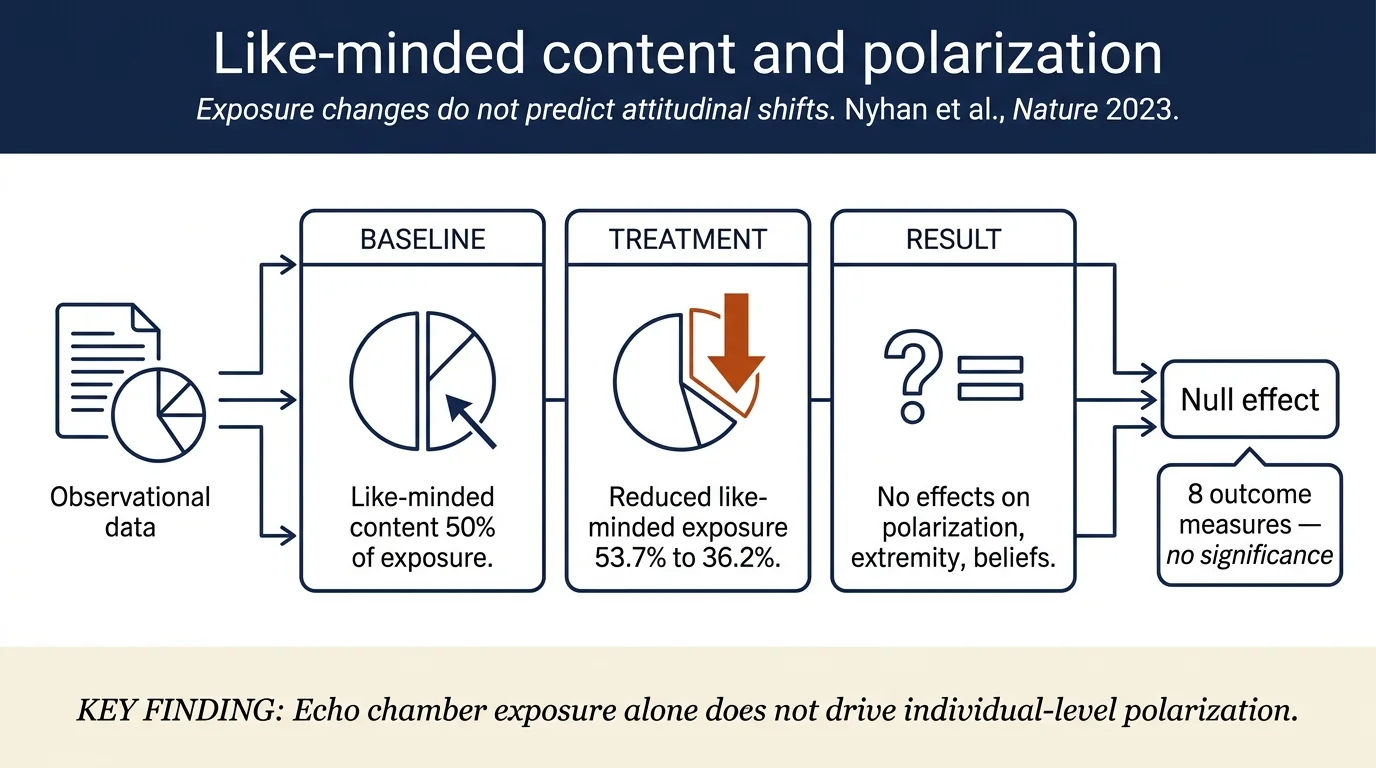
Exposure patterns: The median Facebook user received 50.4% of content exposures from like-minded sources, 14.7% from cross-cutting sources, and 35% from neither category. Among the most active users (top quintile), like-minded content made up 55% of exposures. Importantly, civic and news content together represented only 5–7% of total exposures for most users.
Treatment effects on exposure: Reducing exposure to like-minded sources decreased average daily exposures to like-minded content from 53.7% to 36.2% in the treatment group while remaining stable at 53.7% in controls (p < 0.001). Exposure to cross-cutting sources increased from 20.7% to 27.9% in treatment (p < 0.001). Time spent on Facebook did not significantly differ between groups.
Engagement: Total engagement with like-minded content decreased 0.27 s.d. in the treatment group. However, overall engagement rate (total actions conditional on exposure) showed no significant reduction, and passive engagement with like-minded content actually remained higher in treatment than control groups, contrary to expectations.
Attitudes and polarization: Despite the substantial reduction in like-minded source exposure and increase in cross-cutting content, the treatment produced no significant effects on any of eight pre-registered attitudinal outcome measures: affective polarization, ideological extremity, ideologically consistent views, vote choice and candidate evaluations, partisan-congenial beliefs and views, election misconduct beliefs, and respect for election norms. Point estimates were negative (pointing toward depolarization) but uniformly crossed zero in 95% confidence intervals.
Exploratory heterogeneous treatment effect analyses by political ideology, direction of extremity, and age found no significant subgroup effects, and results did not vary meaningfully based on treatment intensity or timing.
Notes
Strengths:
- Large-scale platform collaboration with unprecedented access to full-population exposure data and causal experimental assignment
- Pre-registered outcomes and comprehensive measurement of both behavioral and attitudinal changes
- Replicated null findings across multiple outcome measures strengthen confidence in the null result rather than suggesting noise
- Study period (2020 US presidential election) is high-stakes and theoretically relevant for detecting polarization effects
Weaknesses and implications:
- The null effect on attitudes despite exposure changes raises questions about what mechanisms actually drive polarization: political communication environment may reflect existing identity more than shape it
- Field experiment constraints (downranking rather than elimination, unblinded treatment, limited intervention duration) may not capture effects of stronger or longer-term exposure reductions
- Results specific to platform-mediated exposure; does not address offline political communication or identity-reinforcing behaviors outside social media
- The finding that engagement with like-minded content remained high despite reduced exposure suggests that platform friction alone may not change behavior — users actively sought out the content
- Raises open questions: do echo chambers reinforce existing polarization rather than create new polarization? Are attitudinal changes from media exposure slow to emerge? Do other information sources dominate social media in shaping beliefs?
This work fundamentally challenges whether algorithmic exposure to like-minded sources is a primary driver of individual-level polarization, with important implications for platform policy and the framing of misinformation and polarization interventions.