Accuracy nudges are minimal, scalable behavioral interventions that prompt users to reflect on the accuracy of content before sharing. Rather than removing content, blocking accounts, or imposing centralized fact-checking, nudges activate users' own accuracy motivation—the finding that most people, when prompted to think about truth, prefer accurate information.
The core insight: inattention to accuracy (not motivated reasoning or political polarization) is a primary driver of misinformation sharing. Social-platform design (likes, followers, engagement metrics, group signaling) makes users think about social outcomes, not factuality. A simple prompt to rate a headline's accuracy—or even a framing like "Is this accurate?"—can redirect attention and improve decision-making.
Evidence
Field experiments show measurable effects:
-
Berinsky, Rand, Bourne & Tushman (2020) — Exploring Potential Solutions to Online Disinformation — Twitter field experiment (N=5,000+ high-risk sharers): a single DM asking "How accurate is this headline?" tripled discernment (gap between sharing true vs. false news increased 50–100%) and improved average content quality by ~5%. Effects persisted for high-visibility accounts.
-
Pennycook et al. (2021) — Shifting attention to accuracy can reduce misinformation online (Nature) — Six experiments (N~6,000) plus Twitter field experiment showing that subtle reminders to think about accuracy increase sharing of accurate news and decrease sharing of false news. Limited attention, not confusion or polarization, drives misinformation sharing.
-
Pennycook & Rand (2020) — Fighting COVID-19 Misinformation on Social Media — Accuracy nudges nearly triple truth discernment on COVID-19 misinformation when users decide what to share. Effect holds across political ideologies and user sophistication.
-
Guess et al. (2020) — A digital media literacy intervention increases discernment between mainstream and false news — Simple "tips" framing accuracy as important (e.g., "Did the source provide evidence?") improved discernment by 26.5% in RCT.
Video overview:
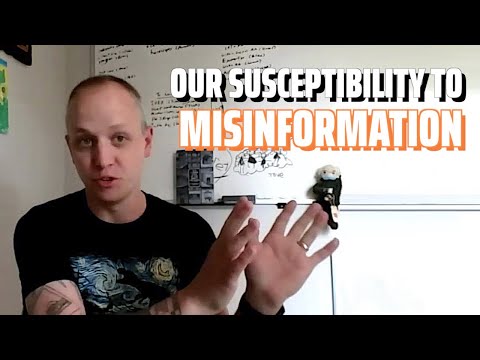
- Pennycook — Our Susceptibility to Misinformation — Talk reviewing the theory and evidence for accuracy nudges, showing that reminding people to focus on accuracy reduces false-content sharing and that the mechanism is attention redirection, not reasoning improvement.
Mechanisms
Accuracy nudges work because:
- People have an accuracy motivation. Most users, when prompted, prefer to share accurate content—this is not partisan-dependent; effects persist across ideologies.
- Attention is the binding constraint. Platform design activates social concerns (how many likes, followers, group membership signals) that distract from accuracy judgment. Making accuracy salient redirects attention without requiring sophisticated reasoning.
- The nudge is non-coercive. Unlike content removal or top-down fact-checking, nudges preserve user agency; users self-police based on their own accuracy judgment.
- Effects generalize. Nudges improve discernment without suppressing engagement broadly (e.g., personal posts, images remain unaffected; only news sharing becomes more selective).
Advantages
- Scalable: A single DM or in-feed prompt can reach millions; no need for human fact-checkers or complex algorithms.
- Depoliticized: Does not require a centralized arbiter deciding what is "true"; users do the evaluation.
- Platform-compatible: Does not require changing core business models or advertising algorithms; only affects news-sharing behavior, not engagement broadly.
- Persistent: Early evidence suggests effects last at least 48 hours; optimization could extend durability.
Limitations and Open Questions
- Persistence: Field experiments have measured effects up to 48 hours; longer-term durability unknown.
- Generalization: Most research on U.S. participants; cross-cultural applicability (especially in high-polarization or authoritarian contexts) untested.
- Banner blindness: Repeated exposure may cause users to ignore nudges; the platform would need to vary messaging to maintain salience.
- Complementary approaches needed: Nudges improve discernment but don't eliminate false sharing entirely; likely most effective paired with platform governance, media literacy, and systemic changes.
- Demographic heterogeneity: Whether nudges are equally effective across age, education, and political sophistication groups under investigation.
Related interventions
- crowdsourced-fact-checking — aggregating lay users' accuracy judgments to scale fact-checking
- behavioral-nudges — broader class of light-touch behavioral interventions
- fact-checking — reactive correction after misinformation spreads
- media-literacy — proactive education on news evaluation (complementary but more labor-intensive)
Platforms and pilots
- Twitter / Jigsaw collaboration: Berinsky and Rand have tested accuracy nudges in partnership with Google's Jigsaw unit (R&D arm), running large-scale randomized experiments (~9,000 subjects) comparing accuracy prompts, digital literacy tips, and social-norm framings.
- Facebook pilot: Mentioned in 2020 webinar; details of implementation and efficacy under development.
- Future platforms: Proposed for X's Community Notes and other crowdsourced correction systems as a pre-correction mechanism.