Debunking refers to the act of correcting false information or retracting claims after they have been disseminated. In the misinformation literature, debunking is a reactive (post-exposure) intervention, contrasted with prebunking (pre-emptive inoculation against false claims). The central challenge in debunking is the continued influence effect: false information often continues to influence reasoning and memory even after exposure to explicit corrections.
Key mechanisms
Why corrections sometimes fail:
The integration failure account suggests that people fail to fully integrate corrective information into their mental model, leaving outdated false beliefs accessible in memory even when they consciously reject them. The selective retrieval account proposes that people may successfully update their beliefs but selectively retrieve the false information when reasoning about related topics (especially under cognitive load or time pressure).
What makes corrections effective:
Research identifies several design principles for effective corrections:
- Provide an alternative explanation. Simply saying "X is false" leaves a gap in reasoning; corrections that offer a plausible alternative ("X is false; here's why Y is actually true") reduce reliance on the false claim.
- Target the source. Highlighting conflicts of interest or poor track records of the source can amplify correction effectiveness, particularly when combined with content-focused corrections.
- Repeat the correction. Stronger or multiple corrections reduce continued influence from strongly encoded misinformation.
- Use simple, clear language. Corrections framed in jargon or lengthy explanations are less effective, particularly under cognitive load.
- Establish credibility of the correction source. Corrections from trustworthy sources (academic, official institutions) are more persuasive than corrections from unfamiliar or low-credibility sources.
- Acknowledge emotions. Misinformation often succeeds by appealing to emotions or worldview; acknowledging these motivations (empathy) can increase receptiveness to corrections.
Continued influence effect
The robust finding that corrections do not eliminate misinformation's influence on reasoning is known as the continued influence effect. After reading a correction, people's subsequent inferences (about related claims, likelihood of events) often still reflect the false claim they consciously rejected. This effect:
- Persists even when corrections are from authoritative sources
- Can occur with long delays between misinformation and correction
- Is sometimes attenuated but not eliminated by strong corrections or repeated exposures
- Operates through both explicit belief and implicit memory
The debunking literature treats the continued influence effect as the core problem: effective debunking is not merely replacing false beliefs with true ones, but designing interventions that eliminate influence on subsequent reasoning.
Key papers
- Ecker et al. (2024) — Don't believe them! Reducing misinformation influence through source discreditation — Tests source discreditation as an intervention to reduce continued influence; shows combined correction-and-discreditation most effective.
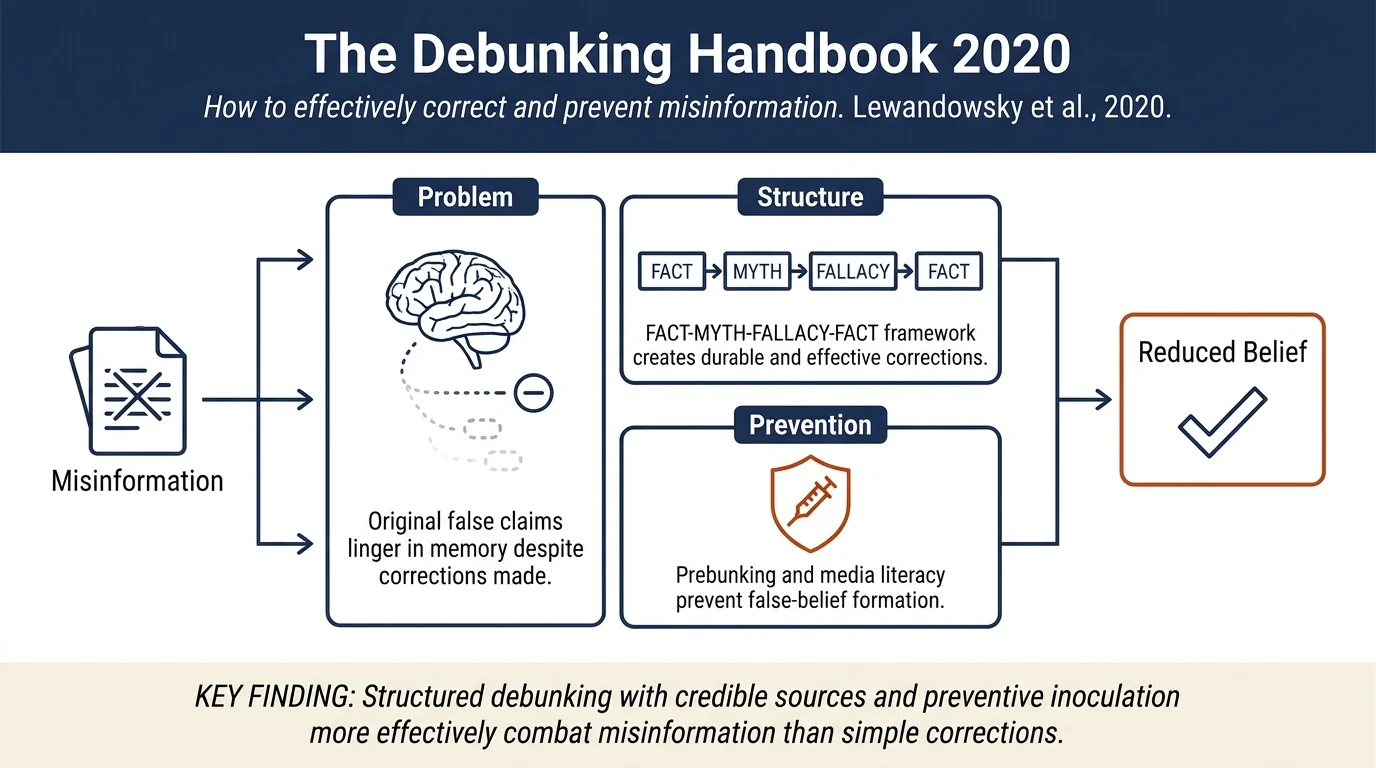
- The Debunking Handbook 2020 — Practical synthesis of research on correcting misinformation; evidence-based strategies to overcome continued influence through detailed refutations, alternative explanations, and proper framing.
- Vraga et al. (2023) — To Debunk or Not to Debunk? Correcting (Mis)Information — WHO chapter introducing the REACT framework (Repetition, Empathy, Alternative explanations, Credible sources, Timeliness) for strategic prioritization and evidence-based principles in misinformation correction.
- Debunking: A Meta-Analysis of the Psychological Efficacy of Messages Countering Misinformation — Meta-analysis of 52 experiments demonstrating that detailed debunking messages sometimes correlate with stronger persistence (the "backfire paradox"); shows elaborated counterarguments reduce this counterintuitive effect.
- Ecker, Lewandowsky, Swire & Chang (2011) — Correcting false information in memory — Foundational experimental study showing stronger retractions reduce continued influence from strongly encoded misinformation, but cannot fully eliminate effects from weakly encoded claims.
- Ecker, Butler & Hamby (2020) — You don't have to tell a story! A registered report testing narrative versus non-narrative misinformation corrections — Registered report finding both narrative and non-narrative corrections effective but narrative format provides no additional benefit for reducing continued influence.
- Ecker, Lewandowsky & Tang (2010) — Explicit warnings reduce but do not eliminate the continued influence of misinformation — Shows specific warnings plus alternative explanations reduce reliance on misinformation more effectively than general warnings, though residual effects persist.
- Lewandowsky, Ecker, Seifert, Schwarz & Cook (2012) — Misinformation and its correction: Continued influence and successful debiasing — Foundational review of cognitive mechanisms underlying continued influence and evidence-based debiasing strategies.
- Ecker, Lewandowsky & Chadwick (2020) — Can corrections spread misinformation to new audiences? — Tests whether corrections of novel false claims risk inadvertently familiarizing audiences with misinformation; finds no familiarity backfire effects, confirming it is safe to correct.
- Ecker, Sharkey & Swire-Thompson (2023) — Correcting vaccine misinformation: A failure to replicate familiarity or fear-driven backfire effects — Direct replication confirming myths-vs.-facts corrections reduce vaccine misconceptions without backfire effects.
- Sanderson, Bowden, Swire-Thompson, Lewandowsky & Ecker (2022) — Listening to Misinformation while Driving — Tests correction effectiveness under cognitive load; shows load impairs corrections but repeated corrections overcome this.
Related topics
- Continued influence effect — The phenomenon that makes debunking challenging; corrections often fail to eliminate influence on reasoning.
- Source Credibility — Mechanism by which corrections can be made more effective through credible sources and attacks on false-source credibility.
- Misinformation Interventions — Broader category of techniques (debunking, prebunking, inoculation, media literacy) to counter misinformation.
- The psychological drivers of misinformation belief and its resistance to correction — Underlying cognitive, affective, and social factors that make misinformation persuasive and difficult to correct.
- belief correction — General cognitive and social mechanisms of updating false beliefs.
Papers on this topic
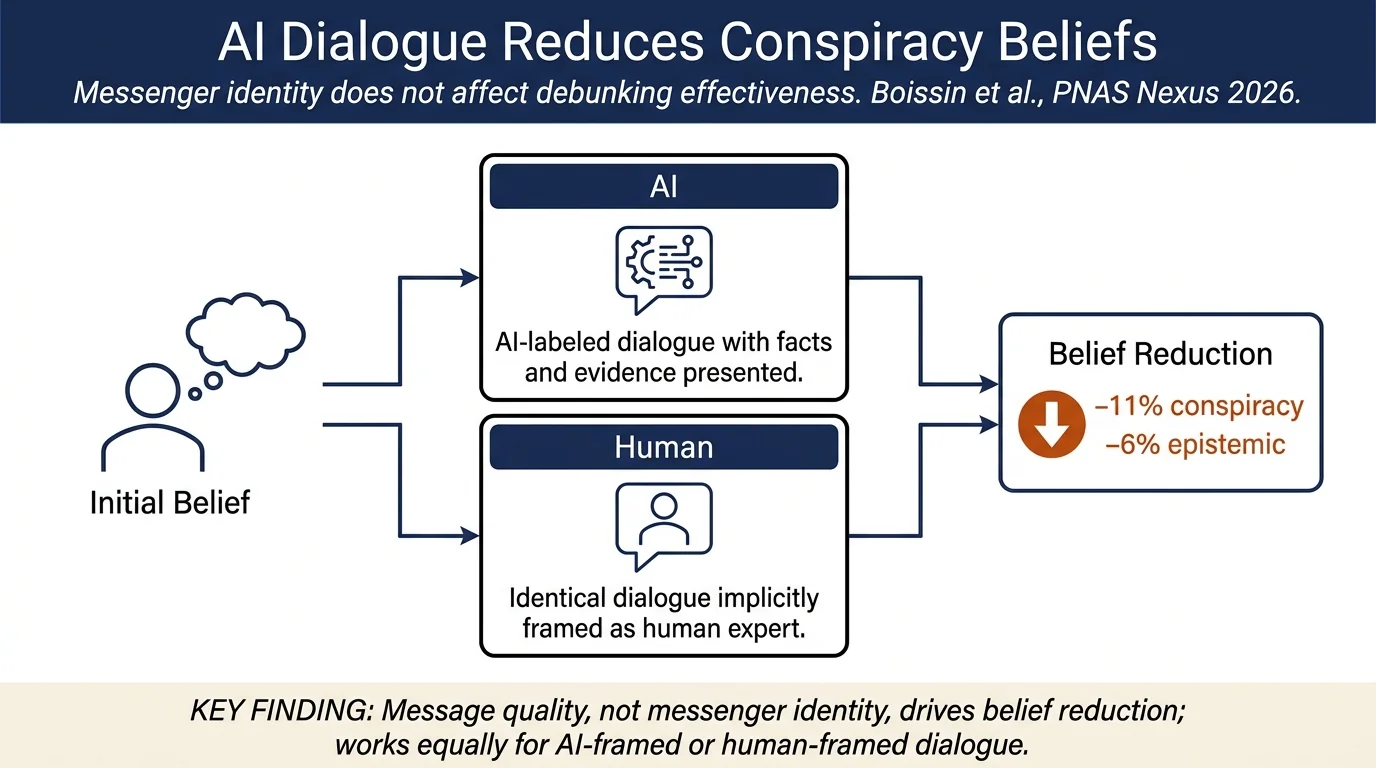 Psychology & interventionsLLMs & generative AI
Dialogues with Large Language Models Reduce Conspiracy Beliefs Even When the AI Is Perceived as Human
Detection methodsPsychology & interventions
Combating misinformation: A megastudy of nine interventions designed to reduce the sharing of and belief in false and misleading headlines
 Detection methodsPsychology & interventions
Durably reducing conspiracy beliefs through dialogues with AI
Psychology & interventionsFact-checking & verification
Don't believe them! Reducing misinformation influence through source discreditation
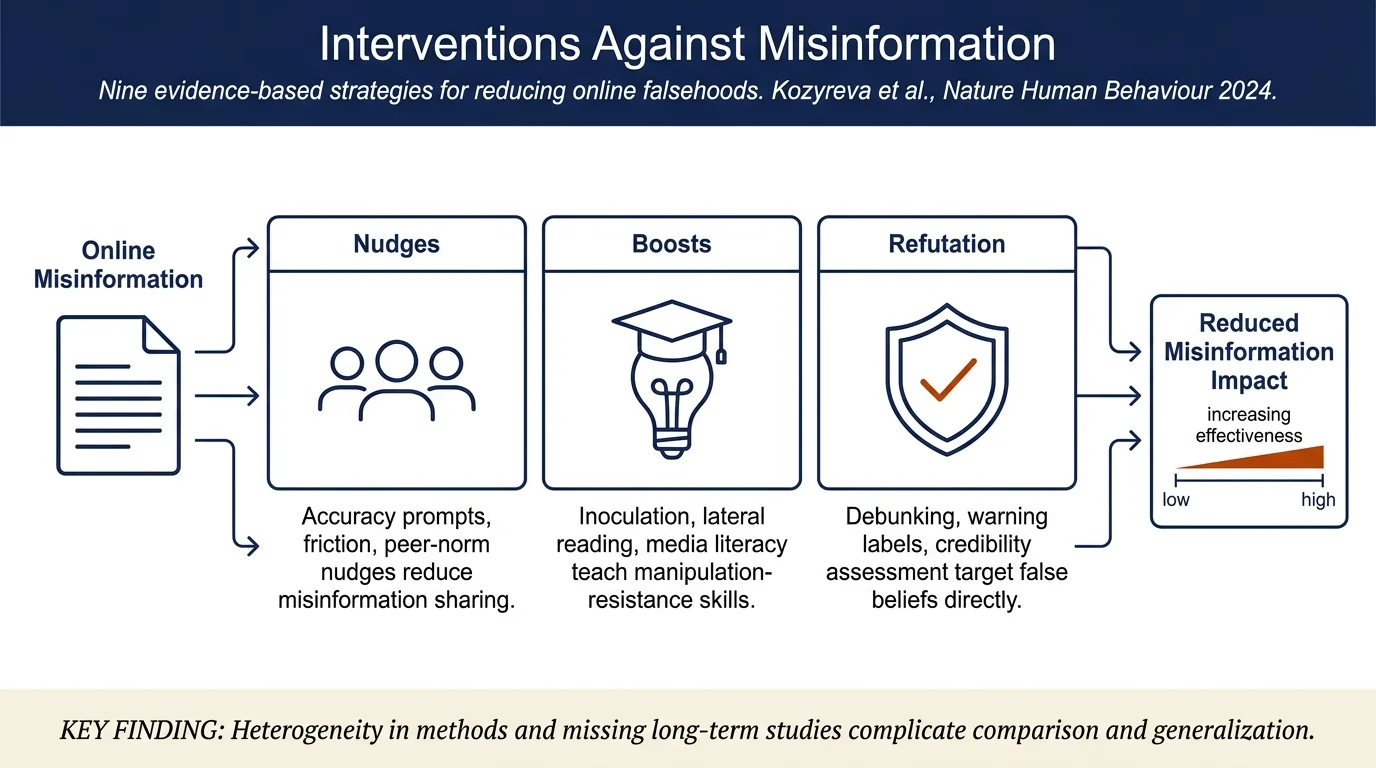 Detection methods
Toolbox of individual-level interventions against online misinformation
Psychology & interventionsDetection methods
Using Psychological Science to Understand and Fight Health Misinformation: An APA Consensus Statement
 Psychology & interventionsDetection methods
Fact or Fake? The Psychology of Misinformation
Detection methodsPlatforms, policy & society
To Debunk or Not to Debunk? Correcting (Mis)Information
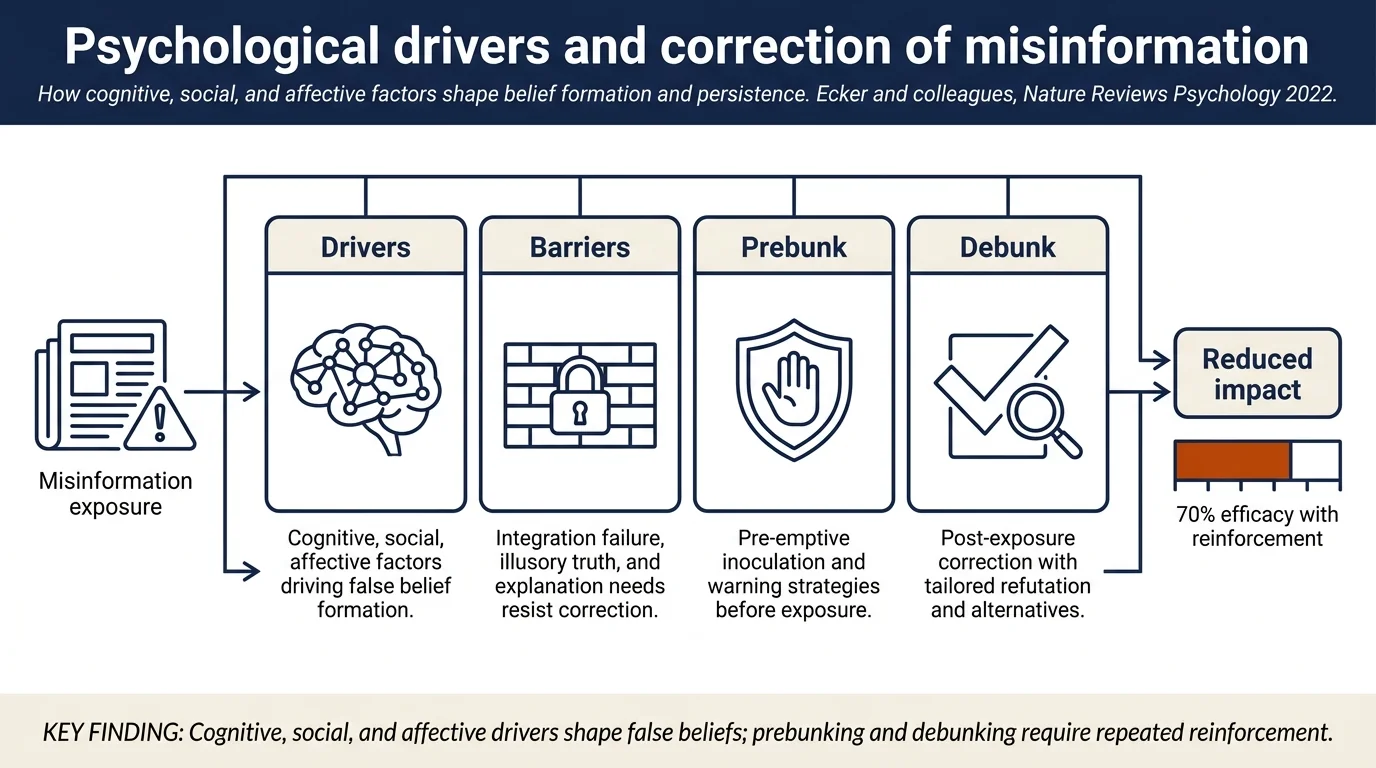 Psychology & interventionsFact-checking & verification
The psychological drivers of misinformation belief and its resistance to correction
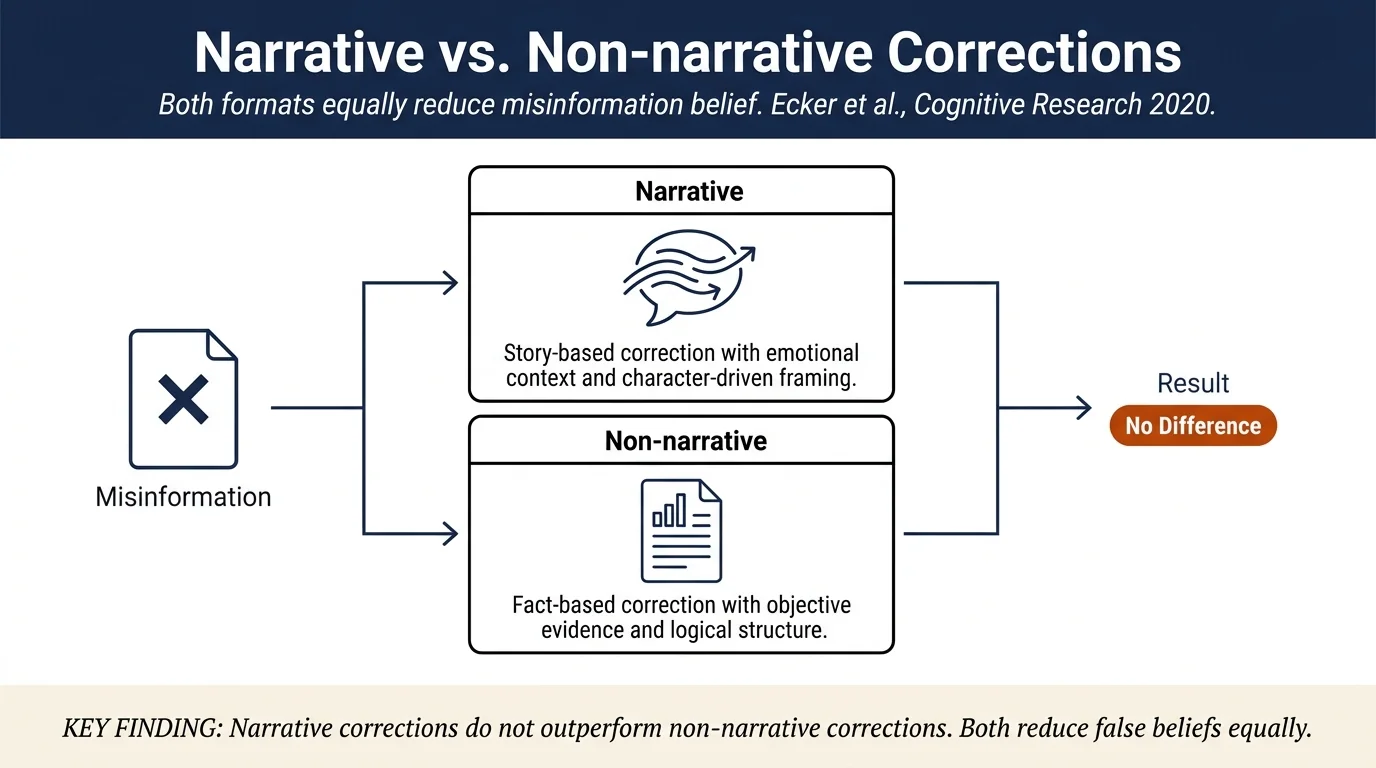 Detection methodsPsychology & interventions
You don't have to tell a story! A registered report testing the effectiveness of narrative versus non-narrative misinformation corrections
 Detection methodsPsychology & interventions
The Debunking Handbook 2020
 Psychology & interventionsDetection methods
The Psychology of Misinformation
 Detection methodsPsychology & interventions
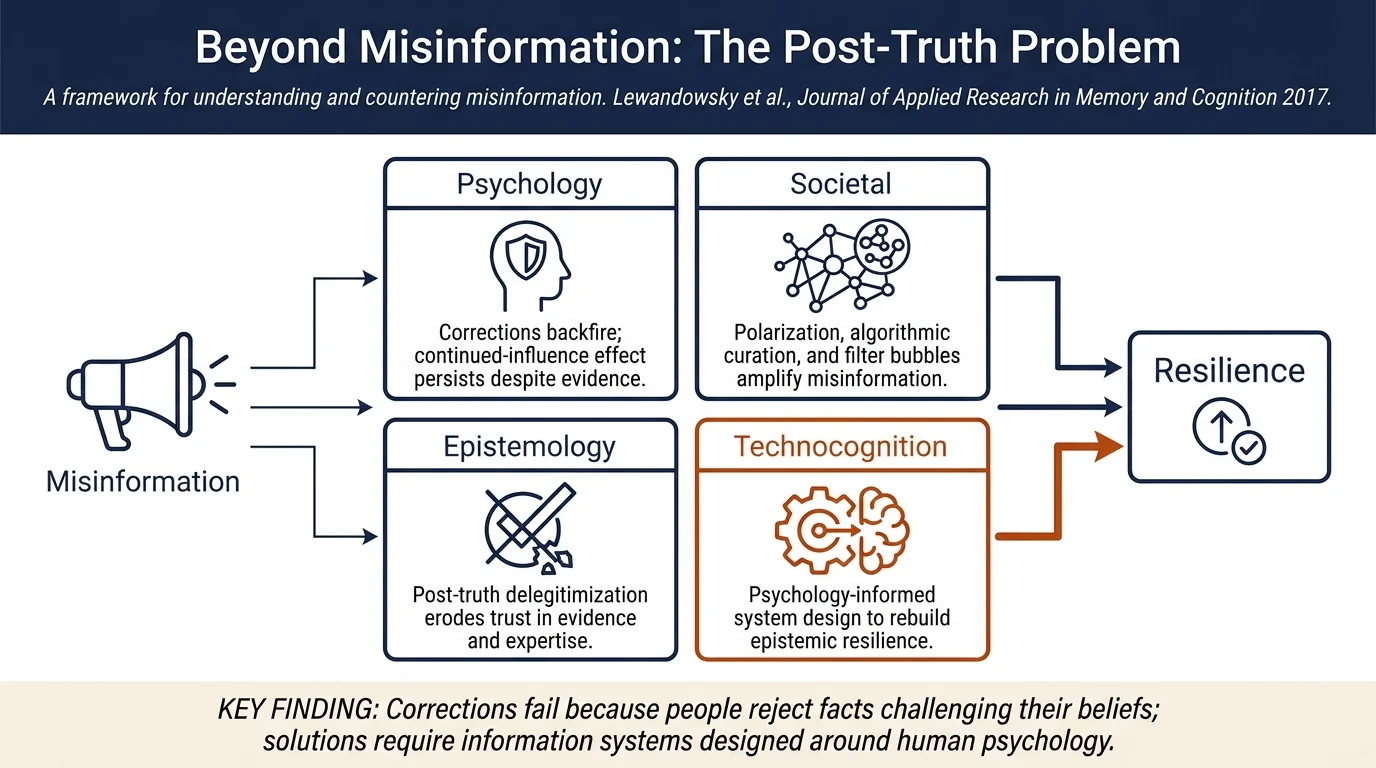
Beyond Misinformation: Understanding and coping with the post-truth era
Detection methodsPsychology & interventions
Letting the Gorilla Emerge From the Mist: Getting Past Post-Truth
 Detection methodsPsychology & interventions
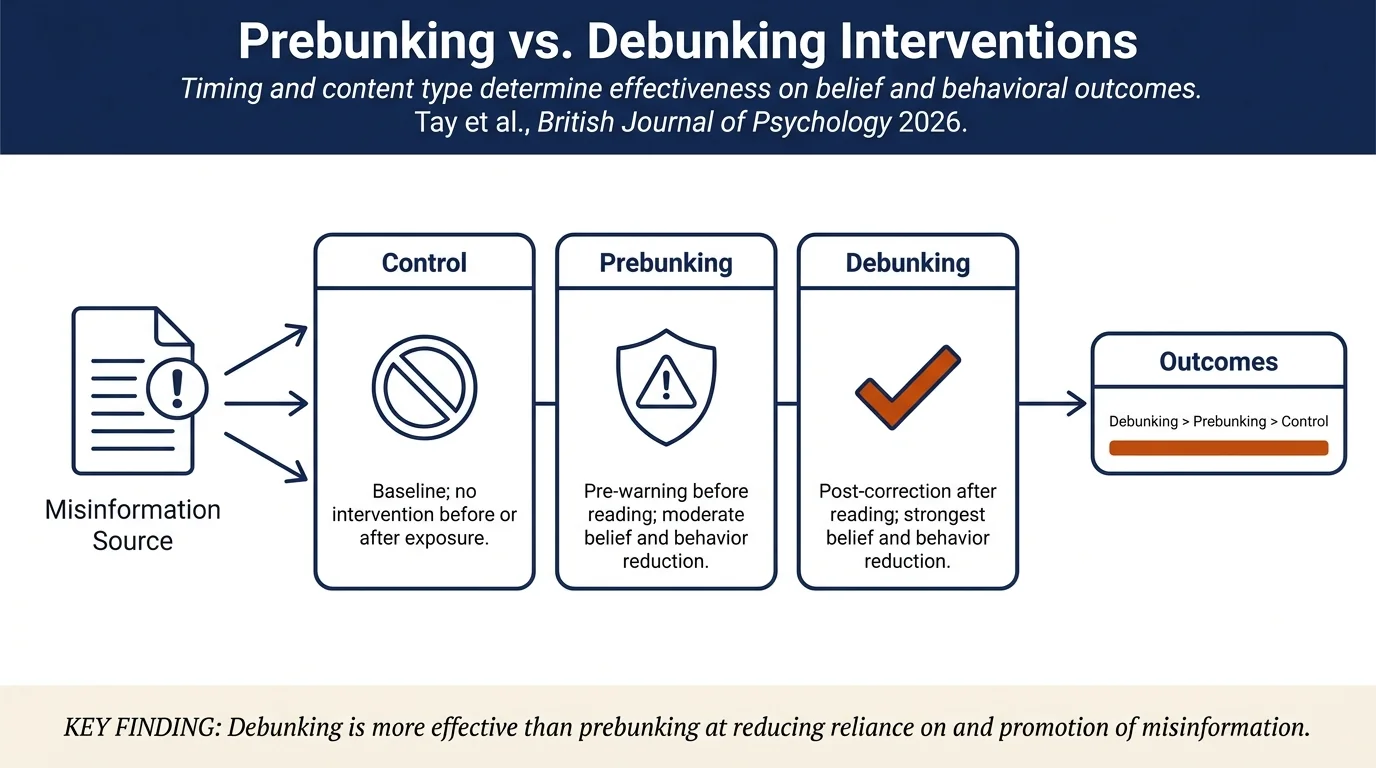
A Comparison of Prebunking and Debunking Interventions for Implied versus Explicit Misinformation