 Stephan Lewandowsky
 John Cook
 Ullrich K. H. Ecker
 Panayiota Kendeou
 Gordon Pennycook
 Ethan Porter
 David Rand
 Jason Reifler
 Jon Roozenbeek
 Philipp Schmid
 Briony Swire-Thompson
 Sander van der Linden
 Emily K. Vraga
 Thomas Wood
Contributions
- Synthesizes two decades of research on misinformation resistance and correction in an accessible format
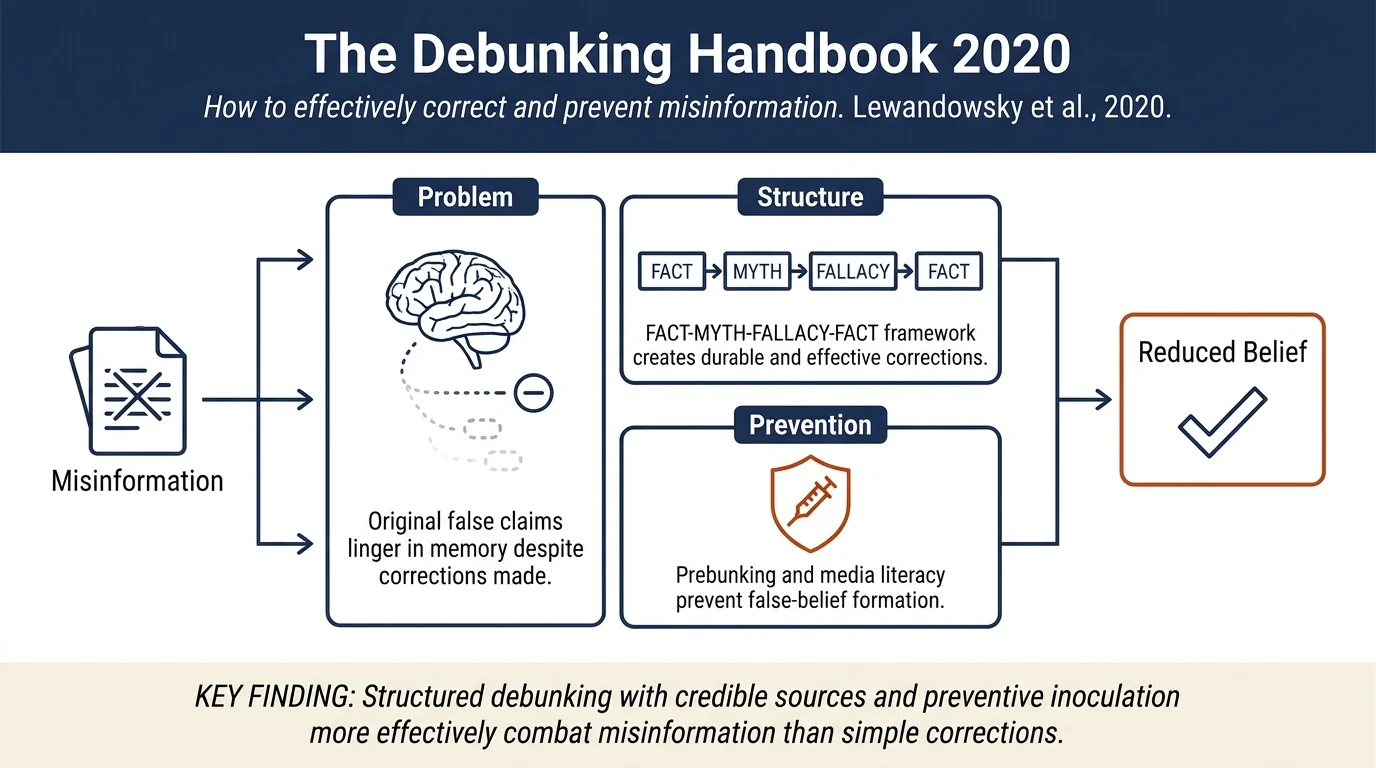
- Introduces the FACT-MYTH-FALLACY-FACT structure for effective debunking
- Addresses the continued influence effect: why corrections often fail to displace initial misbeliefs
- Provides evidence that backfire effects are rare and overstated, contrary to widespread concern
- Details the "strategic landscape" of debunking: when to debunk, whom to involve, and how to frame corrections
- Presents inoculation and media literacy as preemptive strategies to build resistance to manipulation
Key Findings
The continued influence effect — Even when people acknowledge a correction and update their factual beliefs, the original misinformation lingers in memory and continues to influence reasoning in other contexts. This occurs because corrections don't fully undo the memory trace or the inferential habits built on the false claim.
Backfire effects are rare — Early concern that corrections might backfire (strengthen misbeliefs) has been overstated. Research shows backfire effects occur occasionally and unpredictably, and are not a sufficient reason to avoid debunking.
Debunking structure matters — Effective corrections follow a framework: lead with the fact, warn that a myth is coming, explain the fallacy, and reinforce the fact. Simple tag-based corrections ("this is false") are insufficient; detailed refutations with plausible alternative explanations are more likely to stick.
Credibility and source trust — The perceived trustworthiness of the correction source matters more than its expertise. Health professionals, trusted institutions, and messengers aligned with the target audience's values are more persuasive.
Prevention beats correction — Inoculation (preemptive exposure to weakened misinformation techniques) and media literacy training reduce susceptibility to false claims before exposure, and are more efficient than correcting established misbeliefs.
Method
The handbook is a synthesis of empirical literature, not an original research study. The authors reviewed decades of psychology research on belief formation, memory, the illusory truth effect, continued influence, backfire effects, inoculation, source credibility, and media literacy. The document distills this into practical principles and recommendations for communicators, educators, and practitioners.
Notes
This is the second edition of the handbook (first published ~2011); the 2020 update incorporates a decade of new research and reflects the current empirical consensus. It is written for a mixed audience: researchers, practitioners, communicators, and educators. The practical structure and evidence-based framing make it influential in the field, with broad adoption in debunking and media literacy curricula. The emphasis on inoculation and prevention over correction alone reflects a shift toward proactive rather than reactive strategies.
The handbook's credibility argument—that source trust often matters more than expertise—has important implications for platform design and institutional communication about misinformation. The updated treatment of backfire effects, showing they are not a reliable phenomenon, has helped reduce hesitation to debunk in practice.