Contributions
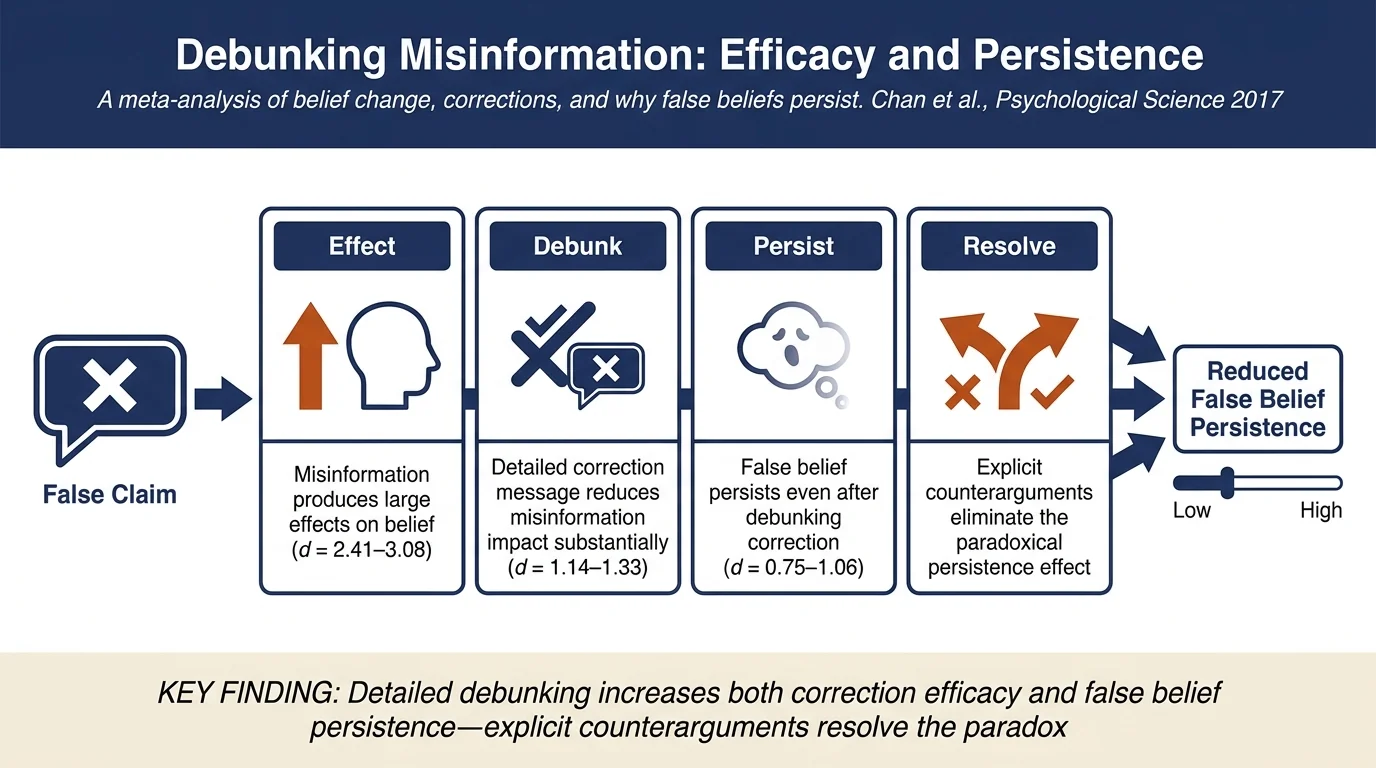
- Comprehensive meta-analysis documenting the magnitude of misinformation effects (ds = 2.41–3.08), debunking effects (ds = 1.14–1.33), and misinformation-persistence effects (ds = 0.75–1.06) across diverse topics and contexts.
- Identification of audience factors that predict weaker debunking: when people generate their own explanations supporting the initial misinformation, the debunking effect weakens.
- Documentation of a paradoxical finding: detailed debunking messages correlate positively with both stronger debunking efficacy and stronger persistence of the original misinformation.
- Demonstration that elaborating counterarguments to the misinformation moderates the continued-influence effect.
Method
Systematic meta-analysis combining 52 experiments from 20 reports (8 studies/experiments included in the formal meta-analysis; N = 6,878 participants). Studies were identified via electronic database searches (PsycINFO, Google Scholar, Medline, PubMed, ProQuest, Social Sciences Citation Index) using controlled keywords and inclusion criteria limiting to empirical, experimental work with outcome measures of participants' beliefs about the misinformation or debunking messages.
Effect sizes computed as Hedges' d, with three-level meta-analyses to account for multiple experiments nested within reports and dependencies among samples. The analysis examined misinformation effect (difference between misinformation and control groups), debunking effect (difference between debunking and control/misinformation-only groups), and misinformation-persistence effect (residual influence of the misinformation after debunking). Moderator analyses coded characteristics of the misinformation, debunking message (level of detail, presence of counterarguments), and audience (whether participants generated supporting explanations).
Results
Misinformation effect: Presenting false information produces large effects (d = 2.41–3.08 across fixed and random effects models). The magnitude is robust across diverse topics (political, medical, social, environmental false claims).
Debunking effect: Providing a detailed correction/debunking message reduces misinformation's influence substantially (d = 1.14–1.33). Debunking is effective at reducing adherence to the false claim.
Misinformation persistence: Even when debunked, the false belief persists (d = 0.75–1.06). This continued-influence effect is smaller than the initial misinformation effect but large and reliable across conditions.
Moderator: generating explanations in support of misinformation. When participants were asked to generate reasons supporting the initial misinformation (before exposure to the debunking), the debunking effect weakened significantly and the persistence effect strengthened. This elaboration of supporting arguments increases commitment to the false belief.
Moderator: level of detail in the debunking message. Contrary to intuition, a more detailed (as opposed to simple/labeled) debunking message correlated with stronger debunking effects but also stronger misinformation persistence. The counterargument-elaboration variable moderated this persistence effect: when debunking messages included explicit counterarguments (causal alternatives explaining why the initial claim was false), the paradoxical persistence boost was eliminated or reversed.
Publication bias: Funnel plots indicated asymmetry, suggesting potential small-study effects. Weighted random-effects models were used; results remained significant when outliers were excluded.
Notes
This meta-analysis is foundational for understanding why debunking is non-trivial and often incomplete. The paradoxical finding—that more detailed corrections increase persistence—is particularly important: it suggests naive amplification of counter-messaging can backfire. The moderation by elaborated counterarguments is actionable: corrections should not just label a claim false, but explain why it is false via causal alternatives or detailed explanations. The paper also highlights that audience characteristics (likelihood of generating supporting reasons, initial confidence in the false claim) predict who will benefit from debunking and who will persist in false belief despite it.