Explore papers
Filter by research area, year and venue. Every filter is in the address bar, so you can share a view as a link.
 Detection methodsDatasets & evaluation
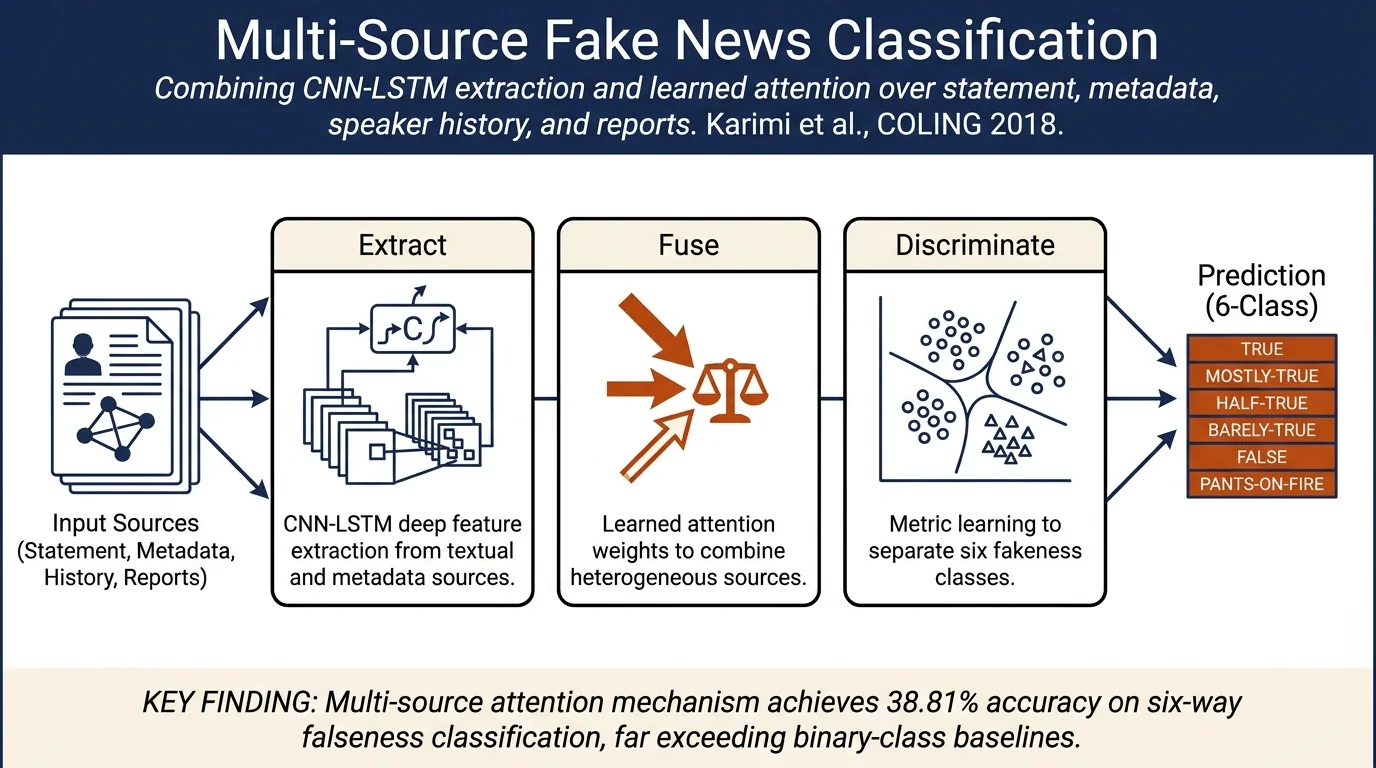
Multi-Source Multi-Class Fake News DetectionProposes MMFD, a multi-source multi-class fake news detection framework combining automated feature extraction (CNN-LSTM), interpretable multi-source fusion (attention mechanism), and fakeness discrimination. Achieves 38.81% accuracy on LIAR dataset across six classes of fakeness (true, mostly-true, half-true, barely-true, false,…
 Deepfakes & multimodalDetection methods
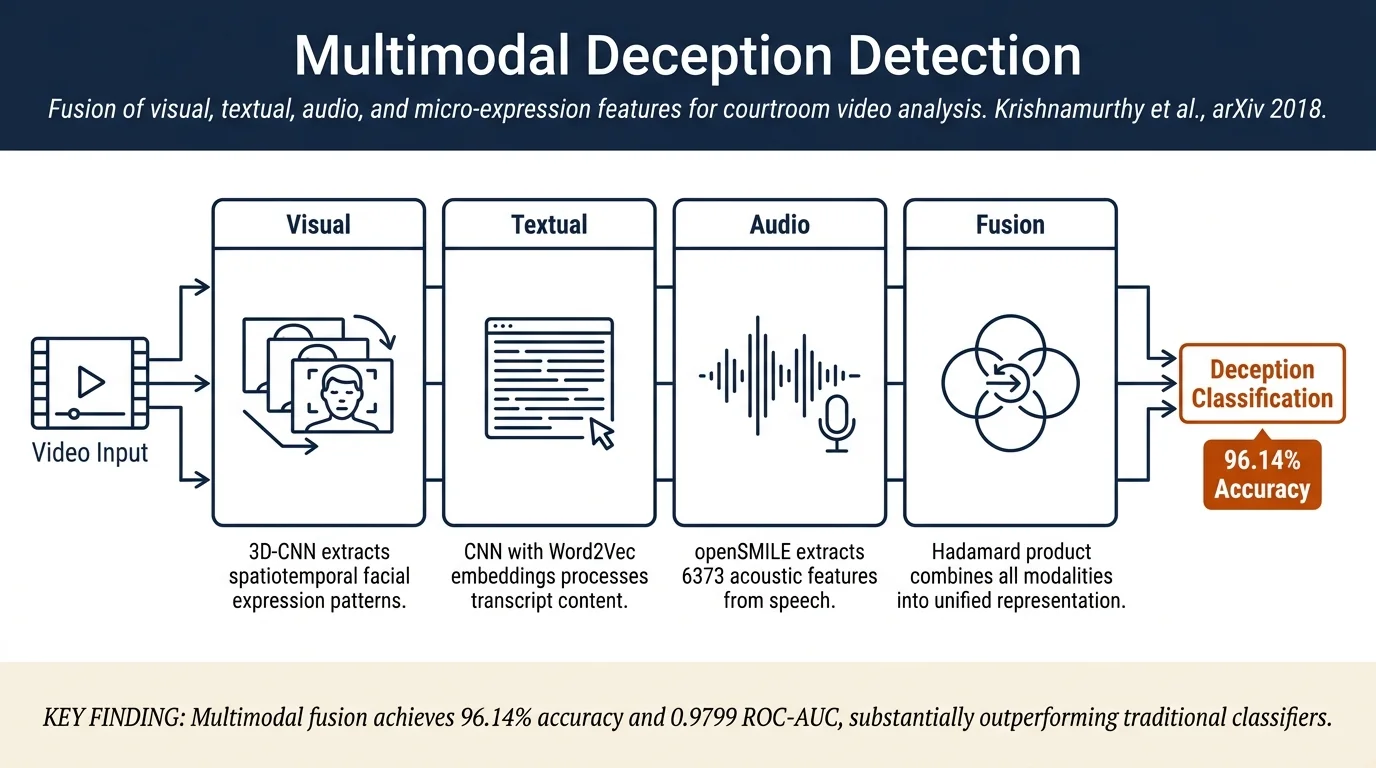
A Deep Learning Approach for Multimodal Deception DetectionThis paper proposes a multimodal neural model for detecting deception in real-life courtroom trial videos by combining visual features from 3D-CNN, audio features from openSMILE, textual features from CNN on transcripts, and manual micro-expression annotations. The model achieves 96.14% accuracy and ROC-AUC of 0.9799, substantially…
 Detection methodsDatasets & evaluation
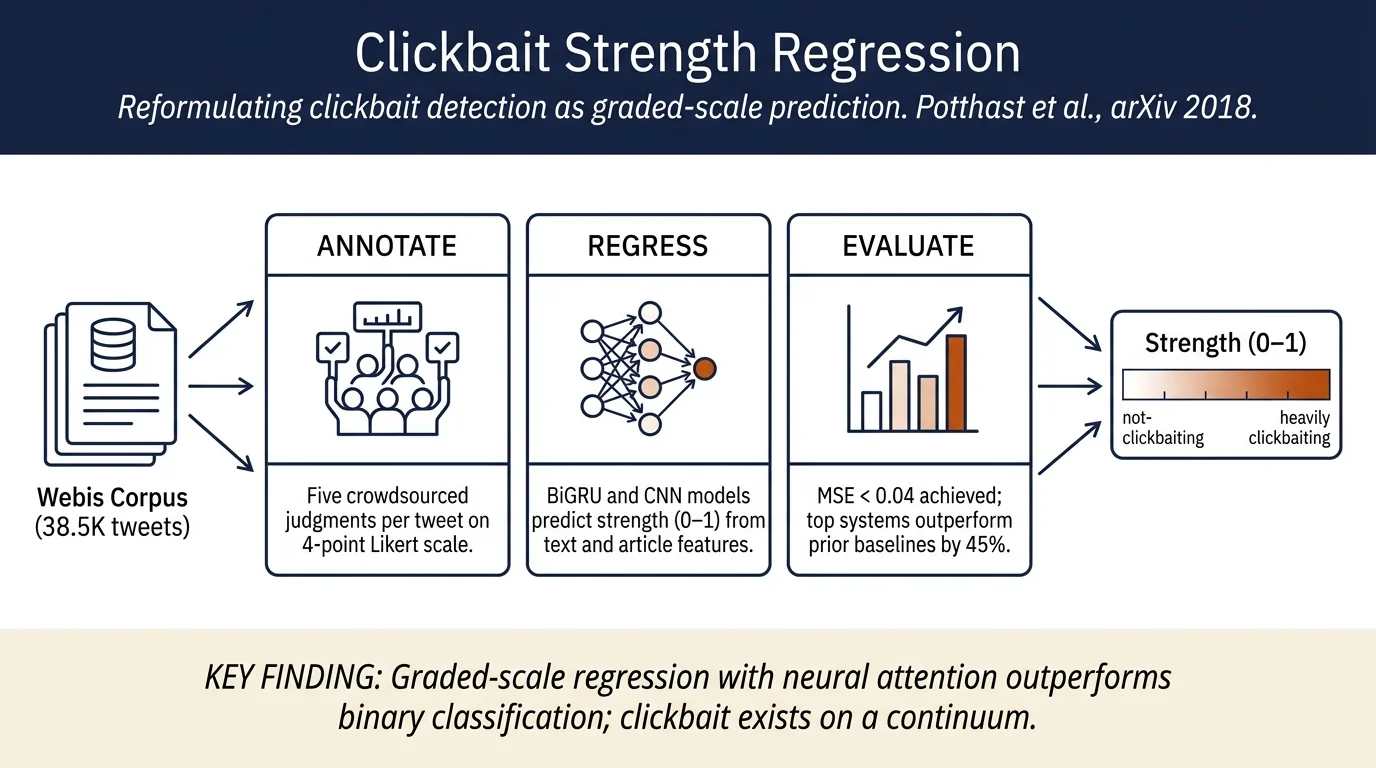
The Clickbait Challenge 2017: Towards a Regression Model for Clickbait StrengthClickbait detection is typically framed as binary classification, but teaser messages exhibit varying degrees of clickbaiting techniques. This paper organizes the Clickbait Challenge 2017, reformulating the task as regression to measure clickbait strength on a graded scale.
 Detection methodsLLMs & generative AI
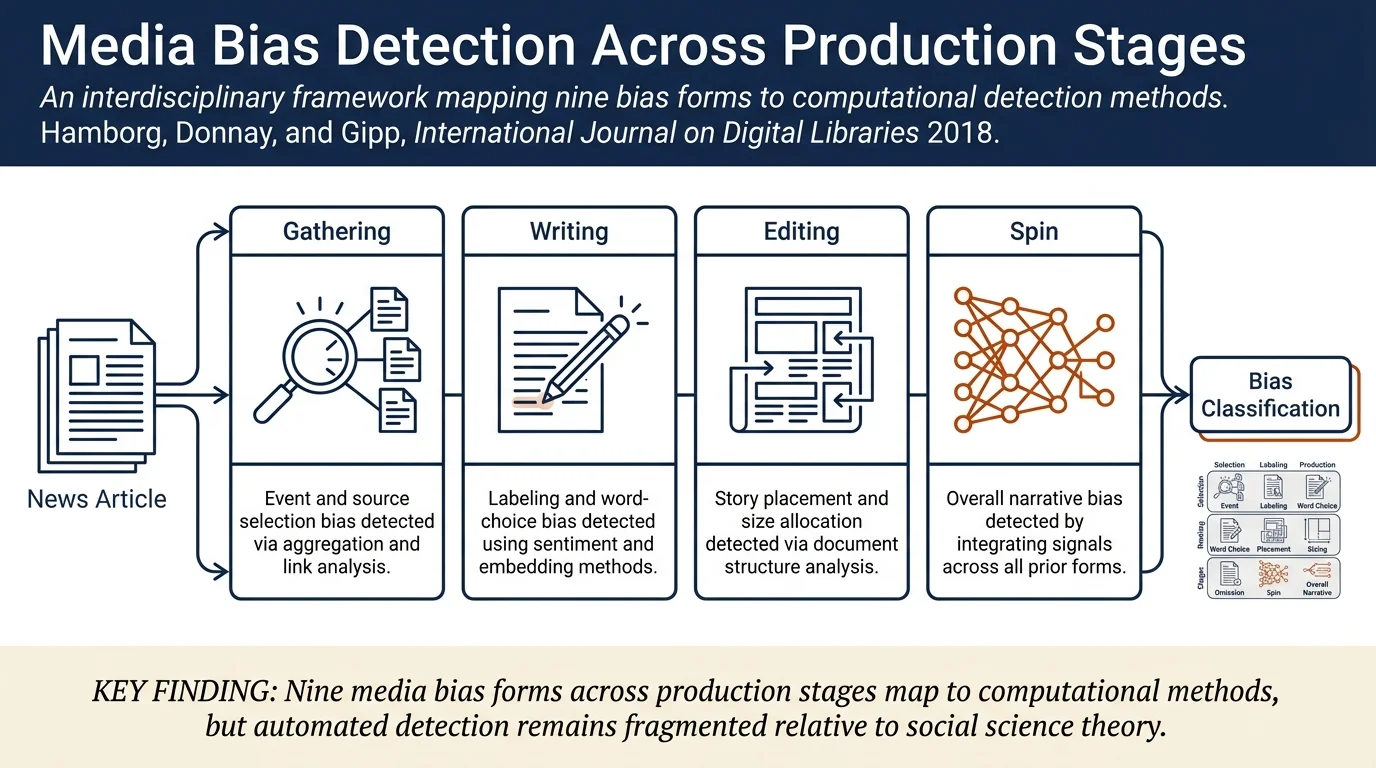
Automated identification of media bias in news articles: an interdisciplinary literature reviewThis paper surveys automated and manual methods for identifying media bias in news articles, bridging social science and computer science approaches. It defines nine distinct forms of media bias and maps social science research onto computational techniques, finding that NLP-based methods are promising for automated detection but remain…
 Platforms, policy & societyDeepfakes & multimodal
The Malicious Use of Artificial Intelligence: Forecasting, Prevention, and MitigationA landmark 2018 report surveying the landscape of potential security threats from malicious uses of AI across three domains—digital, physical, and political security. The work proposes frameworks for forecasting AI-enabled attacks, identifies specific threat scenarios including AI-generated disinformation and deepfakes, and recommends…
 Deepfakes & multimodalDetection methods
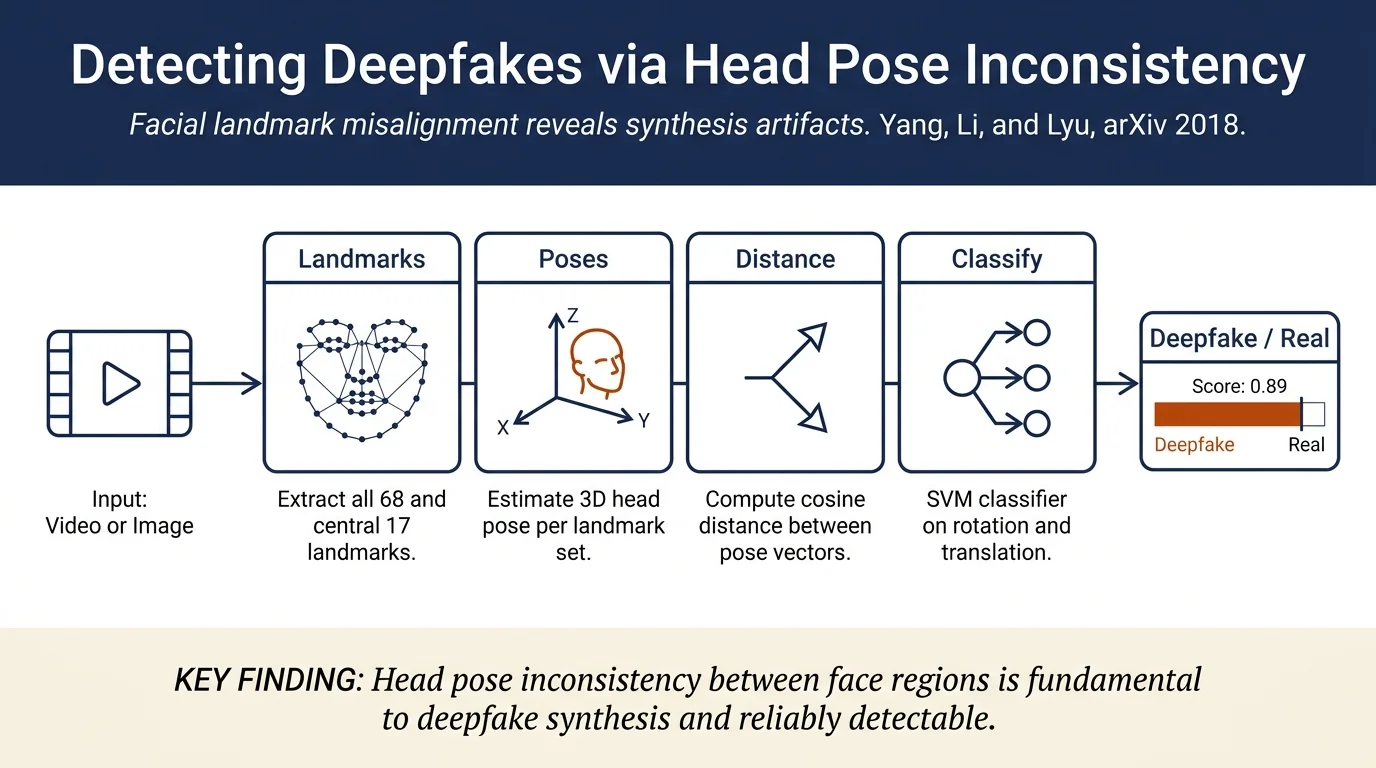
Exposing Deep Fakes Using Inconsistent Head PosesDeepfakes splice a synthesized face into an original image, introducing landmark misalignment errors invisible to the eye but detectable through 3D head pose estimation. The method compares head poses estimated from all facial landmarks versus only the central region; real faces show consistent poses while deepfakes exhibit large…
 Fact-checking & verificationDatasets & evaluation
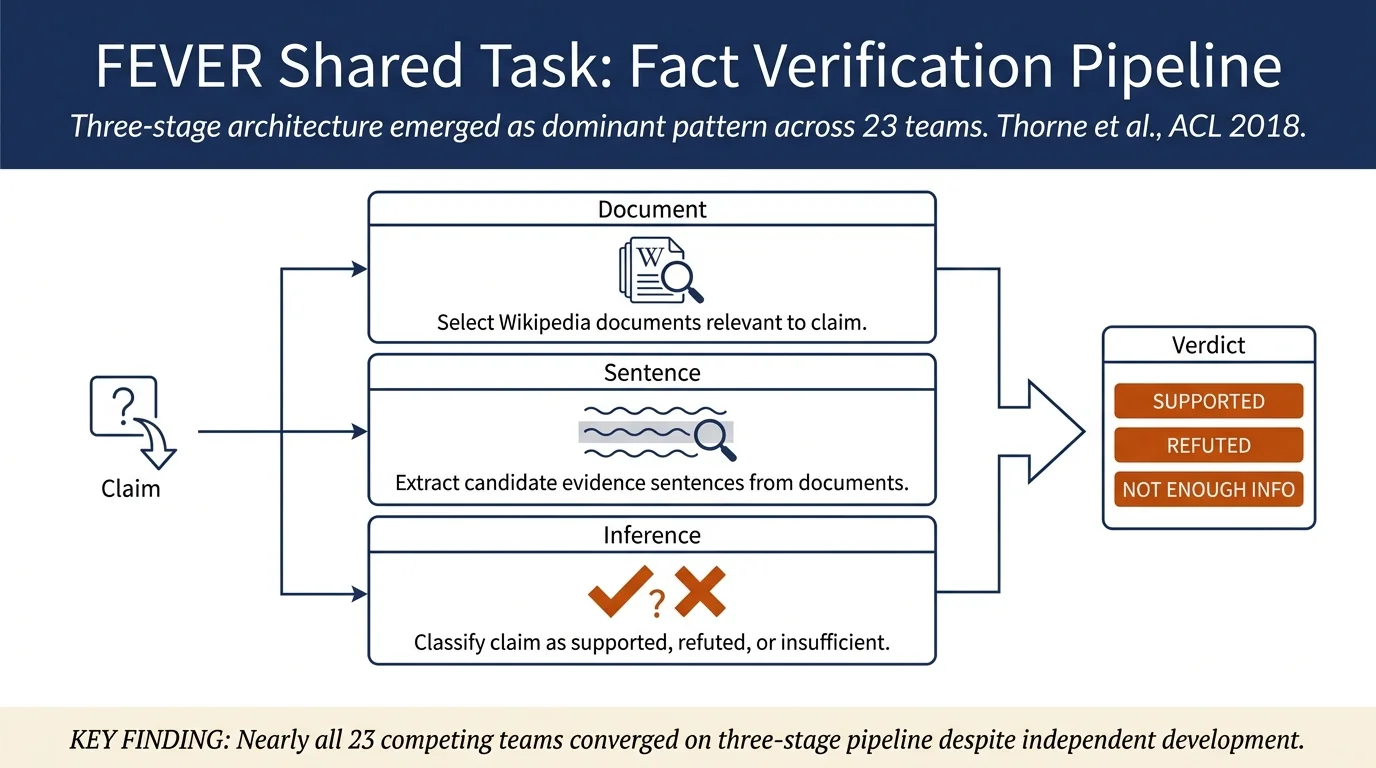
The Fact Extraction and VERification (FEVER) Shared TaskThis paper presents results of the first FEVER shared task competition, which challenged 23 teams to classify whether human-written factoid claims could be SUPPORTED or REFUTED using evidence retrieved from Wikipedia. The best system achieved 64.21% FEVER score, demonstrating the difficulty of joint evidence retrieval and natural…
 Fact-checking & verificationDetection methods
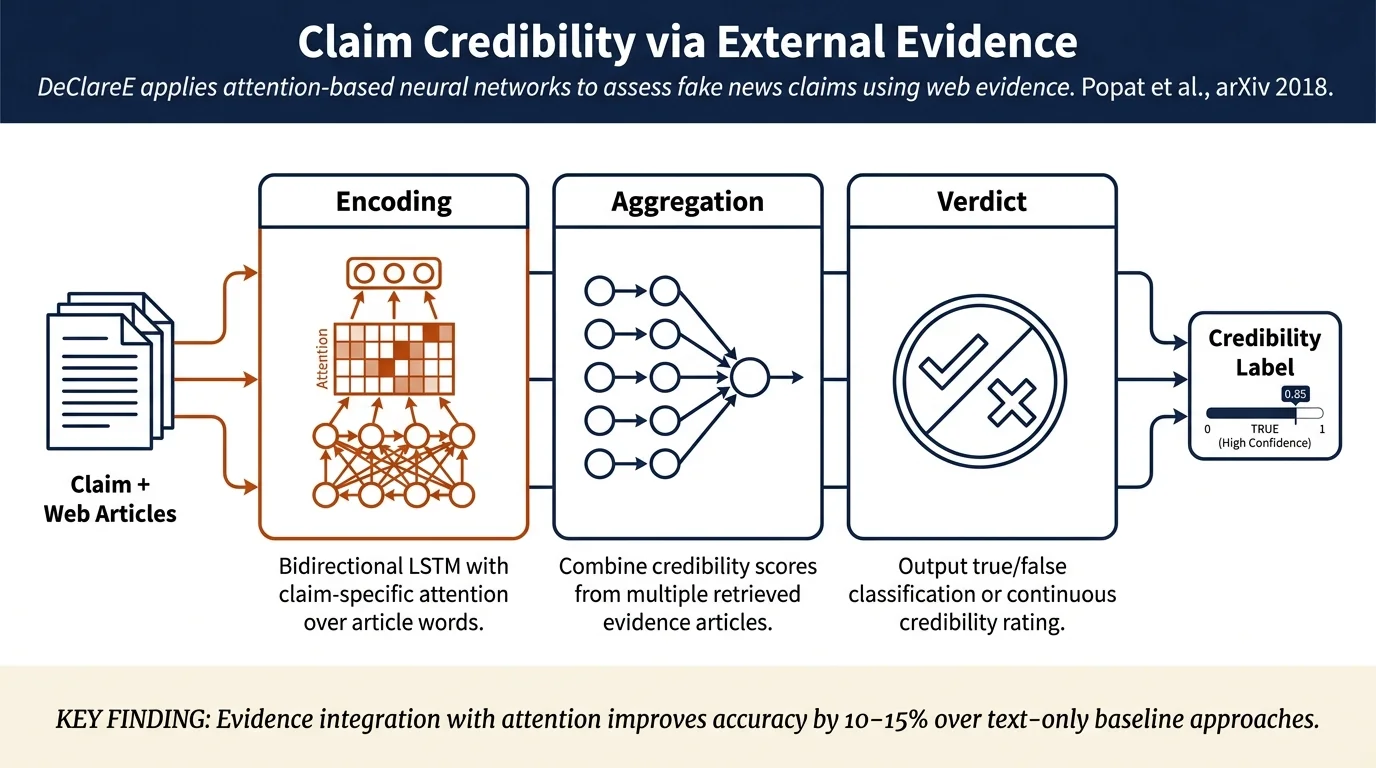
DeClareE: Debunking Fake News and False Claims using Evidence-Aware Deep LearningDeClareE is an end-to-end neural network for evidence-aware credibility assessment of arbitrary natural-language claims. The model combines claim and evidence article representations using bidirectional LSTMs with claim-specific attention, automatically discovering which web articles support or refute a claim without hand-crafted…
 Spread & networksPlatforms, policy & society
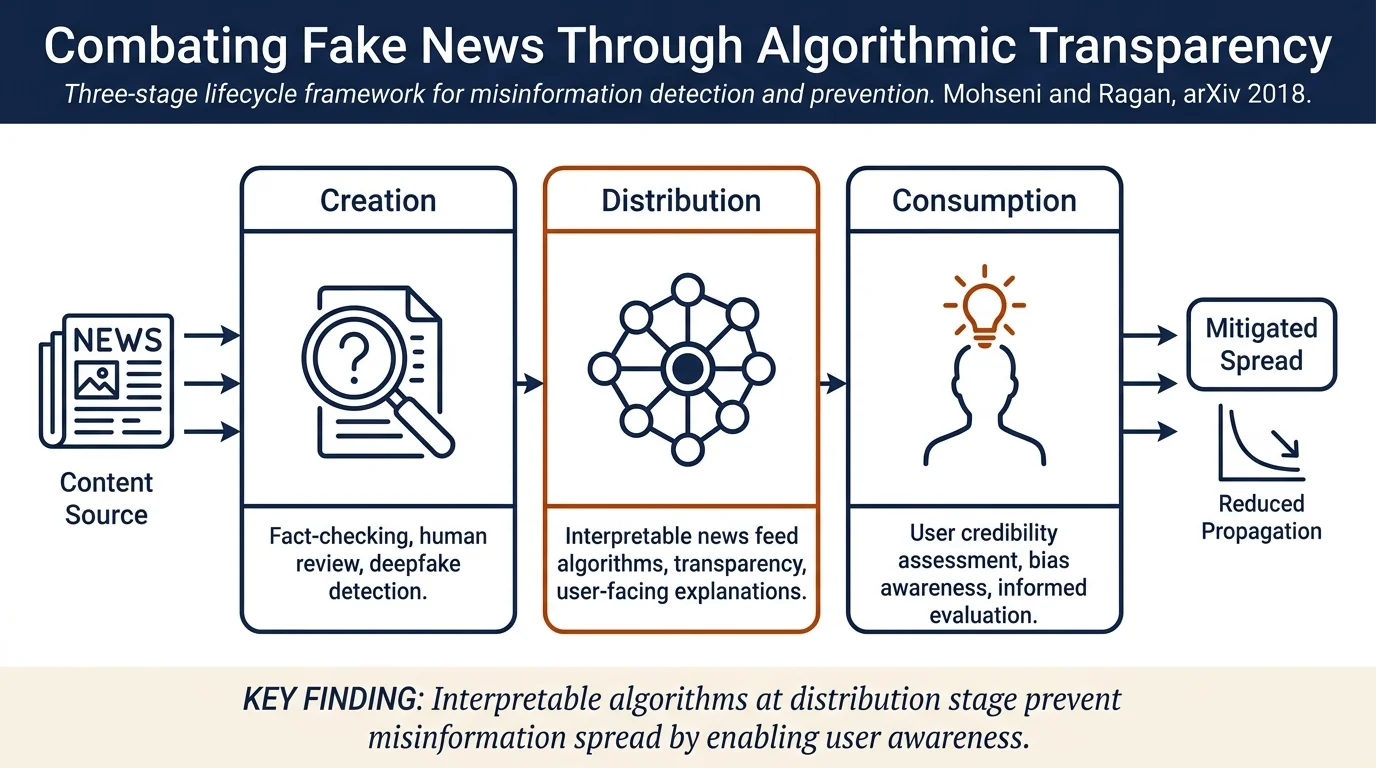
Combating Fake News with Interpretable News Feed AlgorithmsThis position paper reviews fake news detection methods and argues that news feed algorithms are insufficiently transparent, enabling echo chambers and filter bubbles that amplify misinformation. The authors propose interpretable and explainable news feed algorithms as a solution, positioning transparency and user awareness as critical…
 Deepfakes & multimodalDetection methods
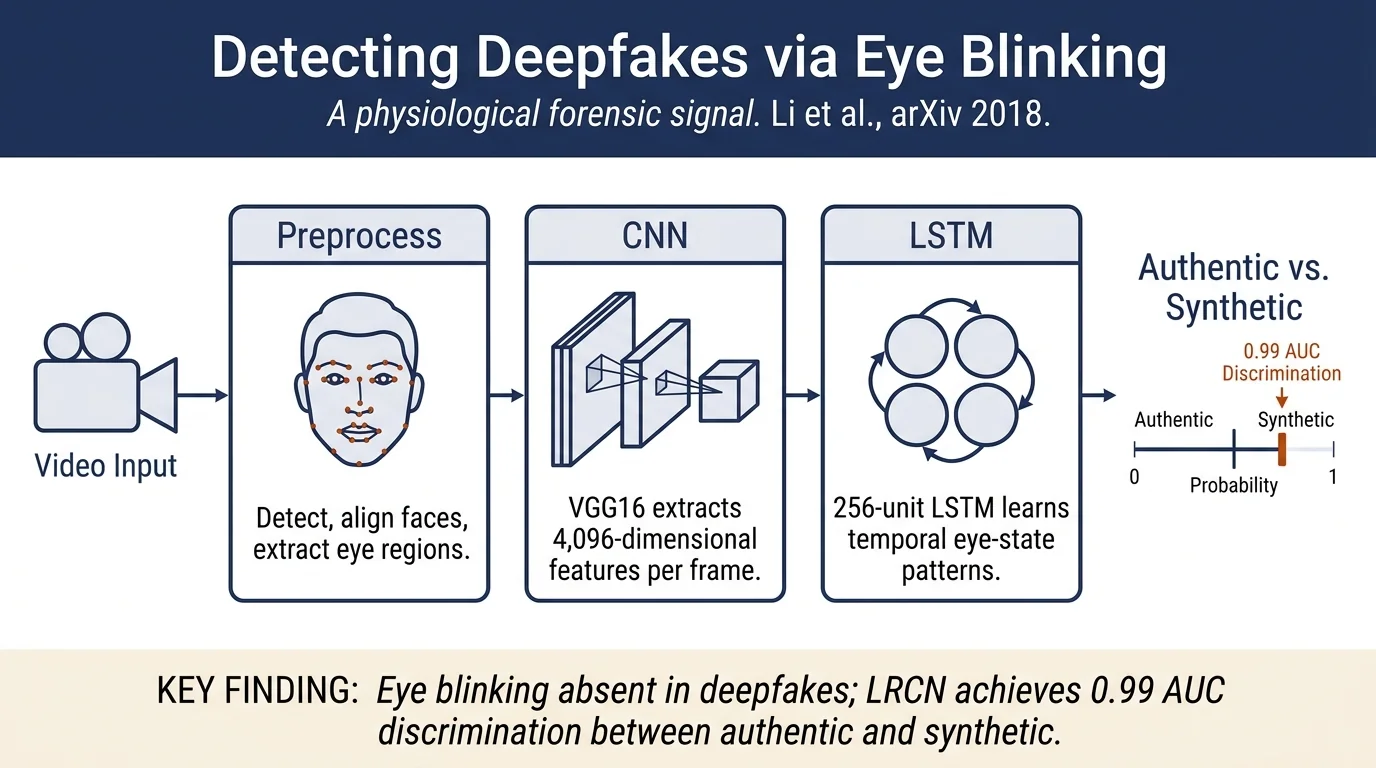
In Ictu Oculi: Exposing AI Generated Fake Face Videos by Detecting Eye BlinkingDetects DeepFake videos by exploiting the absence of natural eye blinking patterns in AI-generated faces. Uses a Long-term Recurrent Convolutional Network (LRCN) combining CNN for feature extraction with LSTM-RNN for temporal modeling of eye state, achieving 0.99 AUC on authentic vs. synthesized videos—a forensic signal invisible to the…
 Spread & networksDetection methods
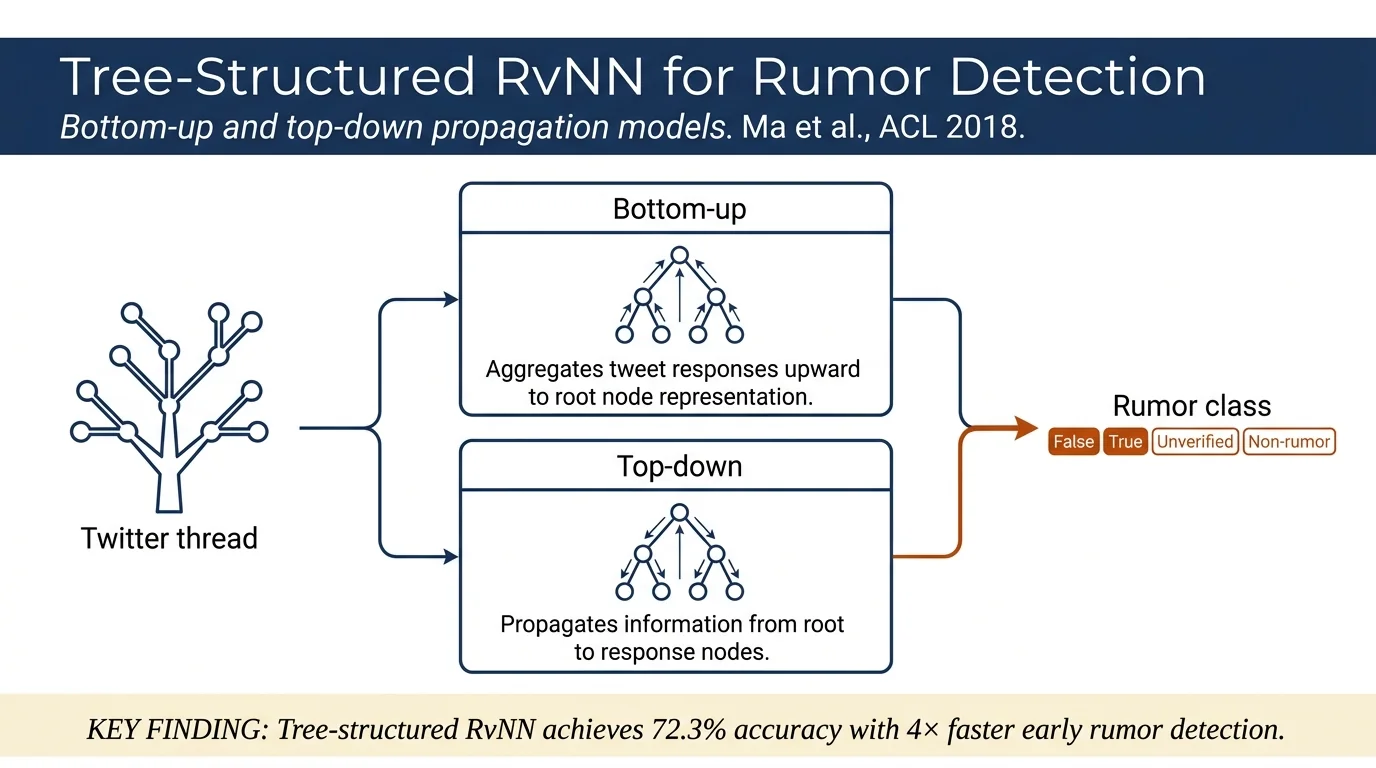
Rumor Detection on Twitter with Tree-structured Recursive Neural NetworksProposes two variants of recursive neural networks (RvNN)—bottom-up and top-down—that operate on propagation tree structures of tweets to detect rumors. Rather than treating tweets sequentially, the model learns representations that respect how tweets actually propagate in response threads.