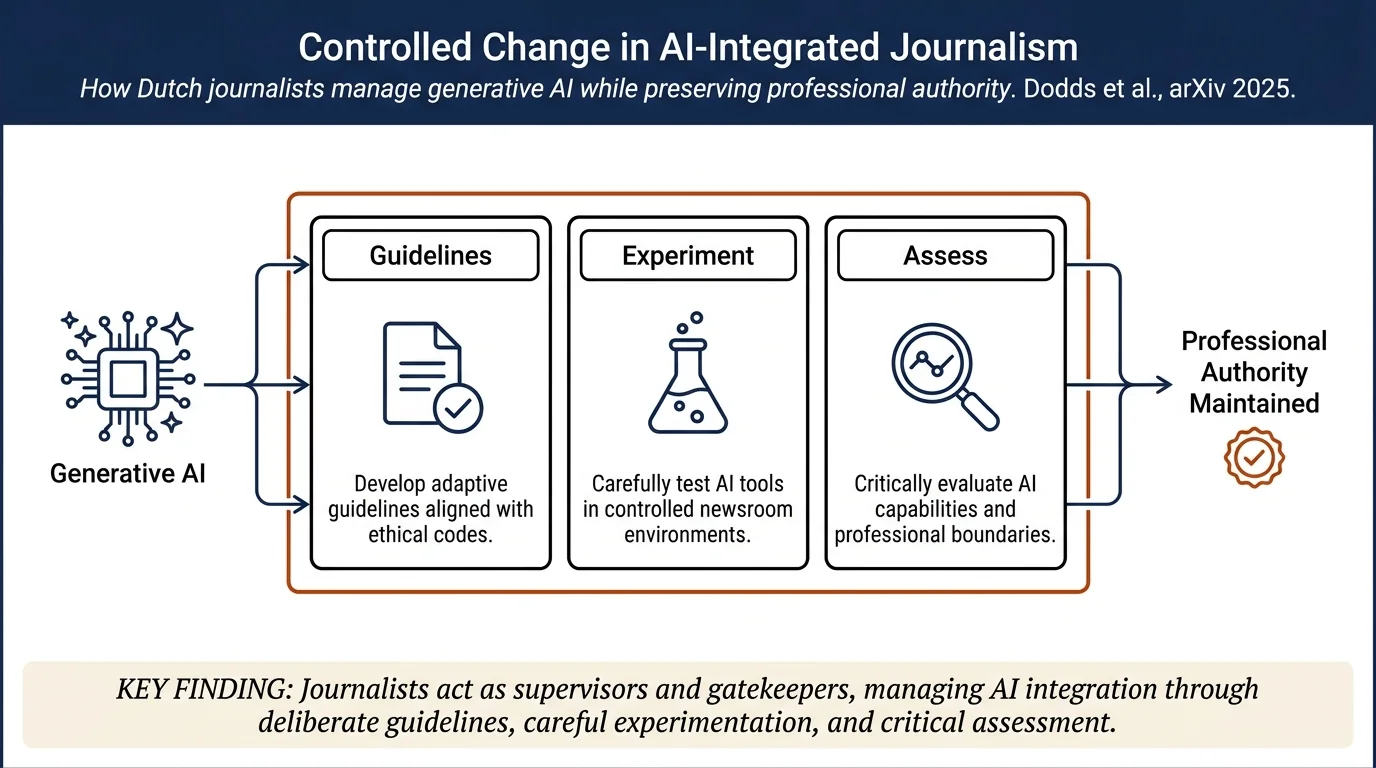
Contributions
- Introduces the concept of "controlled change" to explain how journalists navigate AI integration while maintaining professional authority
- Identifies three mechanisms by which Dutch journalists manage this integration: developing adaptive (evolving) guidelines aligned with ethical codes, deliberate experimentation with AI tools, and critical assessment of AI capabilities and limitations
- Demonstrates that journalists view themselves as supervisors, gatekeepers, and critical interpreters of AI-generated content rather than passive adopters or wholesale rejectors
- Shows that professional authority in journalism is adaptable and continuously renegotiated through interaction with emerging technologies
Method
Qualitative research design using 13 semi-structured interviews conducted between May and August 2023 with professionals across Dutch media organizations (news organizations include AD, NPO, NOS, ANP, RTL, NRC, Het Parool, De Volkskrant, and DPG). Participants held diverse roles: journalists, editors, foreign editors, editors-in-chief, strategy directors, innovation managers, and data chiefs. Interviews were transcribed verbatim and translated from Dutch to English. Data analysis followed grounded theory, using open coding followed by axial coding to group concepts into thematic categories, with the concept of "controlled change" emerging inductively during the analysis.
Results
AI Experimentation. Dutch journalists are actively testing AI tools in controlled newsroom environments, treating AI as a tool to enhance efficiency rather than replace human judgment. Testing focuses on transcription, summarization, headline generation, and creative brainstorming. Journalists emphasize speed and accuracy gains while remaining cautious about over-reliance. One editor noted: "We want to be right, we want to be careful. Fast is second."
Adaptive Guidelines. Newsrooms are developing "living documents" that evolve as new AI capabilities emerge. Guidelines aim to balance encouraging responsible experimentation with ensuring AI use aligns with existing ethical codes. Journalists stress that guidelines must address not just what AI can do, but the ethical and professional boundaries of AI use. One interviewed editor explained: "Everyone can play journalist... Some stories will explicitly add, 'This story was typed by a human.' So soon, some stories will explicitly add, 'This story was typed by a human,' so to speak. And in that, you should understand that the writer has done journalistic work."
Critical Assessment of Capabilities and Limitations. Journalists acknowledge AI's value for enhancing productivity and efficiency but remain deeply concerned about erosion of verification, fact-checking, and investigative work—the core of journalistic practice. As one data editor stated: "You cannot let a computer do your thinking, do the journalistic process of gathering news, reading, trying to interpret, summarize, asking questions, looking for things that are not correct, testing the truth." Despite uncertainty about where AI integration is heading, journalists recognize AI's legitimate role as a tool for enhancing journalism when intentionally and carefully managed.
Notes
This is a timely qualitative study grounding journalists' perspectives on AI integration in a specific regional context (Dutch media). The concept of "controlled change" offers a productive middle ground between technological determinism (AI inevitably transforms journalism) and wholesale rejection, emphasizing the agentic role of journalists themselves. The study's focus on professional authority as continuously negotiated through interaction with technology—rather than fixed or inevitably eroded—aligns with sociological literature on professions and automation. One limitation is the Dutch-specific sample; generalizability to other media systems, particularly those with different regulatory environments or institutional structures, remains unclear.