Professional authority in journalism refers to the recognized power and influence journalists hold through demonstrated expertise, adherence to ethical standards, institutional backing, and their role as gatekeepers and arbiters of information. It is distinct from political or social power; rather, it is the legitimacy that allows journalists to be recognized as reliable interpreters of fact and meaning.
Historical foundations
Journalistic authority traditionally rested on three pillars:
- Technical expertise: Training in reporting, verification, and narrative construction
- Ethical codes: Adherence to professional standards (truthfulness, independence, accountability, fairness)
- Institutional gatekeeping: Editorial control over what information reaches the public
Under this model, authority derived largely from the journalist (or news organization) as an individual or institution claiming trustworthiness.
Contemporary challenges to professional authority
Modern pressures on journalistic authority include:
- Digital platforms: Social media distributes information without editorial gatekeeping, enabling competing voices
- Public skepticism: Declining trust in mainstream media, particularly among polarized audiences
- Economic pressure: Cost-cutting reduces investigative capacity and editorial oversight
- Speed demands: 24-hour news cycles incentivize rapid publication over deliberate verification
- Technological change: Automation, algorithms, and AI-generated content blur the boundary between journalistic judgment and machine output
Authority in an age of automation and AI
As generative AI and automated systems enter newsrooms, professional authority itself must be renegotiated. Key questions include:
- Oversight and judgment: Can journalists maintain authority when AI systems generate content, headlines, or news stories?
- Transparency: Do audiences need to know when AI was used? Does disclosure affect credibility?
- Responsibility: Who bears editorial responsibility for errors in AI-assisted reporting?
- De-skilling: Does reliance on AI erode the expertise that underpins authority?
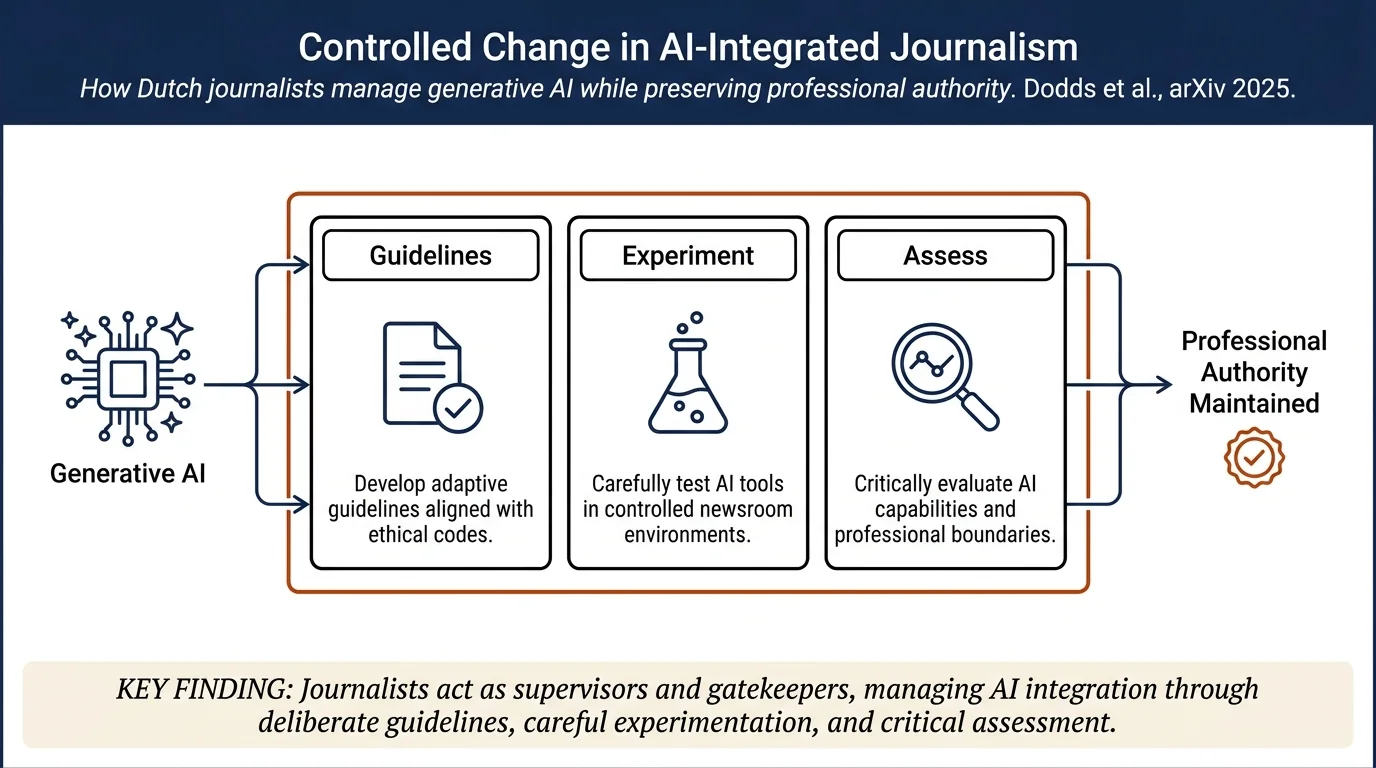
Research suggests authority is not eroded merely by using AI, but rather by how it is used—journalists who actively supervise, test, and critically assess AI systems may preserve authority by positioning themselves as gatekeepers of AI-generated content rather than passive adopters.
Connections
- Journalism and professional practice — foundational institutional role and decision-making
- Generative AI — technologies reshaping content production
- Automation in journalism — systematic application of AI and algorithms to newswork
- Trust — audience-side perception of journalistic legitimacy
Key papers
- On Controlled Change: Generative AI's Impact on Professional Authority in Journalism — Introduces "controlled change" as a framework for how journalists actively manage AI integration while maintaining professional authority through adaptive guidelines, experimentation, and critical assessment
- The GenAI Catch-22: Use of Generative Artificial Intelligence in Norwegian Newsrooms During the 2025 Parliamentary Election — Identifies structural risks: GenAI adoption in newsrooms can erode the human expertise required to oversee those systems
- Carlson (2017) — Journalistic Authority — theoretical framework positioning authority as continuously renegotiated through interaction with audiences, sources, and technologies