Automation in journalism refers to the application of computational systems, algorithms, and software to assist with or perform tasks traditionally carried out by human journalists. This encompasses data-driven reporting, algorithmic story selection, automated news generation, transcription systems, and emerging generative AI tools.
Historical development
Computational assistance in journalism is not new. Early applications included:
- Automated transcription (1990s onward): Speech-to-text systems for broadcast journalism
- Data-driven journalism (2000s): Databases, computational analysis, and visualization tools enabling stories derived from large datasets
- Algorithmic news aggregation (2010s): Systems ranking and filtering news by relevance, recency, and engagement
- Template-based news generation (2010s): Producing routine news (sports scores, earnings reports) from structured data
Contemporary automation: Generative AI
Recent advances in large language models have expanded the scope of automation:
- Text generation: Writing headlines, summaries, news stories, social media posts
- Creative assistance: Brainstorming angles, suggesting topics, refining narratives
- Routine content production: Sports reporting, financial earnings, weather
- Search and research: Retrieving relevant information, analyzing documents, identifying patterns
- Transcription and translation: Converting speech to text, translating content across languages
Challenges and trade-offs
Efficiency gains: Automation reduces time spent on routine, repetitive tasks, freeing journalists for investigative work.
De-skilling risk: Heavy reliance on automated systems may erode human expertise, creating vulnerability to errors that go undetected because oversight capability declines.
Loss of editorial judgment: Automated systems make decisions (what to report, how to frame it, whom to emphasize) based on patterns in training data, potentially amplifying biases or shifting coverage toward engagement-driving stories rather than important ones.
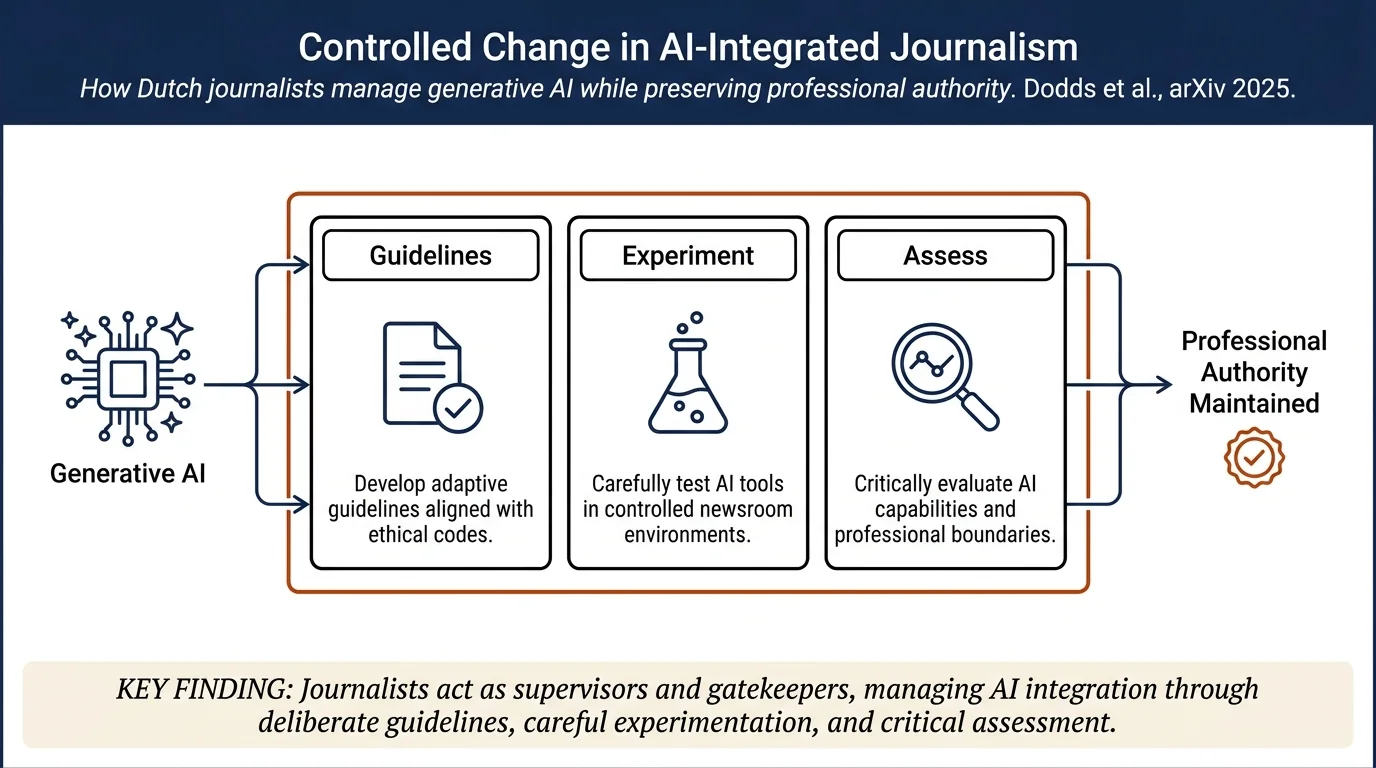
Professional authority: As more of the work becomes automated, journalists must redefine their roles—from content creators to supervisors, editors, and critical interpreters of machine-generated output.
Transparency and credibility: Audiences may distrust AI-assisted reporting if they don't know automation was used. Conversely, disclosure of automation can undermine confidence in the work.
Empirical findings
Research shows:
- Journalists value automation for efficiency but worry about loss of oversight and expertise
- Newsrooms using heavy automation during high-stakes events (elections, breaking news) can miss errors because reduced editorial capacity weakens quality control
- Guidelines for responsible automation are evolving, but remain "living documents" that change as technology and newsroom practices advance
- Journalists do not see automation as an inevitable replacement, but rather as a tool that requires active management to avoid undermining core journalistic functions
Connections
- Journalism and professional practice — the institutional context in which automation is deployed
- Generative AI — the technology driving modern automation
- Professional authority — how automation affects journalists' legitimacy and role
- Trust — how automation affects audience trust in news
Key papers
- On Controlled Change: Generative AI's Impact on Professional Authority in Journalism — Qualitative study of how Dutch journalists develop adaptive guidelines and critically assess AI systems to maintain professional authority in an automated newsroom
- The GenAI Catch-22: Use of Generative Artificial Intelligence in Norwegian Newsrooms During the 2025 Parliamentary Election — Empirical evidence that intensive GenAI adoption can lead to de-skilling, eroding the human expertise needed to catch errors in high-stakes coverage
- Graefe (2016) — Automated Journalism — foundational overview of algorithmic story generation and its implications for newswork