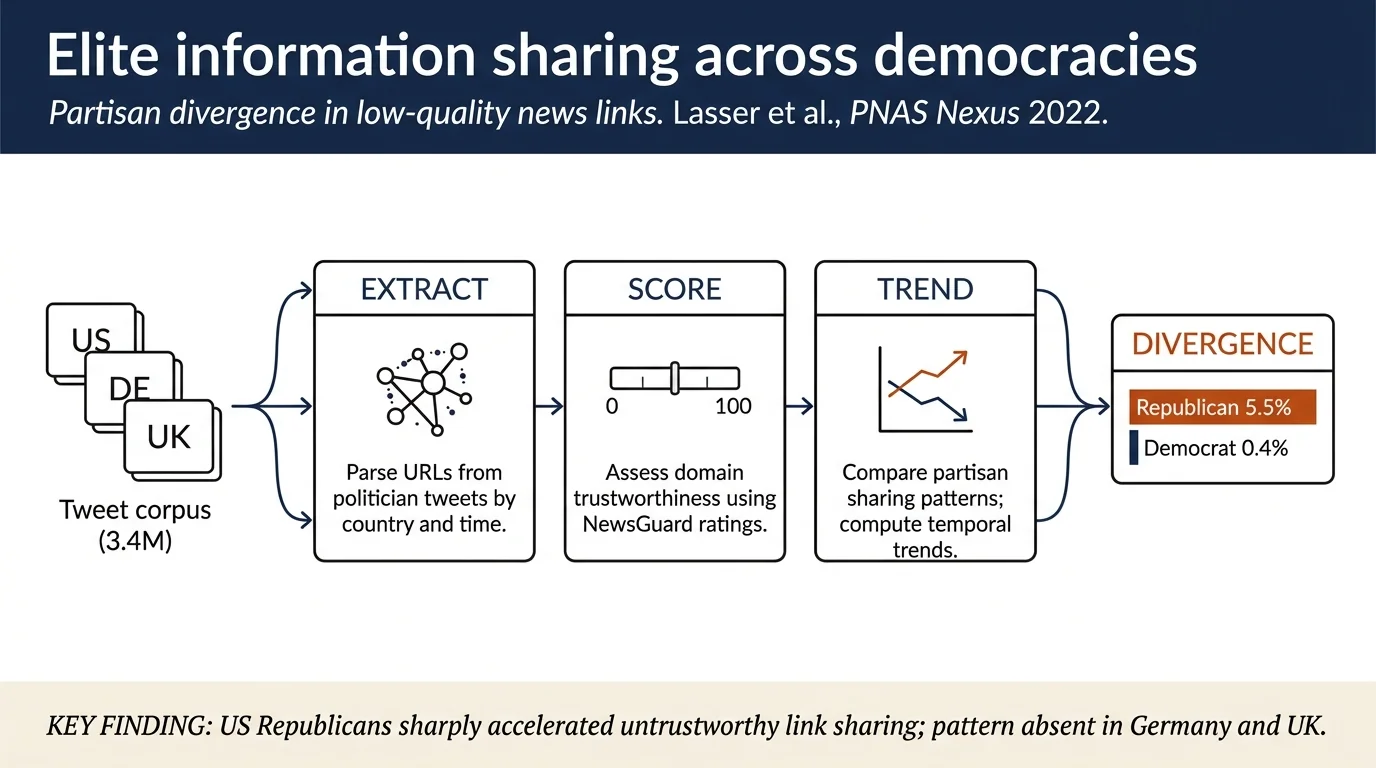
Contributions
- Large-scale empirical analysis of 3.4 million tweets from politicians across three democracies, coded using NewsGuard's domain-trustworthiness scores (0–100, threshold 60 for "trustworthy")
- Quantification of partisan asymmetry in information quality: Republicans share 9.1× more links to untrustworthy domains than Democrats (3.86% vs. 0.43%)
- Evidence of accelerating divergence in the US: Republican tweet-sourcing trustworthiness declined from 89.9 ± 0.1 to 85.2 ± 1.8 points between 2016–2018 and 2020–2022 (interaction: β = −4.01, p < 0.001), while Democrat sourcing stayed stable (94.2 to 94.8 points)
- Comparative finding that this acceleration is specific to the US; German and UK conservative parties show no similar trend, suggesting structural or institutional factors unique to American politics
- Robustness check using independently compiled trustworthiness database confirms core finding
Method
The study scraped the 3,200 most recent tweets (between 2016-01-01 and 2022-03-16) from 1,023 US congressional accounts (61.7% coverage), 822 German parliamentarian accounts (65.7% coverage), and 726 British parliamentary accounts (78.6% coverage). A corpus of 1.7B, 754M, and 960M tweets respectively was assembled (excluding retweets and non-native-language tweets).
All URLs in the tweets were extracted and expanded (shortened links like bit.ly were resolved to actual domains). Domain trustworthiness was assessed using NewsGuard's professionally curated ratings (0–100 scale), which indexes 6,860 English and 145 German language domains as of March 2022. Domains scoring below 60 are classified as "not trustworthy." The database covers 46.5% of US congressional links, 58.8% of German parliamentary links, and 39.2% of British parliamentary links.
For the US, analysis was stratified by ideological score (GovTrack); for Germany and the UK, by party affiliation. Temporal trends were computed using monthly rolling averages (3-month window). Bootstrap confidence intervals (1,000 iterations) were calculated at the monthly level.
Results
Overall proportions: Republicans share 9.1× more untrustworthy links than Democrats (3.86% vs. 0.43%, SD 1.65). In Germany, CDU/CSU members share 6.3× more than SPD (0.18% vs. 0.03%). In the UK, Tories share 4.7× more than Labour (0.25% vs. 0.05%). Overall, conservative parties across all three countries share somewhat lower-quality sources, but the absolute rates in Germany and UK are ~1/10th to ~1/5th of the US asymmetry.
Temporal trends: Republican sourcing trustworthiness (average NewsGuard score) declined significantly from 2016–2018 to 2020–2022 (89.9 ± 0.1 to 85.2 ± 1.8 points; interaction β = −4.01, 95% CI [−4.66, −3.37], t(204532) = −12.13, p < 0.001). Democrat sourcing remained stable (94.2 ± 0.4 to 94.8 ± 0.1 points).
The proportion of untrustworthy links (score < 60) posted by Republicans doubled over this period (2.4% ± 0.2% to 5.5% ± 0.7%), while Democrat sharing remained flat (0.4% ± 0.3% to 0.4% ± 0.1%).
In Germany, AfD scores were stable (83.9 ± 1.1 to 83.0 ± 1.3) as were CDU/CSU scores (92.2 ± 0.8 to 91.6 ± 0.8). In the UK, Tory and Democratic Unionist Party scores showed no meaningful change. The proportion of untrustworthy links in both countries remained stable or improved slightly.
A robustness check using an independently compiled trustworthiness database confirmed the core finding: Republican untrustworthy links increased from 5.9% ± 0.3% to 11.3% ± 2.9%, while Democrat links slightly decreased (0.8% ± 0.8% to 0.3% ± 0.1%).
Notes
This study is notable for bridging elite-behavior analysis with large-scale computational methods, isolating a uniquely American phenomenon of accelerating divergence rather than merely documenting an existing partisan gap. The comparison across three democracies strengthens the claim that this is not an inevitable feature of left-right politics but rather a specific American dynamic, possibly driven by the 2020 election, the Trump presidency's epistemic heterodoxy, or the US media ecosystem's structural properties (absence of public broadcasting dominance, two-party system, algorithmic amplification).
The reliance on domain-level trustworthiness (rather than article-level fact-checking) is a methodological choice worth noting: it captures the reputation of a news outlet over time but misses nuances of individual articles from mixed-quality publishers. The findings are robust to this choice (robustness check with independent database), and domain-level assessment scales better for millions of links than individual fact-checking would.
A potential limitation is that coverage varies by country (46.5% of US links matched, 39.2% of UK links) due to NewsGuard's English-language focus. However, coverage differences are modest and similar between parties, so unlikely to bias the partisan comparison.