Contributions
- Generative model of misinformation spread: Adapts infectious-disease models to Twitter data, capturing temporally-varying virality and engagement decay.
- Systematic intervention evaluation: Evaluates removal, fact-checking labels, nudges, virality circuit breakers, and account banning across 544 misinformation incidents, with quantified efficacy for each and their combinations.
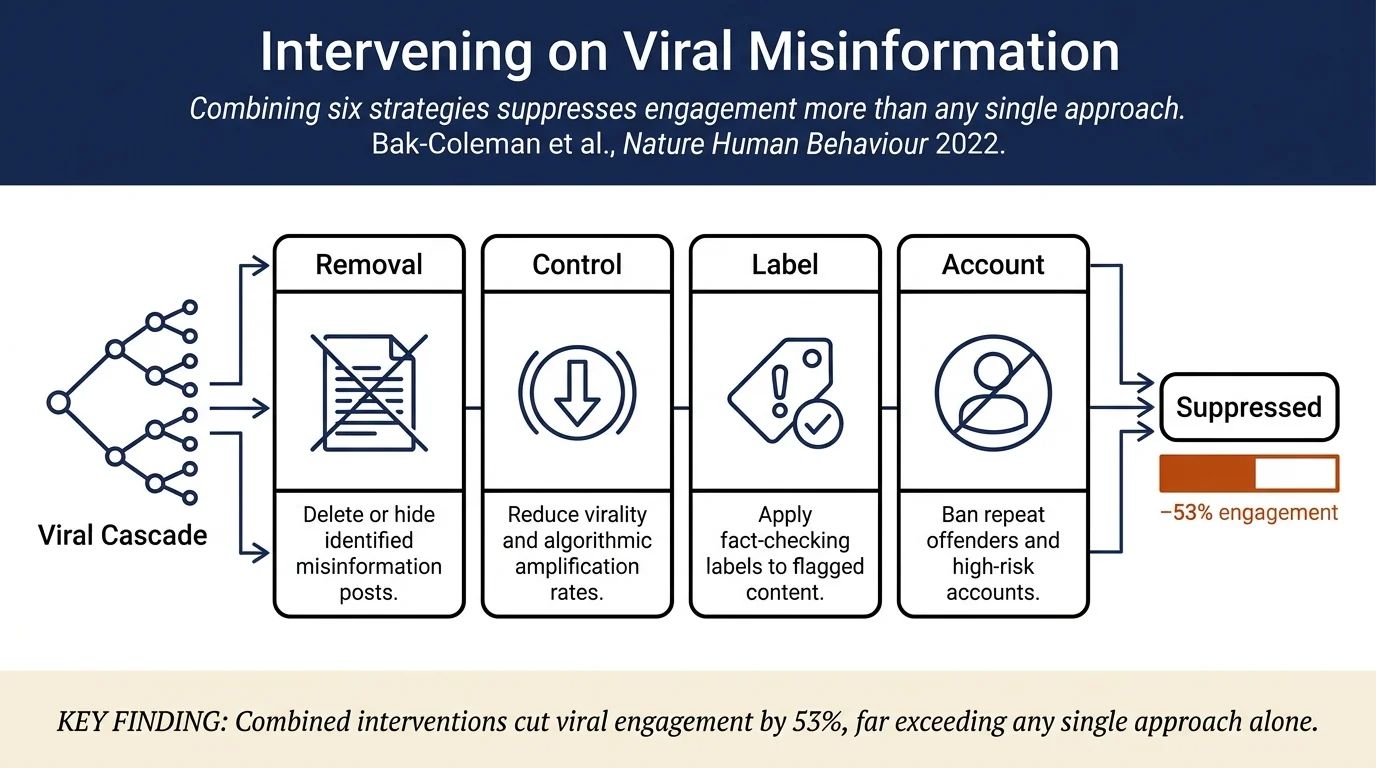
- Combined-approach advantage: Demonstrates that mixing strategies (e.g., removal + virality reduction) yields substantially larger reductions in engagement than any single intervention.
- Timing and threshold effects: Shows that intervention timing and follower thresholds (who gets the intervention) critically affect outcome; removal applied early achieves highest impact.
Method
Data collection: Twitter posts from the 2020 US presidential election (Sep 1 – Dec 15, 2020; 1.04 million posts). 544 distinct misinformation incidents identified through keyword detection and manual labeling of narratives and false claims.
Model: Contagion model with latent virality parameter (v) representing the rate at which an event gains audience. Virality decays exponentially over time. Model fit using Bayesian methods with generic, weakly-informative priors.
Interventions simulated:
- Outright removal: All posts deleted (or hidden) at specified time
- Virality circuit breaker: Reduce virality by a fixed percentage (10%, 20%, etc.)
- Fact-checking labels: Warning labels on flagged content
- Nudges: Reduce the probability users share (via warnings or media-literacy intervention)
- Account removal: Three-strikes policy for repeat offenders
- Combinations: Removal + virality reduction, removal + account banning, etc.
500 simulations per intervention per event, tracking cumulative engagement (retweets, quote tweets, replies).
Results
Individual interventions (weak, in isolation):
- Outright removal: 89% reduction in cumulative engagement (95% CI: 82.2%, 93.3%)
- Virality circuit breaker (10% reduction): 45.3% engagement drop (95% CI: 39.8%, 49.8%)
- Fact-checking labels: 12.7% reduction (when applied to verified accounts only)
- Nudges: ~20% reduction (modest effect)
- Account removal (after 4-hour delay): limited effect; works better when targeting high-follower-count accounts
Combined approaches:
- Modest removal (5% of content) + virality circuit breaker (10%): ~53% reduction in cumulative engagement (89% CI: 44.82%, 62.82%)
- Aggressive version (20% removal, 20% virality reduction): ~65% reduction
Key interaction: Combined strategies show higher efficacy than predicted by individual effects alone (superadditive benefit), suggesting that interventions interact favorably—removal of top spreaders + platform-level viraliy damping together suppress cascade more than either alone.
Timing sensitivity: Interventions applied immediately after detection far more effective than delays of 120+ minutes; 40% of engagement occurs in the largest event's first hour.
Notes
This paper's key contribution is quantifying the law of diminishing returns for individual interventions and the surprising effectiveness of combinations. The work is grounded in the dynamics of real misinformation events (2020 US election) rather than synthetic cascades, lending practical weight to its recommendations. The generative model is relatively simple—it treats virality as a single latent parameter and does not capture network structure, platform algorithms, or user demographics—but that simplicity is a strength for policy-level reasoning: it isolates intervention efficacy from the complexity of why misinformation spreads in the first place.
One limitation: the model assumes interventions are applied uniformly (all users in a condition get the nudge, or a fixed percentage of posts are removed). Real-world deployment might target high-risk users or particularly viral content, potentially achieving higher efficacy. Conversely, real platforms face constraints the model ignores: censorship concerns, legal challenges, enforcement overhead. The work does not directly address these ethical and practical frictions, instead offering a quantitative baseline for what could work if deployed without limitation.