Contributions
-
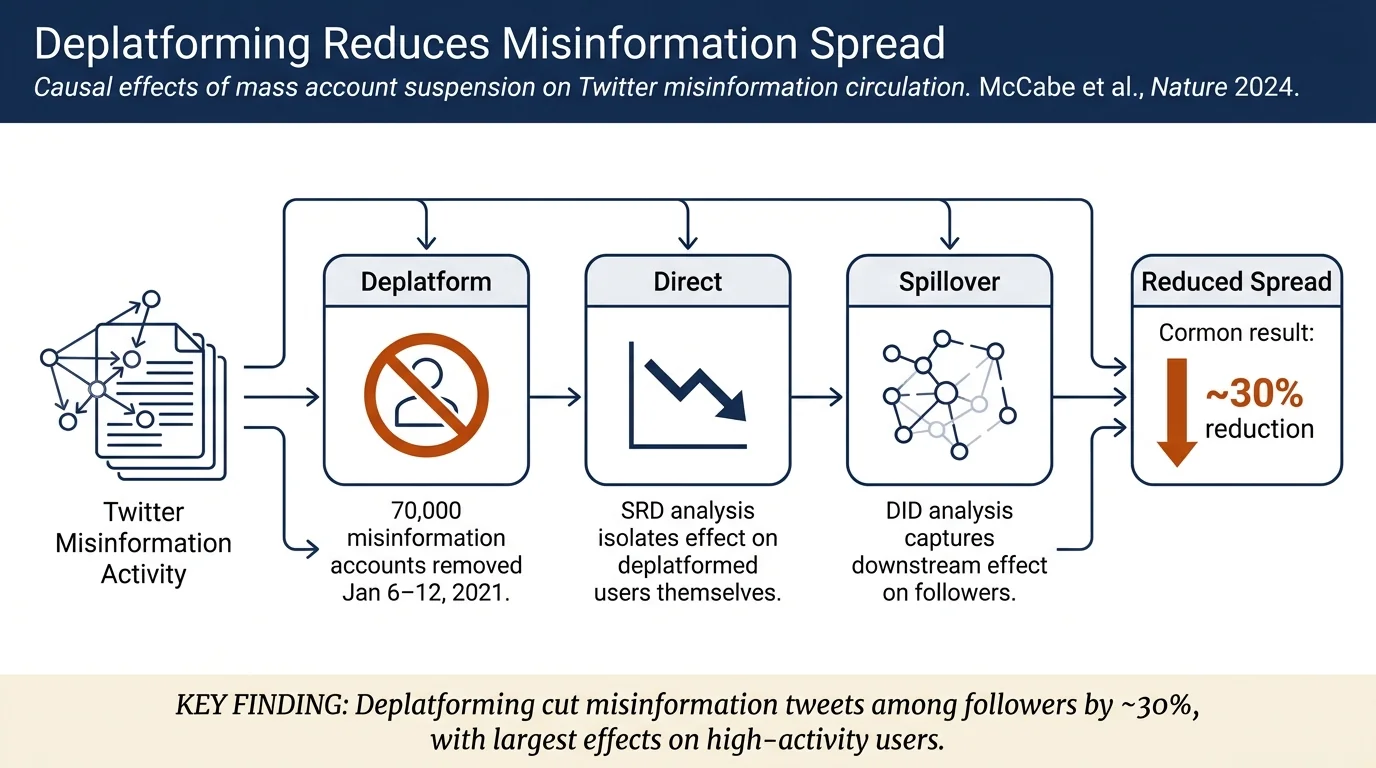
Natural experimental evaluation of platform deplatforming. Leverages the sudden, mass deplatforming intervention in response to January 6th as a quasi-experimental shock. Analyzes outcomes across multiple user subgroups (deplatformed users, followers of deplatformed users, Trump supporters, general users) over nearly three months.
-
Separate identification of direct and spillover effects. Uses sharp regression discontinuity (SRD) to isolate the direct effect on deplatformed users themselves, and a difference-in-differences (DID) design to estimate spillover effects on users who followed deplatformed accounts. Shows both pathways contributed to reduced circulation.
-
Heterogeneous effects by user behavior and engagement level. Demonstrates the deplatforming intervention had differentiated impacts: largest effects among high-activity misinformation sharers, smaller effects among moderate sharers, and minimal effects on low-activity users. Shows the "dose" of misinformation sharing changed most for the most prolific reshares.
-
Robustness across subgroup definitions and specifications. Tests the parallel paths assumption underlying the causal estimates, varies the definition of followers and misinformation sharers, and reports placebo tests. Finds results robust to multiple design choices.
Method
The authors combined observational panel data from Twitter with quasi-experimental design. Their primary dataset consists of Twitter's "Twitter Panel"—a dataset of 3.1 million users' tweets and retweets since late 2017, supplemented with 500,000+ active daily users during December 2020–January 2021.
They defined their primary outcome as daily counts of misinformation URLs shared and reshared. Misinformation domains were identified by combining NewsGuard's hand-curated list (fact-checking organizations) and the journal Computation Journalism's registry, identifying unreliable sources of information.
The SRD analysis treated the January 6, 2021 deplatforming intervention as a discontinuity: comparing misinformation sharing behavior of deplatformed users immediately before versus after 8–12 January 2021. The DID analysis compared users who followed at least one deplatformed account (treatment group) with users who did not (control group), leveraging the parallel-paths assumption that both groups would have responded similarly to the real-world events of January 6th in the absence of the deplatforming intervention.
Results
The SRD analysis found:
- Direct effect on deplatformed users: The intervention reduced misinformation retweeting among deplatformed users by approximately 10–20% (depending on how followers are defined), with larger reductions in total misinformation tweets.
- Spillover effect on followers: The deplatforming intervention reduced misinformation tweets among users who followed deplatformed accounts by ~0.14–0.4 (adjusted) to 0.04 (unadjusted) tweets per day, representing roughly 30% reduction in misinformation sharing among the followers.
The DID results showed heterogeneity by user behavior:
- Trump-only followers showed the strongest intervention effect—the deplatforming reduced their misinformation sharing significantly.
- Supersharers (top 0.1% of misinformation sharers) showed the most dramatic drop in misinformation activity after the intervention.
- QAnon sharers showed a sharp discontinuity in activity after January 6th, particularly for QAnon-specific content, becoming the least active group post-intervention among specialized communities.
Post-deplatforming, many misinformation traffickers who were not deplatformed left Twitter voluntarily, suggesting the intervention had broader chilling effects beyond the directly targeted accounts. The reduction in misinformation circulation persisted for weeks after the intervention.
Notes
The study's main strength is its natural experiment framing and use of pre-existing panel data, which avoids some limitations of lab studies or surveys. The authors carefully document their identification assumptions, particularly the parallel-paths assumption underlying the DID design, and test robustness through placebo tests and specification checks. The heterogeneity analysis (by user activity level and Trump-follower status) is well-executed and reveals that deplatforming's effectiveness is not uniform.
A key limitation acknowledged by the authors is that the deplatforming intervention coincided with the Capitol insurrection and January 6th media coverage, making it difficult to fully disentangle the causal effect of deplatforming itself from the real-world shock of the event. The SRD design partially addresses this through the parallel-paths assumption, but some residual ambiguity remains. Additionally, the results are specific to Twitter's ecosystem and may not generalize to other platforms with different user bases, algorithmic ranking, or moderation strategies. The study focuses on aggregate circulation counts and does not assess downstream belief change or downstream sharing on other platforms.