Examining the consumption of radical content on YouTube
Authors: Homa Hosseinmardi, Amir Ghasemian, Aaron Clauset, Markus Mobius, David M. Rothschild, Duncan J. Watts
Venue: Proceedings of the National Academy of Sciences, 2022 — DOI
TL;DR
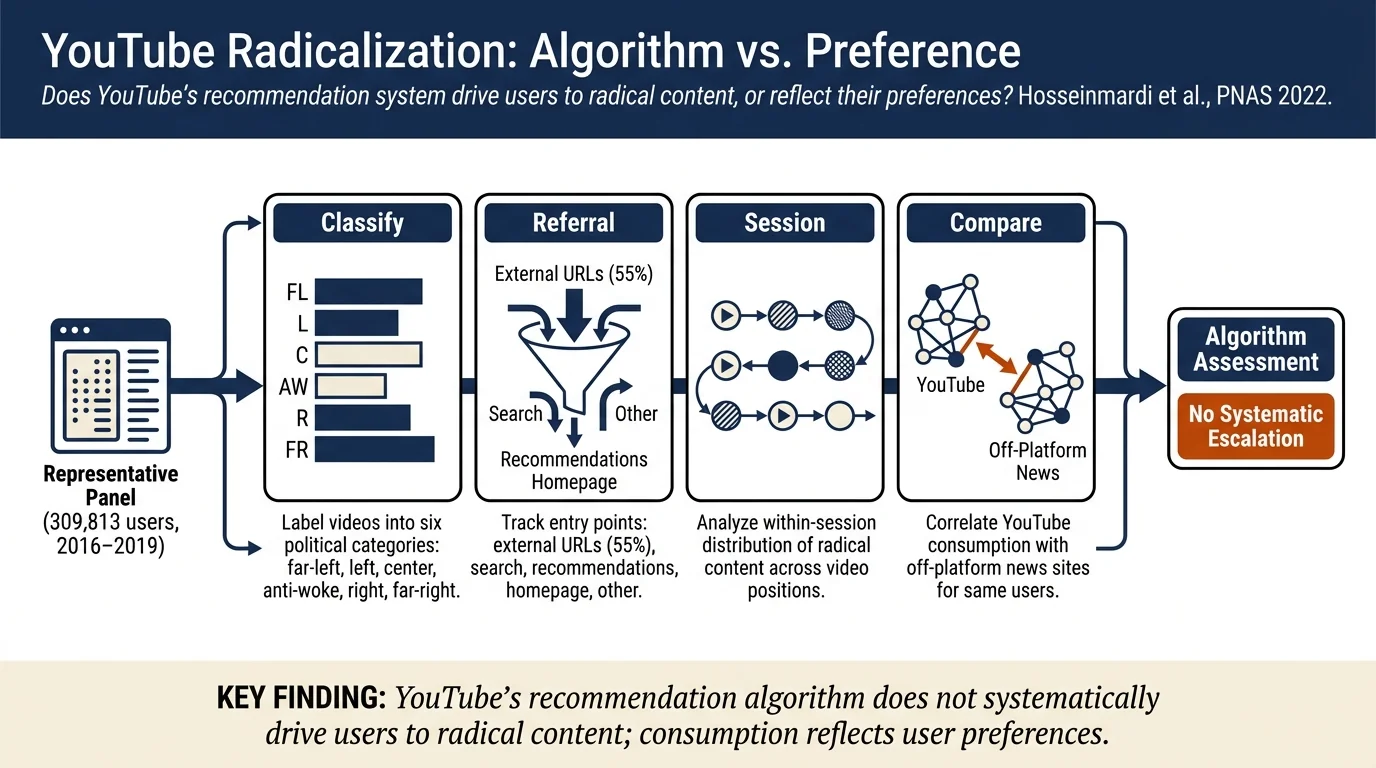
Using a representative panel of 309,813 Americans (2016–2019), this study finds that YouTube news consumption is dominated by mainstream sources; far-right content reaches a small, stable share of users; and anti-woke content grew steadily. Critically, no evidence suggests YouTube's recommendation algorithm systematically drives users to radical content—instead, consumption patterns reflect user preferences that extend across the broader web.
Contributions
- Large-scale empirical evidence on YouTube's role in radical content consumption, using individual-level browsing data rather than anecdotes or simulated experiments.
- Multi-dimensional analysis of content pathways: referral sources, session dynamics, and on/off-platform correlation to isolate the effect of recommendations.
- Distinction between far-right and anti-woke content as separate phenomena, with anti-woke growing more rapidly and drawing from a different user base.
- Evidence against systematic algorithmic radicalization: users reach far-right videos via diverse pathways; sessions show no escalation toward extremity; far-right consumption correlates strongly with off-platform viewing of similar content.
Method
Data: Nielsen's nationally representative desktop web panel, 309,813 panelists with ≥1 YouTube pageview, 21.4M video views across 9.9M unique video IDs, 2.3M channels, Jan 2016–Dec 2019.
Labeling: Videos classified into six political categories—far-left, left, center, anti-woke, right, far-right—by mapping labels from two prior studies (Ledwich & Zaitsev 2019, Ribeiro et al. 2020) covering 1,100+ channels. Missing labels imputed via random forest classifier (AUC ≥0.95).
Clustering: Hierarchical clustering on normalized monthly viewership vectors to identify six user communities, each centered on one political category.
Analyses: - Aggregate trends in user count and watch time per category (2016–2019) - Individual-level engagement (per-video watch time, monthly consumption) - Community switching (transition probabilities month-to-month) - Burst effects: exposure to concentrated content and future consumption - Referral paths: YouTube homepage, search, user/channel, prior video, external URL - Session analysis: frequency of radical content within and across sessions
Results
Headline findings:
-
Mainstream dominance: News accounts for only 11% of YouTube consumption; the 974 labeled channels represent ~3.3% of total watch time. Left-leaning mainstream content is the largest community (0.63% of users, 1.65% watch time).
-
Far-right is small and stable: 0.05% of users, declining slightly from 2016 peak. Watch time doubled (0.17% → 0.30%), but grew slower than overall news. ~335k Americans per month consumed far-right content.
-
Anti-woke is growing: Started at far-right's size (0.05% of users), grew to 0.4% users and 1.02% watch time by 2019—faster growth than far-right. ~764k Americans per month consumed anti-woke content. Per-video watch time roughly doubled.
-
Higher engagement but smaller audience: Median per-month watch time for far-right and anti-woke users up to 2× that of left/center/right users (p < 10⁻⁴).
-
No within-session escalation: Session analysis shows nearly uniform distribution of radical content across video positions within a session. Far-right frequency does not increase with session length—in fact, opposite trend observed (longer sessions have lower far-right fraction). Contradicts claim that recommendations drive escalation.
-
Diverse entry points: 55% of far-right videos reached via external URLs (41%), homepage (8%), or search (6%). Only 36% preceded by another video (implicating recommendations). Left-leaning content shows stronger recommendation role (40% homepage).
-
Off-platform correlation: Members of far-right/anti-woke communities 2–3× more likely to consume far-right content on non-YouTube news domains (breitbart.com, infowars.com). Anti-woke users show same off-platform bias as far-right users (1.5–2.2× right-leaning, 2.2× far-right).
-
Burst effect: Exposure to concentrated bursts of anti-woke content predicts future anti-woke consumption (~2× larger effect than other categories), but this is correlational, not causal (endogenous treatment).
-
Community stickiness: Users remain in their political communities month-to-month. Cross-community movement: right/far-right more likely to enter anti-woke; anti-woke members more likely to leave for left/center/right than for far-right.
Connections
- Related to 2020 Ribeiro Radicalization Youtube — applies to same question but with larger, more representative dataset and richer off-platform comparison.
- Cites and extends methodology from Ledwich Zaitsev Algorithmic Amplification on channel classification and recommendation mechanisms.
- Complements Bail Affective Polarization Echo Chambers on polarization dynamics beyond YouTube.
- Addresses Munger Phillips Recommendation Algorithm Bias concern about algorithmic effects using population-level data.
- Cited in policy debates on platform responsibility for radicalization; see Algorithms Platform Governance.
Notes
Strengths: - Representative panel avoids self-selection bias of opt-in studies. - Four-year observation window captures trends; stability of far-right consumption falsifies "exponential radicalization" narrative. - Off-platform comparison (on/off-YouTube consumption correlation) is novel and revealing—suggests user preference, not algorithm. - Session analysis properly operationalizes recommendation effect: if algorithm drove escalation, we'd see content drift within sessions; we don't. - Honest about limitations (desktop-only, ~20% unavailable videos, imputation uncertainty).
Limitations: - Desktop-only; mobile adoption may differ (authors note 2× more mobile than desktop YouTube users). - Channel-level labels proxy for video-level content; not all videos in a far-right channel are political. - Does not observe recommended videos users rejected, only chosen videos. - Imputation of 20% unavailable videos adds noise; sensitivity analysis uses upper/lower bounds. - Referral analysis doesn't account for multi-tab browsing; some videos attributed to external sites may have been recommended in background tabs.
Methodological innovations: - Propensity-score matching for burst analysis controls for pre-treatment consumption rates and demographics. - Supervised learning imputation of missing labels maintains statistical rigor under missing data. - Normalized session indices allow comparison across different session lengths.
Nuance on anti-woke: Authors distinguish anti-woke (IDW, ASJW label categories) from far-right, and show it draws disproportionately from right-wing users but is not a unidirectional gateway to far-right. Anti-woke users who leave their community move to left/center at higher rates than to far-right. Suggests anti-woke is a distinct political category, not merely a stepping stone.
Implications beyond scope: Paper concludes YouTube is one library in a larger ecosystem. If radicalization is a social problem, it's driven by broader factors (political polarization, declining media trust, cord-cutting) rather than YouTube alone. Suggests future work focus on ecosystem-wide dynamics rather than platform-specific interventions.