 Preslav Nakov
Contributions
-
Barrier taxonomy: Identified and validated 20 specific barriers to challenging misinformation on social media, grounded in literature across organizational behavior, psychology, and computer-human interaction.
-
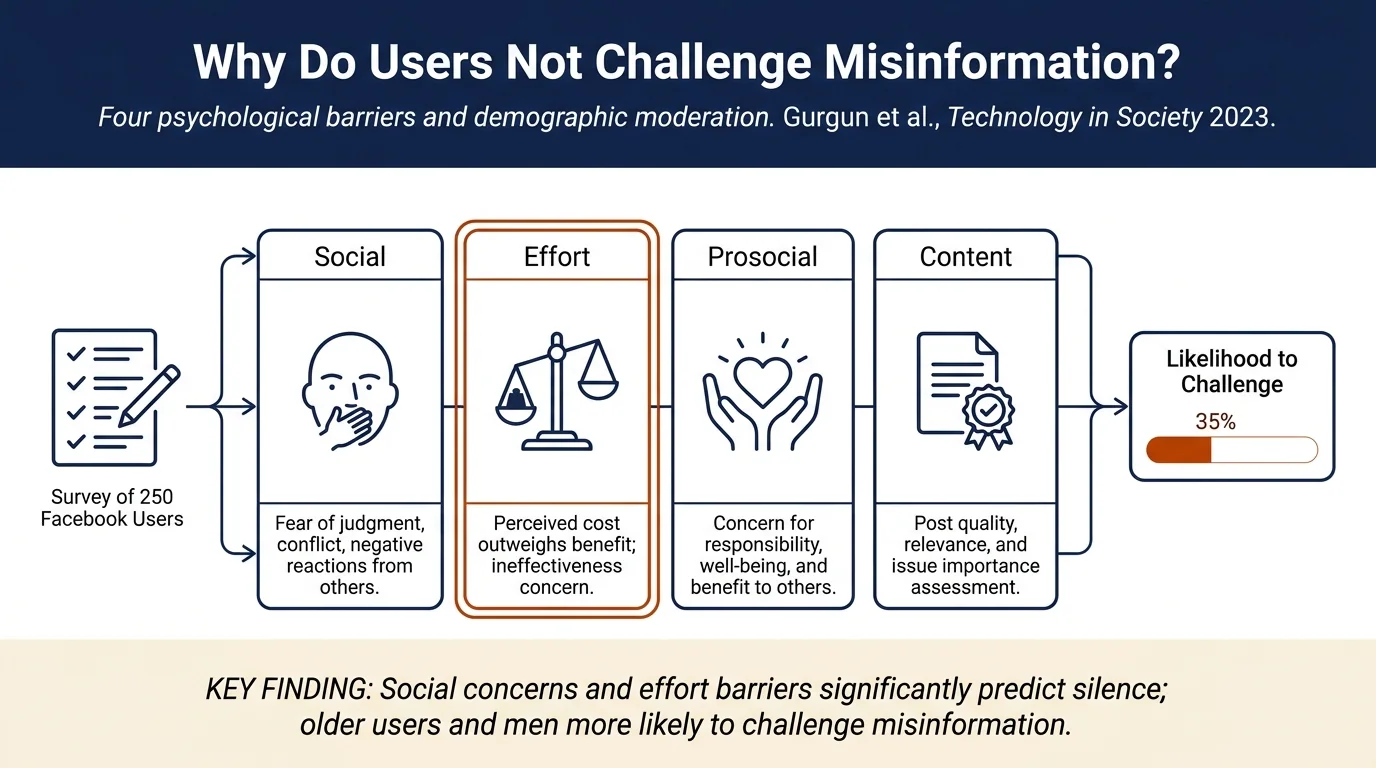
Four-factor model: Used Principal Component Analysis (PCA) to demonstrate that barriers collapse into four interpretable factors (social concerns, effort/interest, prosocial intents, content-related), providing actionable groupings for intervention design.
-
Demographic moderation: Demonstrated statistically significant age effects (older users more willing to challenge) and gender differences (men report higher effort/interest barriers; women prioritize content-related factors), revealing opportunities for demographically tailored interventions.
-
Psychological grounding: Connected barriers to established psychological theories (spirals of silence, social conformity, protection motivation theory, effort/justification theory) explaining why users remain silent despite awareness of misinformation.
Method
Participants: Online survey of 250 UK adult Facebook users (143 women, 104 men, 3 non-binary; mean age 50.6 years; 63% with university+ education).
Procedure: Participants indicated their likelihood of publicly challenging misinformation on a 7-point Likert scale (1 = Extremely unlikely, 7 = Extremely likely). They then rated 22 potential barriers derived from prior literature on a scale assessing applicability (1 = Not applicable, 7 = Extremely applicable).
Analysis:
- Principal Component Analysis (PCA) with varimax rotation extracted four components accounting for 64% of variance.
- Ordinal logistic regression tested whether each factor predicted likelihood to challenge, controlling for age and gender.
- Spearman's rank-order correlations and independent-samples t-tests examined demographic differences.
Results
Overall likelihood to challenge: Only 35.2% indicated they were "likely" or "extremely likely" to challenge misinformation; 46.4% were "unlikely" or "extremely unlikely."
Four factors identified:
-
Social concerns ($\alpha = 0.908$): concerns about being viewed negatively, aggressive reactions, conflict; negatively correlated with age ($r = -0.246, p < .001$) and gender ($r = -0.138, p < .05$), indicating older individuals and women less concerned with social judgment when challenging.
-
Effort/interest considerations ($\alpha = 0.815$): perceived effort required, lack of personal benefit, ineffectiveness of challenges; men reported significantly higher scores ($M = 0.166, SD = 0.92$) compared to women ($M = -0.113, SD = 1.047$), $t(245) = -2.179, p = .03$.
-
Prosocial intents ($\alpha = 0.897$): concerns about responsibility, benefit to others; did not significantly predict likelihood to challenge but captured important motivational nuances.
-
Content related factors ($\alpha = 0.750$): issue relevance, post quality; individuals with higher education reported lower concern about content quality when deciding to challenge ($F = 5.741, p < .05$).
Ordinal logistic regression: Only "social concerns" and "effort/interest considerations" were statistically significant predictors of likelihood to challenge ($p < .05$). Age was a significant main effect, with older individuals more likely to challenge misinformation.
Notes
Strengths:
- Psychologically grounded identification of barriers across multiple literatures (organizational, psychology, HCI)
- Explicit measurement of demographic moderation effects, moving beyond one-size-fits-all intervention assumptions
- Large enough sample (N=250) for valid PCA and regression
Limitations:
- UK-only sample; generalization to other demographics, cultures, and platforms (Twitter, TikTok, etc.) unclear
- Self-reported likelihood to challenge, not actual behavior—offline context may differ substantially
- Survey design: asking about reasons not to challenge may inadvertently activate barriers (reactance, priming effects)
- Moderate effect sizes; multiple barriers and their complex interactions suggest multivariate interventions required
Future work: The authors call for observational and experimental designs testing interventions that target the identified barriers in situ; investigation of platform-specific designs that lower perceived effort or social risk; longitudinal tracking of whether demographic differences in barrier salience remain stable or shift with platform familiarity.