 Miriam Metzger
Contributions
- Extends the MAIN credibility model (Sundar, 2008) by testing its applicability specifically to fact-checking sources and introducing a transparency heuristic to explain why crowdsourcing is perceived as unexpectedly transparent
- First empirical study to systematically compare credibility perceptions across all five major types of fact-checkers available to the public
- Demonstrates that individual receiver characteristics (analytical thinking, information literacy, political ideology) significantly predict credibility assessments of fact-checkers differently depending on source type
- Shows that credibility perception is a critical mediator between source type and actual sharing intentions, though agreement with the verdict also independently predicts sharing
Method
Study 1 (survey): 993 US participants from Amazon Mechanical Turk completed an online survey measuring credibility perceptions of five fact-checker types on six dimensions (expertise, trustworthiness, objectivity, goodwill, transparency, overall credibility). The survey also measured participants' analytical thinking, information literacy, political ideology, and social media/news use habits.
Study 2 (experiment): 1,002 participants viewed health-related false claims followed by fact-checks sourced from one of five types (Twitter, Logically.AI, FactCheck.org, Fox/USA Today, or Birdwatch—a crowdsourced fact-checking service). Participants then rated the credibility of the fact-check source and provided their agreement with the verdict, usage intentions, and sharing intentions on validated scales. Participants' demographics, analytical thinking, information literacy, and political ideology were also measured.
The paper uses ANOVA, hierarchical regressions (controlling for demographics and media use), and post-hoc pairwise comparisons to test hypotheses about how source type, credibility dimensions, and receiver characteristics predict credibility assessments and downstream behavior.
Results
Credibility across source types (Study 1):
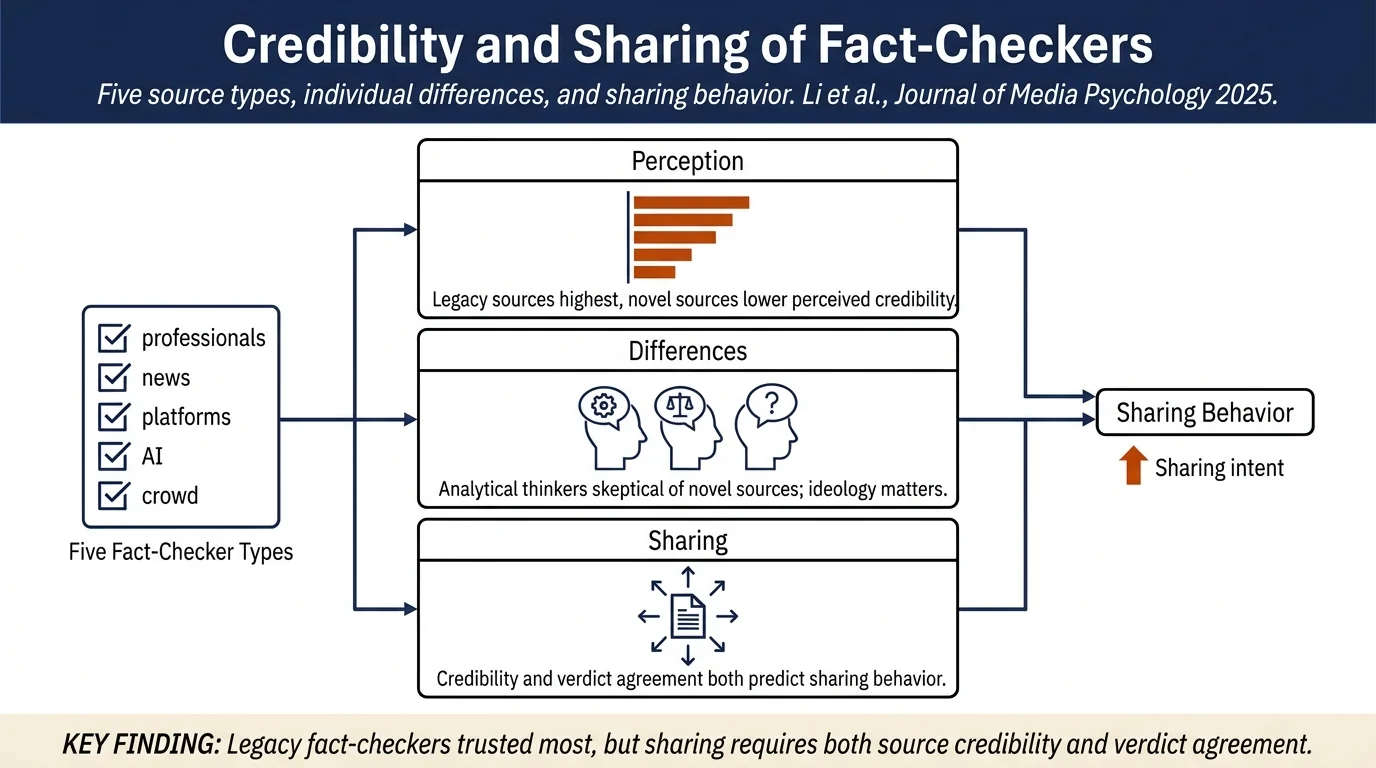
- Professional fact-checkers scored highest overall (M=4.98, SD=1.43), followed by mainstream news organizations (M=4.66, SD=1.39)
- AI fact-checkers (M=4.38, SD=1.39) and crowdsourcing (M=3.91, SD=1.47) scored lowest
- Professional fact-checkers were rated highest in expertise and trustworthiness; they were also rated as more transparent than AI or crowdsourcing
- AI and crowdsourcing were perceived as more objective than legacy sources but lower in expertise and transparency
- Social media platforms were perceived as lowest overall and lowest in goodwill, transparency, and objectivity
Individual differences (Study 1):
- Analytical thinking negatively predicted credibility of professional (β=−.096), AI (β=−.090), crowdsourcing (β=−.144), and social media platforms (β=−.199); no effect on mainstream news
- Information literacy negatively predicted credibility of AI (β=−.117) and crowdsourcing (β=−.117) but not mainstream or professional fact-checkers
- Political ideology: conservatives perceived professional and mainstream fact-checkers as less credible (β≈−.26, p<.001), but ideology did not predict credibility of novel sources
Sharing and usage intentions (Study 2):
- People were more likely to share fact-checks when they agreed with the verdict (β=−.121, p<.001) and when they perceived the source as more credible (β=.061, p<.05)
- Fact-checkers from professional sources and USA Today were more likely to be shared (M=3.70, M=3.55) than Birdwatch crowdsourcing (M=3.23)
- Credibility significantly predicted fact-check sharing intention (β=.215, p<.001) even after controlling for agreement with verdict
MAIN model findings:
- Results align with MAIN model's prediction that legacy sources are high in expertise and transparency
- Contradicts MAIN model on some points: AI was perceived as higher in expertise than expected (possibly due to authority heuristic)
- Crowdsourcing was unexpectedly high in transparency (suggesting transparency heuristic operates when people understand the methodology)
Notes
Strengths: Large sample sizes (N=1,995 total), multiple operationalizations of credibility using validated scales, controlled experimental design with varied source types, measurement of multiple receiver characteristics, real-world fact-check sources rather than hypothetical ones, focus on sharing intention as an important outcome beyond mere belief change.
Limitations: US-only sample with potential demographic skew (MTurk workers); survey and experiment used different fact-checkers (health topics only in Study 2); single-item measures for some constructs (sharing and usage); cross-sectional data preventing causal inference on credibility formation; conservative political ideology slightly overrepresented, limiting generalization to other contexts. Future work should test with broader topics, diverse international samples, and longitudinal designs.
Implications: Legacy fact-checkers remain dominant in perceived credibility but face public skepticism in politically polarized environments. Novel sources (AI, crowdsourcing) offer higher perceived objectivity but struggle with transparency and expertise perceptions; interventions highlighting their transparent methodologies may help. Analytical thinkers show heightened skepticism toward novel sources—possibly protective but potentially limiting adoption of innovations in fact-checking. Sharing depends on agreement with verdict as much as source credibility, suggesting fact-checks that challenge existing beliefs face an adoption barrier even from credible sources.