How people's decision-making processes, cognitive heuristics, emotional responses, and social motivations influence their susceptibility to misinformation and their sharing behavior. Rather than focusing on demographic correlates or logical fallacies, behavioral research examines the mechanisms by which users evaluate and decide to spread information.
Key mechanisms
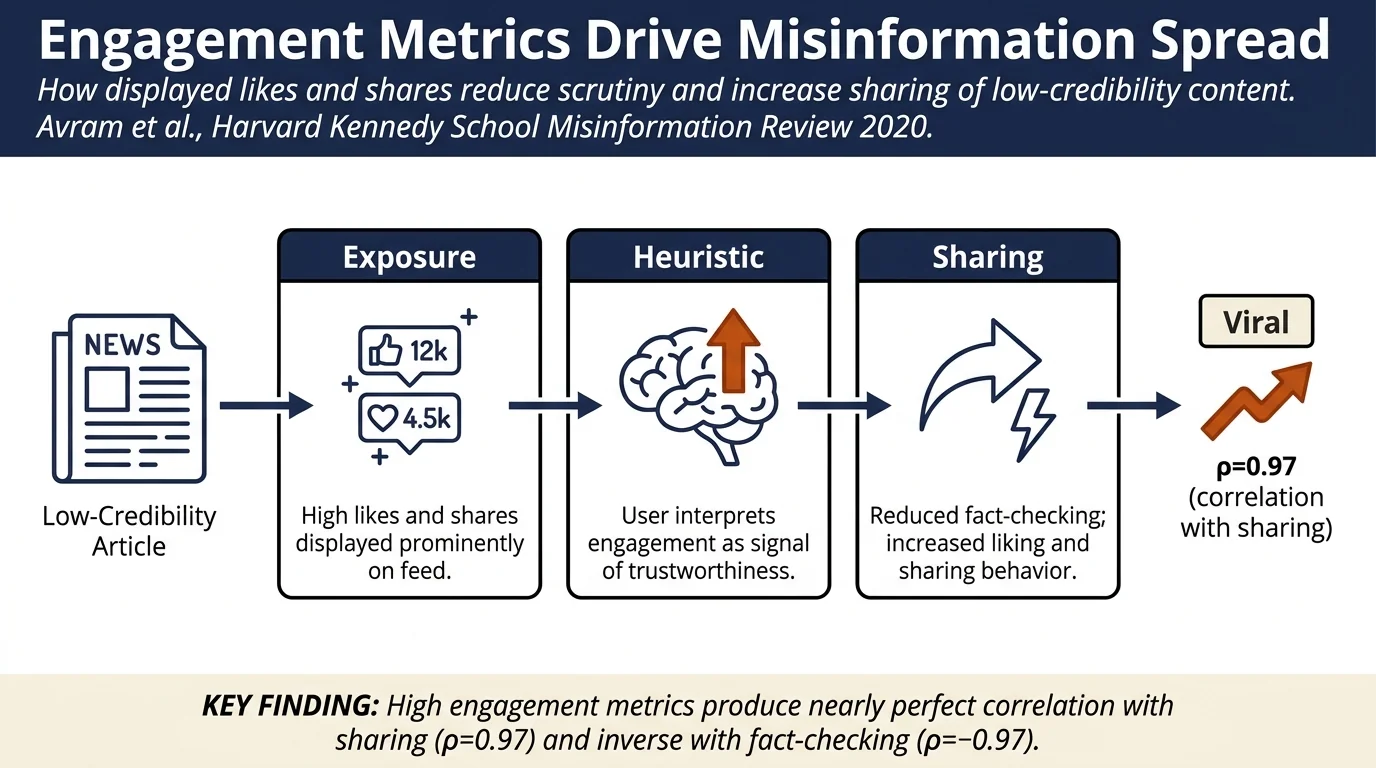
Heuristic credibility assessment: Users rely on rapid, intuitive cues (social endorsement, source reputation, design polish) rather than systematically evaluating content. Engagement metrics serve as social proof heuristics: high engagement signals popularity and can trigger a shortcut inference that content is trustworthy Avram et al. (2020).
Novelty and surprise: False information is perceived as more novel and surprising than true claims. People preferentially share novel information because it has higher informational value and attracts more attention Vosoughi, Roy & Aral (2018).
Emotion and valence: Emotionally charged content (especially anger, fear, and moral outrage) spreads faster and is shared more frequently. Political misinformation leverages partisan emotions and identity-protective cognition.
Social influence: Users are influenced by what their peers believe and share. Social proof from friends or in-group members affects both belief formation and sharing decisions. The "illusory truth effect" and "mere exposure effect" mean repeated exposure (especially from trusted sources) increases perceived veracity.
Sharing motivations: People share content for diverse reasons beyond belief: social signaling, identity expression, entertainment, and community participation. Misinformation may spread through sharing for identity reasons even among users who don't believe it.
Confirmation bias and selective exposure: Users preferentially seek and share information that aligns with preexisting beliefs, creating echo chambers that amplify misinformation and reduce exposure to corrections.
Intervention targets
Behavioral research suggests interventions should:
- Teach credibility heuristics that are easier to apply than systematic verification (e.g., lateral reading, source checking)
- Disrupt automatic sharing through friction or pausing mechanisms
- Appeal to social motives by making corrections or skepticism socially rewarding
- Inoculate users against manipulation by exposing them to weakened misinformation before encountering strong versions
- Engage identity-protection by framing corrections as aligned with group values rather than contradicting them
Key papers
- Avram et al. (2020) — Exposure to social engagement metrics increases vulnerability to misinformation — Demonstrates that platform engagement displays increase both liking and sharing of low-credibility content while decreasing fact-checking, showing a specific behavioral mechanism where heuristic signals override systematic evaluation.
- Vosoughi, Roy & Aral (2018) — The Spread of True and False News Online — Large-scale empirical study showing humans drive false news to spread further and faster than true news; novelty and surprise drive sharing behavior independent of platform algorithms.
- Weng et al. (2012) — Competition among memes in a world with limited attention — Agent-based models showing that social network structure and limited attention generate heavy-tailed popularity distributions; demonstrates that content quality matters less than network effects in determining virality.
Related topics
- Credibility assessment for fake news detection — how users evaluate information
- Misinformation spread and diffusion — how behavioral patterns aggregate to network-level diffusion
- Media literacy — building awareness of behavioral vulnerabilities
- Psychology of belief formation and reasoning — cognitive and emotional bases of belief formation
- Social networks and online communities — how interpersonal influence shapes behavior
Papers on this topic
 Psychology & interventionsDetection methods
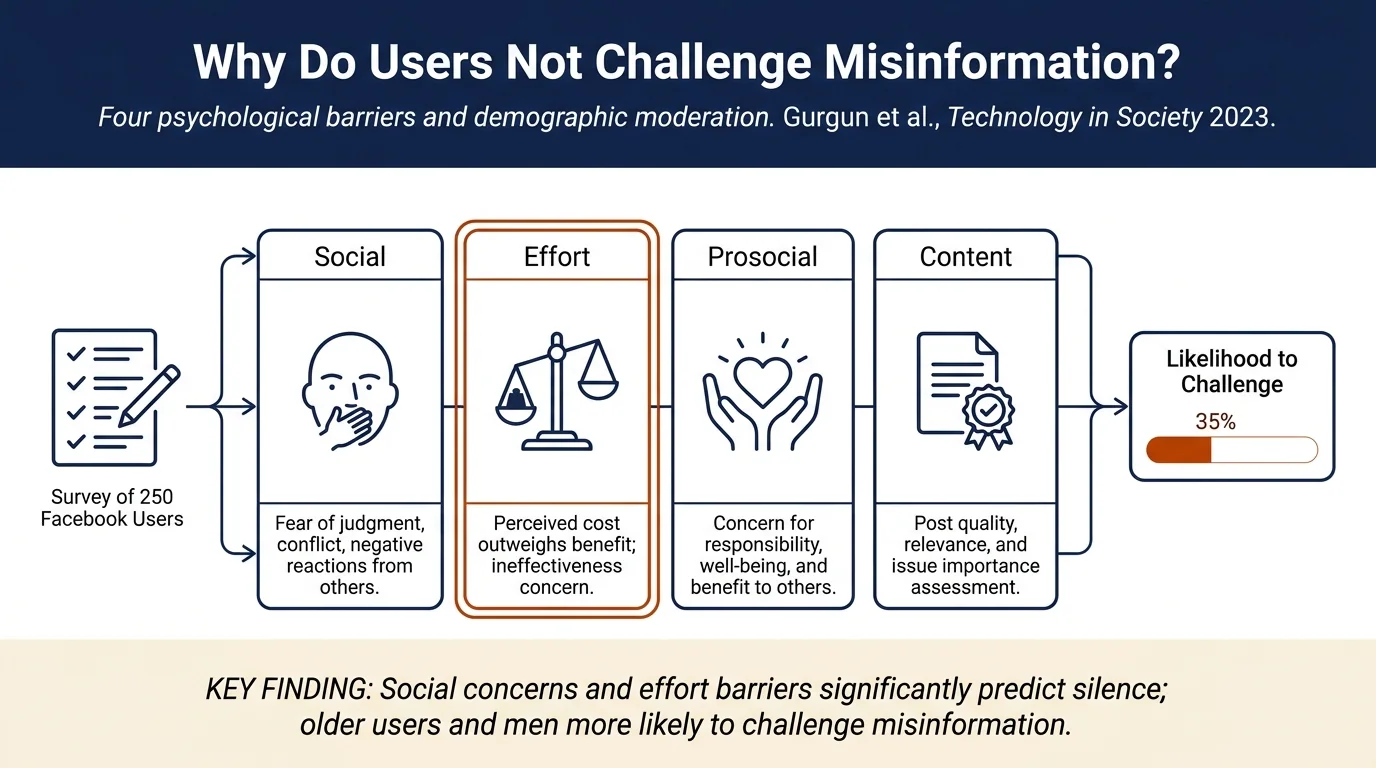
Why do we not stand up to misinformation? Factors influencing the likelihood of challenging misinformation on social media and the role of demographics
 Spread & networksDetection methods
Exposure to social engagement metrics increases vulnerability to misinformation