 Karen M. Douglas
 Gordon Pennycook
 David Rand
 Cass Sunstein
 Joshua A. Tucker
 Sander van der Linden
Contributions
- Synthesizes evidence from multiple behavioral science fields on how to promote pandemic response behaviors
- Identifies nine high-impact research topics with direct policy implications
- Highlights the importance of social context, cultural variation, and inequality in shaping pandemic responses
- Provides specific, evidence-based recommendations for leaders, media, and public health communications
- Emphasizes the role of shared identity, trust, and cooperation in collective pandemic response
Key Research Topics
The paper is organized around nine interconnected topics, each with distinct behavioral insights:
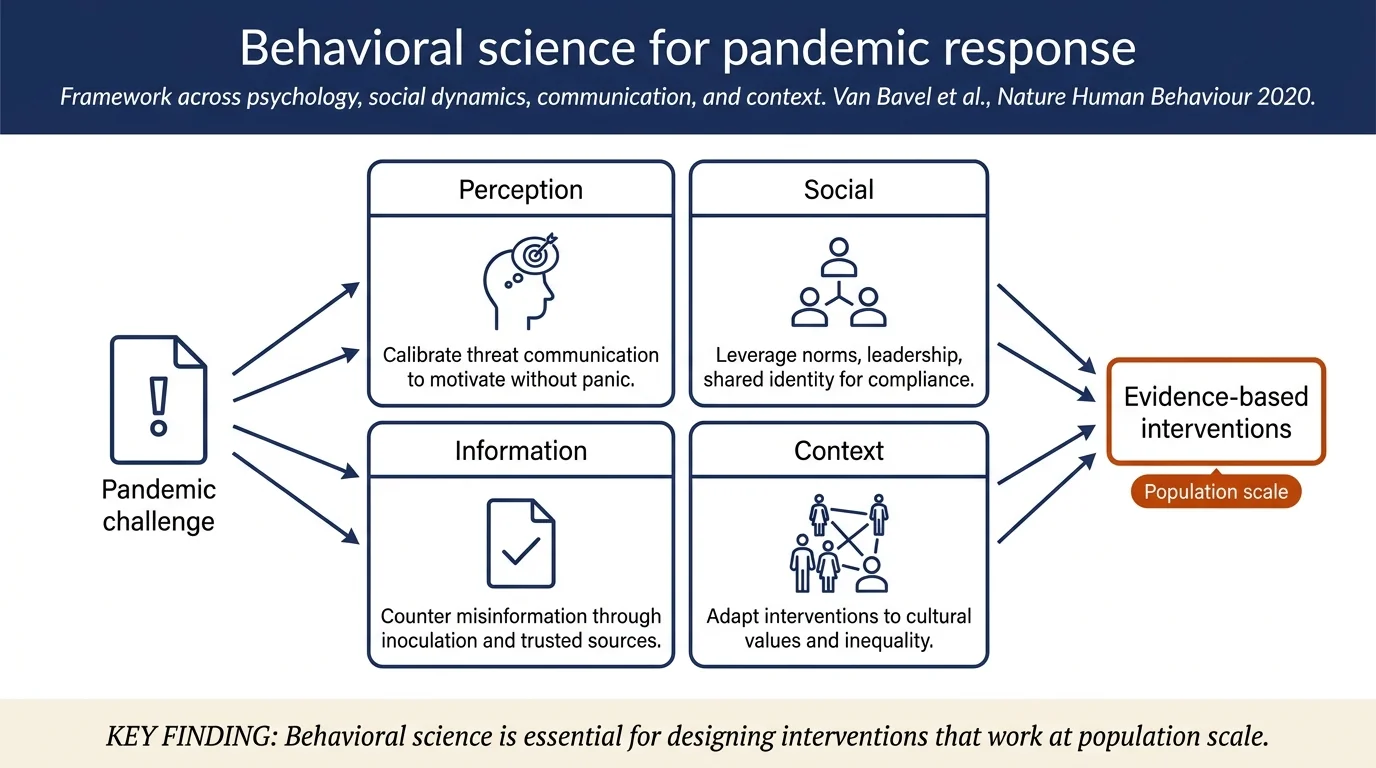
Threat perception. Fear and threat responses can motivate protective behavior but also trigger defensive reactions, prejudice, and panic. The paper reviews evidence on how to calibrate threat communication to avoid both under-response and harmful overreaction, including the distinction between fear appeals and accurate emotional framing.
Social norms and inequality. People conform to perceived social norms—whether their peers are mask-wearing, social-distancing, or complying with quarantine. Changing perceived norms can amplify behavior change efforts. However, social inequality, racism, and ethnic discrimination shape who adopts recommendations and who bears the burden of disease, complicating uniform public health messaging.
Science communication. Effective pandemic communication requires credible sources, accurate information, and sustained engagement with different audiences. The paper discusses barriers (conspiracy theories, pre-existing distrust) and strategies (inoculation against misinformation, transparent uncertainty, narrative framing).
Conspiracy theories and false beliefs. COVID-19 conspiracy narratives emerged early and persist widely, especially when they fulfill psychological needs or align with prior political beliefs. The paper reviews evidence on debunking and alternative approaches to counter misinformation.
Leadership and identity. Leaders who highlight shared identity and common purpose can mobilize cooperation and compliance. Perceived leader trust, competence, and fairness influence whether the public follows public health guidance. Cultural and political contexts shape which leadership framing succeeds.
Social context and cultural variation. Cultural values (individualism, tightness of social norms, power distance) influence pandemic response. Social inequality, economic pressure, and prior discrimination all affect adherence to recommendations and willingness to sacrifice.
Moral decision-making. People weigh moral trade-offs differently during crises (self vs. collective, near vs. distant). Understanding moral reasoning helps frame policies and communications in language that resonates with diverse groups' values.
Cooperation and collective interest. The tension between individual and collective benefit is fundamental to pandemic response. Strategies include emphasizing shared identity, highlighting reciprocal cooperation, and signaling that others are cooperating.
Stress, mental health, and coping. Isolation, economic hardship, and chronic stress during lockdowns can harm mental and physical health. The paper reviews evidence on mitigating isolation, supporting connections, and building resilience.
Polarization. Political polarization can undermine coordinated action and unified messaging. Pandemic response is complicated when different groups receive contradictory information or see the crisis differently. The paper reviews strategies for reducing polarization and building shared understanding.
Method and Results
This is a perspective piece, not an empirical study. The authors review the literature on each topic and synthesize actionable insights for policy and practice. Key findings include:
- Evidence-based communication and leadership strategies can shift behavior at scale
- Misinformation and conspiracy theories can be countered through multiple channels, including inoculation and collaborative fact-checking
- Social context and cultural variation must inform intervention design—one-size-fits-all messaging fails
- Building trust in institutions, leaders, and peers is foundational to pandemic response
- Addressing inequality and discrimination is integral to equitable public health measures
Notes
This perspective is exceptionally broad and authoritative, written by 43 leading researchers across psychology, political science, behavioral economics, neuroscience, and public health. It synthesizes research at the intersection of behavioral science and crisis response, making it a canonical reference for understanding how social science informs pandemic policy. The paper's strength is its scope and accessibility; its honest gaps are in actionable metrics for assessing which interventions actually succeed at scale in real conditions. Follow-ups should focus on rigorous evaluation of specific communication campaigns and interventions across diverse cultural and political contexts.