Contributions
- Characterized Twitter use during a major natural disaster, analyzing network topology and user behavior under crisis
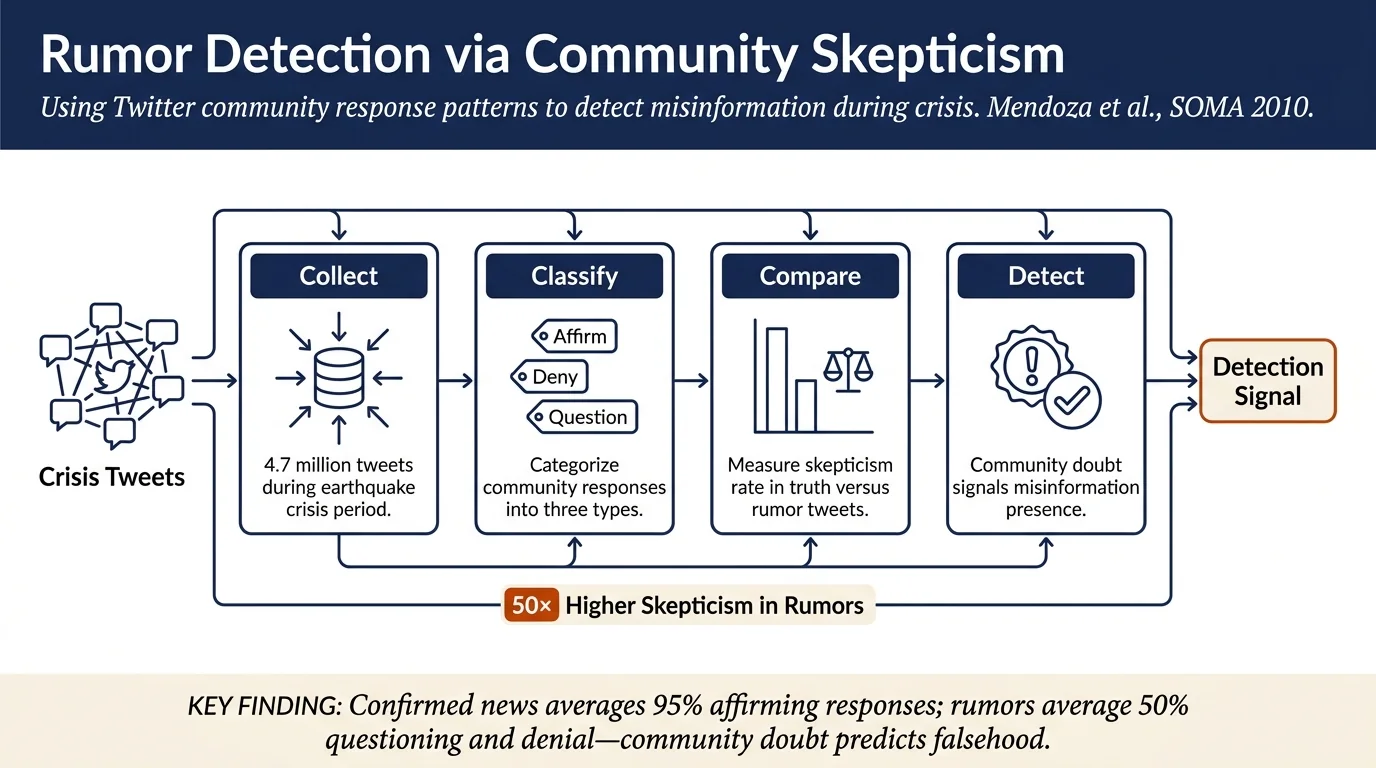
- Studied information propagation patterns, showing that confirmed truths receive 95.5% affirmative responses while false rumors receive ~50% questioning responses
- Identified that the Twitter community acts as a "collaborative filter" of information, with community skepticism correlating strongly with falsehood
- Proposed using aggregate tweet classification (affirms/denies/questions) as a signal to detect rumors
Method
The authors collected ~4.7 million tweets from Feb 27 to Mar 2, 2010 using the Santiago timezone and earthquake-related keywords (#terremotochile, location names). They analyzed the social network structure (716k users, 1,018 average followers) and information propagation through retweet graphs. For the core veracity study, they manually selected 7 confirmed truths and 7 false rumors based on external sources, collected 42-700 unique tweets per case, and classified each tweet as: affirms (confirms the information), denies (refutes it), questions (asks about it), or unrelated. Results were aggregated and compared across categories.
Results
Confirmed truths averaged 160.4 affirming tweets per case vs. 0.6 denying tweets (95.5% affirmative rate). False rumors averaged 119.4 affirming tweets vs. 30.9 denying tweets and 71.7 questioning tweets (50% deny/question combined). The asymmetry is striking: rumor tweets face ~50× more skepticism than truthful tweets. Retweet propagation during the first hours showed rapid diffusion, with retweet trees forming within 30 minutes and reaching 6 degrees of separation for the largest subgraph.
Notes
Strengths: Novel real-world study of misinformation during an actual crisis with manual ground truth. Clear empirical evidence that community skepticism correlates with falsehood. Simple, interpretable finding (question rate as a proxy for doubt) could be actionable.
Limitations: Small sample of curated rumors/truths (14 total cases) may not generalize. No measurement of rumor detection latency—did skepticism emerge fast enough to prevent harm? No discussion of why rumors are questioned more (community knowledge, phrasing cues, source credibility of original poster). Twitter's role in the event is understated due to infrastructure failures in first 48 hours.
Follow-ups: Scaling to thousands of rumors; temporal analysis of when skepticism emerges relative to peak diffusion; distinguishing good skepticism (domain experts) from noise; connecting to source credibility and user authority.