Contributions
- First large-scale manually annotated dataset of Twitter rumors (~10,400 tweets across 5 rumors: obama, airfrancue, cellphone, michelle, palin)
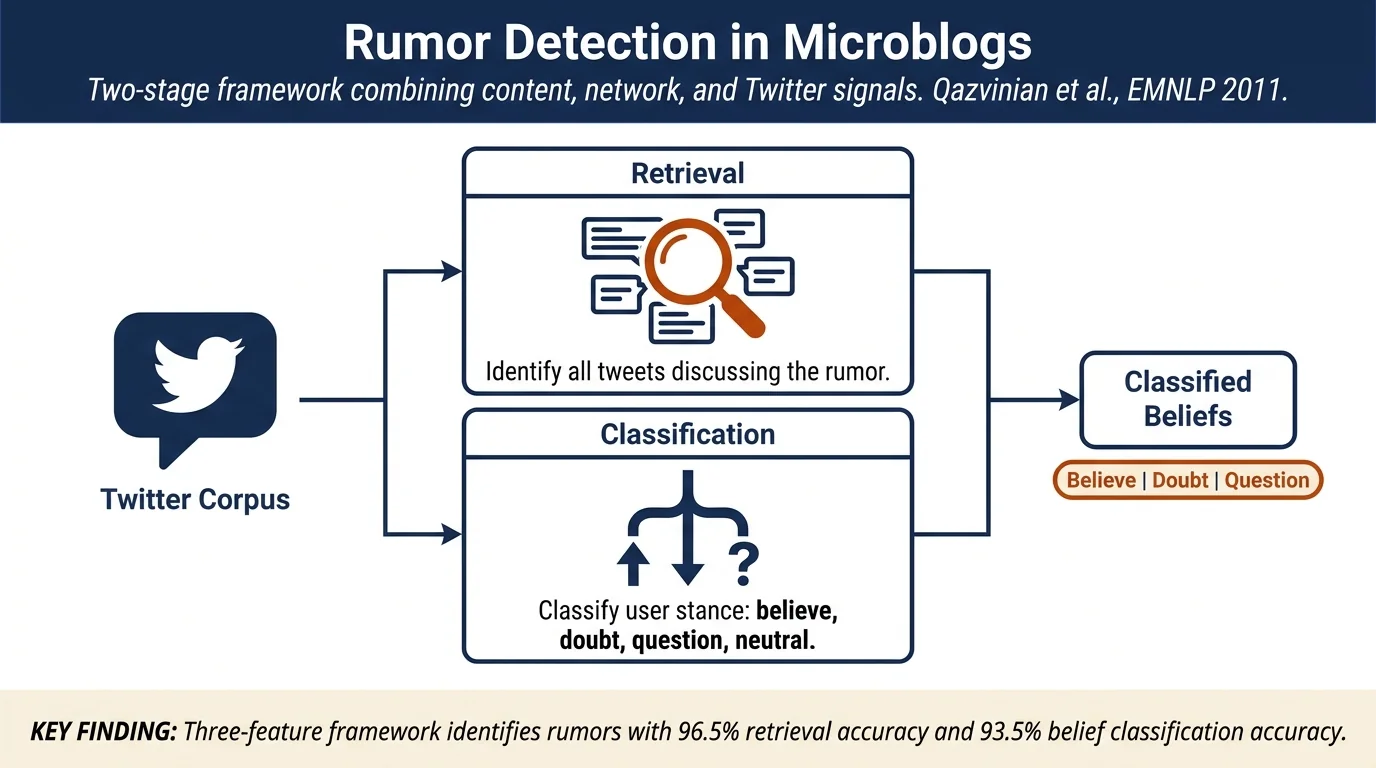
- Framework for two-stage rumor identification: (1) rumor retrieval (retrieve all tweets discussing a specific rumor), (2) belief classification (identify whether users endorse, refute, or question the rumor)
- Comprehensive feature engineering combining content, network, and Twitter-specific signals
- Statistical models (L1-regularized log-linear models) achieving strong performance on both tasks
Method
The approach frames rumor identification as two related NLP tasks:
Rumor Retrieval: Given seed rumors, retrieve all relevant tweets from a corpus. Uses L1-regularized log-linear models combining log-likelihood ratios of features computed from positive and negative training sets. Features include:
- Content-based: lexical unigrams/bigrams, part-of-speech unigrams/bigrams
- Network-based: whether the tweeting user has posted/retweeted rumors before (user model), whether a tweet is retweeted by users with a history of spreading rumors (re-tweet user model)
- Twitter-specific: hashtags and URLs extracted from tweets. URLs are fetched and their content modeled with unigram/bigram language models
Belief Classification: Among tweets flagged as rumorous, identify whether the poster believes the rumor, refutes it, questions it, or is neutral. Uses the same feature sets (content, network, Twitter signals) to train classifiers on labeled tweets; a tweet is marked as "believe" if the poster endorses the rumor statement, "doubt" if they explicitly deny or question it, or "neutral" if they express no clear stance.
The optimization employs orthogonal-wise limited-memory quasi-Newton (OWL-QN) for efficient L1-regularized objective minimization.
Results
Rumor Retrieval (Information Retrieval framework):
- L1-regularized log-linear model with all 9 features: Mean Average Precision (MAP) 0.965 (95% CI: [0.936, 0.994])
- Substantially outperforms regex-only baseline (MAP 0.587) and KL-divergence baseline (MAP 0.803)
- Content-based features (precision/recall tradeoff) + network features show strongest gains
Belief Classification:
- All-feature model: 93.5% accuracy, 94.4% precision, 90.6% recall, F_{β=1} = 0.925
- Content features alone (TXT+POS): 94.1% accuracy
- Network features (USR): 84.8% accuracy
- Twitter-specific (TAG+URL): 68.3% accuracy
- Combining all three feature types provides significant improvement over any single set
- Win/loss ratio (correct/incorrect): 14.395 (indicating strong discriminative power)
Notes
This is one of the first large-scale computational studies of rumors on social media. The manual annotation of >10,000 tweets at high inter-rater agreement (κ=0.95 for rumor retrieval, κ=0.85 for belief classification) establishes a rigorous standard for the field. The three-category feature framework (content, network, Twitter-specific) became a de facto standard for early social-media misinformation detection. Key insight: network-based features (user history of rumor involvement) and Twitter-specific signals (hashtags, URLs) substantially improve performance over content alone, foreshadowing the importance of social-graph and platform-specific signals in later work. The paper's distinction between rumor retrieval (finding all discourse about a claim) and belief classification (determining user stance) cleanly separates two related but distinct problems.