 Filippo Menczer
Contributions
- Demonstrates empirically that displayed social engagement metrics significantly increase user vulnerability to low-credibility information in a realistic social media context
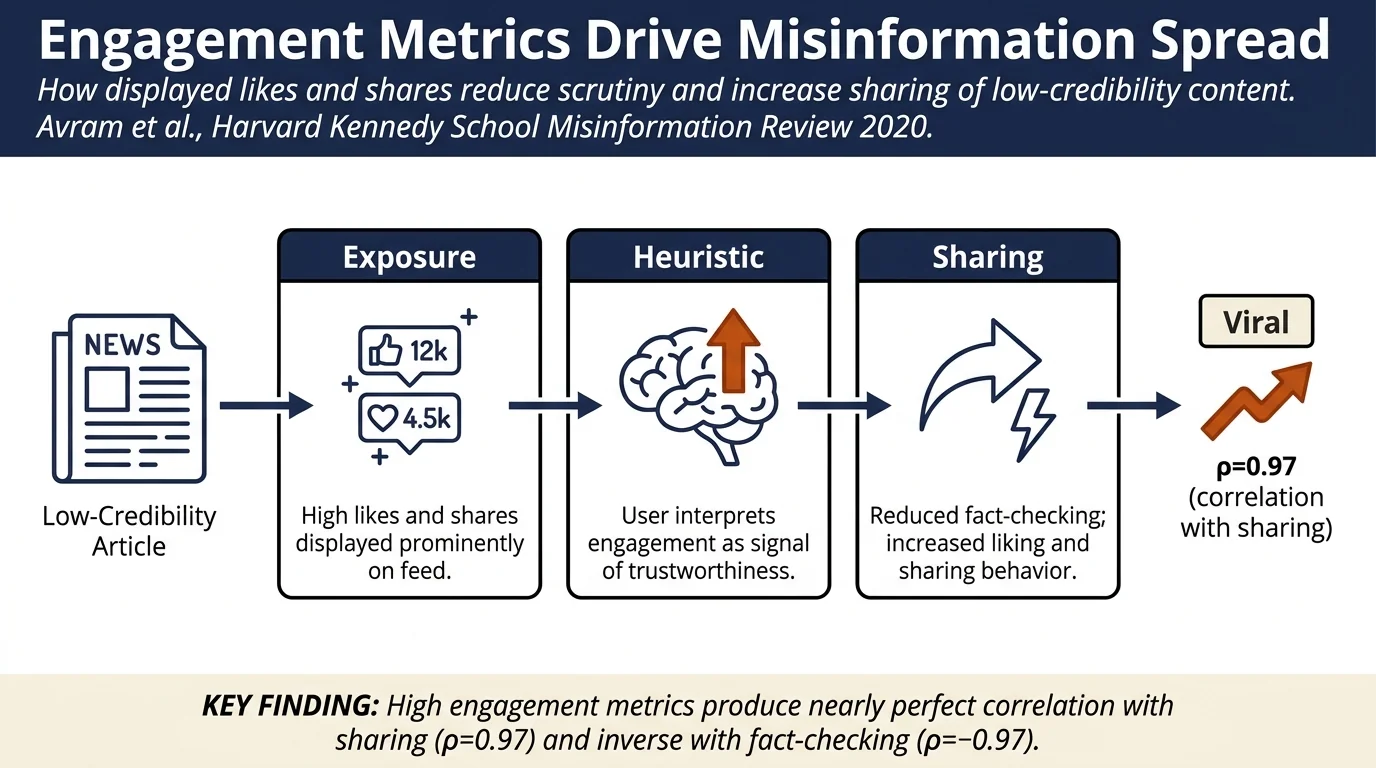
- Shows that high engagement metrics not only increase sharing but also reduce fact-checking behavior, a double vulnerability
- Uses a large-scale experimental game-based approach (8,606 unique players, ~120,000 articles) to control conditions while maintaining ecological validity
- Provides design implications for platforms: engagement metrics may inadvertently facilitate misinformation spread by using aggregate popularity as a proxy for trustworthiness
Method
The researchers developed Fakey, an online news literacy game that simulates Facebook and Twitter feeds. The interface displays realistic article elements: photo, headline, description, and social engagement metrics (the total count of Likes and Shares).
Experimental design: Players are presented with batches of ten news articles, each showing a randomly generated social engagement number (drawn from an approximately log-normal distribution with a maximum cutoff). For each article, players choose one of four actions: Share, Like, Fact Check, or Skip. The underlying articles come from two curated sets: mainstream news sources (32 carefully selected outlets representing diverse viewpoints) and low-credibility sources (flagged by reputable fact-checking organizations as publishing fake news, conspiracy theories, clickbait, and rumors).
Data collection: Over a 19-month deployment (May 2018–November 2019), 8,606 unique players from English-speaking countries played ~120,000 games involving ~120,000 articles (roughly half from low-credibility sources). Players' countries: United States (78%), Australia (8%), UK (4%), Canada (3%), Germany (3%), Bulgaria (2%).
Analysis: Researchers measured the correlation between displayed engagement numbers $n$ and player actions (like/share rates, fact-check rates) using the nonparametric Spearman correlation test due to skewed distributions. For low-credibility articles, they found strong positive correlations ($\rho = 0.97, p < 0.001$ for liking/sharing; $\rho = -0.97, p < 0.001$ for fact-checking), indicating high engagement is inversely related to fact-checking behavior. Mainstream articles showed weaker correlations ($\rho = 0.66, p < 0.001$ for liking/sharing; $\rho = -0.62, p < 0.001$ for fact-checking).
Results
Finding 1: High engagement metrics strongly increase both like/share rates and decrease fact-checking for low-credibility content. The correlation between engagement numbers and liking/sharing behavior is remarkably strong ($\rho = 0.97$), suggesting users interpret high engagement as a signal of reliability or importance. Conversely, high engagement is associated with less fact-checking ($\rho = -0.97$).
Finding 2: When researchers binned players into three categories by exposure to social engagement (low, medium, high), the effect held at the individual player level. Players exposed to high engagement numbers were significantly more likely to like/share low-credibility articles and significantly less likely to fact-check them, as shown in Figure 2 of the paper. The trend persists even for mainstream articles, though the effect is weaker.
Statistical detail: Kruskal-Wallis tests confirmed statistically significant differences across engagement bins for both low-credibility and mainstream articles ($\chi^2(2) = 117.14$ and $\chi^2(2) = 161.80$ for low-credibility; $\chi^2(2) = 576.37$ for mainstream fact-checking).
Notes
Strength: The experimental design is elegant and controlled (random engagement numbers, balanced source mix, large-scale longitudinal data). The use of a game environment maintains realism while enabling causal inference about engagement exposure.
Limitation: The game environment differs from real social media in important ways—players know they are in a game and may exhibit different reasoning than authentic news consumption. The researchers acknowledge that the even mix of mainstream and low-credibility sources may bias players to expect misinformation (more than the population encounters in the wild).
Gap: The paper raises but does not fully explore how engagement metrics might be redesigned to inform users without amplifying misinformation. It calls for future work on alternative display strategies (e.g., highlighting source trustworthiness, hidding engagement counts, ranking by credibility indicators rather than engagement).
Significance for platform design: The findings have direct implications for social media platforms' feed algorithms and UI. Platforms could reduce the spread of low-credibility content by either hiding engagement metrics or redesigning how they signal information quality. The finding that engagement is such a strong behavior driver suggests that changes to engagement display might have outsized effects on misinformation mitigation.