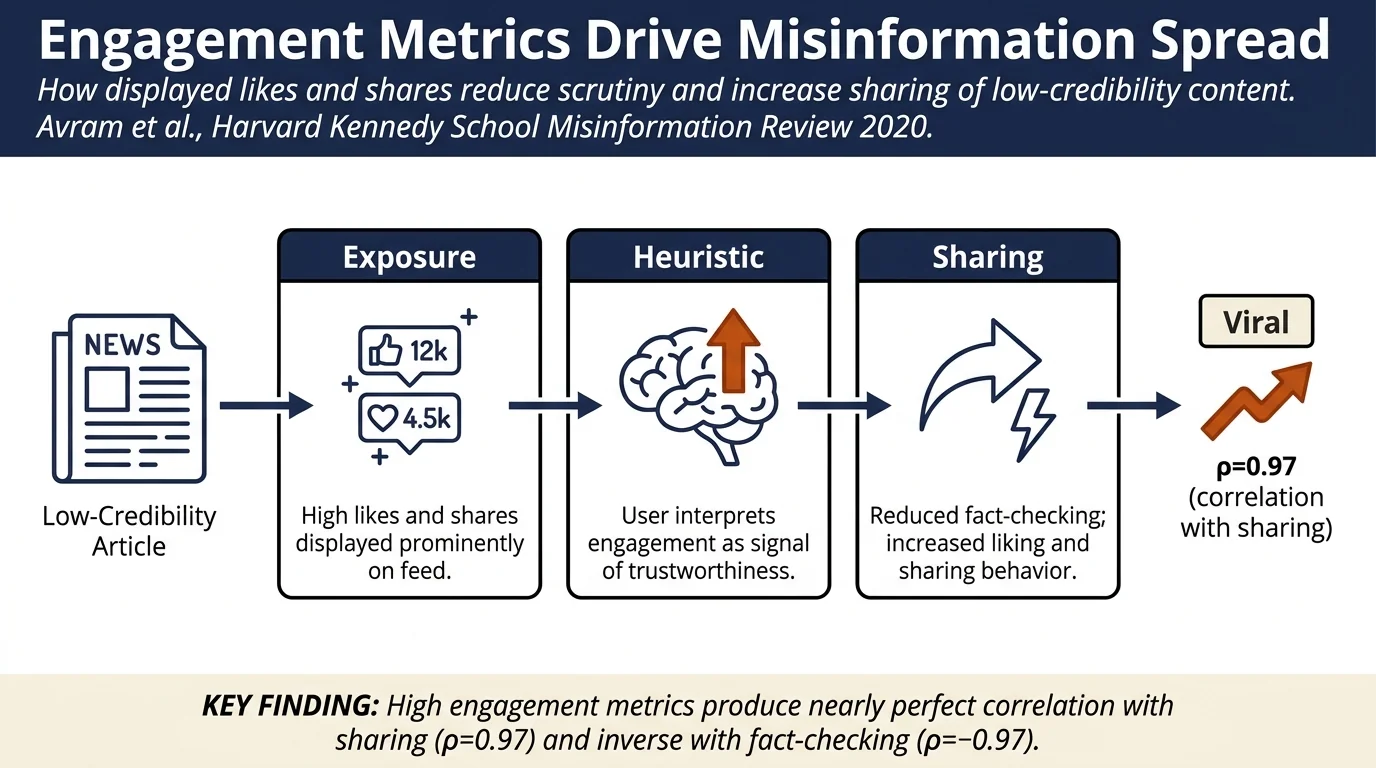
The design features and affordances of social media platforms shape how misinformation spreads, who encounters it, and how users evaluate its credibility. Platform design is not neutral: algorithmic ranking, interface elements (likes, shares, comments), feed structure, and recommendation systems all influence both user behavior and information flow.
Key dimensions
Engagement metrics: Displays of likes, shares, and other engagement counts serve as social proof heuristics. High engagement numbers can signal importance or credibility to users, potentially increasing the spread of low-credibility content. Users often interpret popularity as trustworthiness, decreasing their scrutiny of high-engagement content Avram et al. (2020).
Algorithm and ranking: Most platforms prioritize engagement (time-on-site, comments, shares) over quality, creating economic incentives for sensational, emotionally charged, or false content. Echo chambers and filter bubbles emerge from algorithmic ranking that reinforces user preferences rather than exposing users to diverse viewpoints.
Interface affordances: The simple affordances of sharing, retweeting, and commenting lower friction for broadcasting content without verification. The lack of built-in fact-checking or lateral-reading affordances means users cannot easily verify claims while consuming content.
Transparency and control: Most platforms provide limited visibility into how algorithms rank content or who sees posts. Users cannot directly control their own feed ranking or easily understand why they see certain content, limiting their agency in managing misinformation exposure.
Design implications for misinformation mitigation
Platforms could reduce misinformation spread by:
- Hiding or redesigning engagement metrics to reduce their use as credibility signals
- Modifying algorithms to prioritize quality, source credibility, or diverse perspectives over raw engagement
- Adding friction to sharing (e.g., confirming articles are read before resharing, requiring users to view fact-checks)
- Improving transparency about how recommendations work and allowing user control over algorithmic ranking
- Supporting lateral reading by providing easy access to external sources for verification
Key papers
- Avram et al. (2020) — Exposure to social engagement metrics increases vulnerability to misinformation — Demonstrates empirically that displayed engagement metrics increase user vulnerability to low-credibility content through a heuristic credibility mechanism.
- Menczer (2022) — Hacking Online Virality — Analyzes how network structure (echo chambers) and limited attention (engagement-driven ranking) create vulnerabilities exploitable by bots and misinformation campaigns.
- Bak-Coleman et al. (2022) — Combining interventions to reduce the spread of viral misinformation — Evaluates platform-level interventions including content removal, friction, virality circuit breakers, and account banning; shows combined strategies effective.
Related topics
- Attention economy — engagement metrics and algorithmic ranking compete for user attention
- Echo Chambers — algorithmic ranking reinforces network homophily
- Cascade Prediction — understanding how platform affordances shape information diffusion
- Credibility assessment for fake news detection — how design features influence credibility judgment
- Media literacy — user education about platform mechanics and design manipulation