Contributions
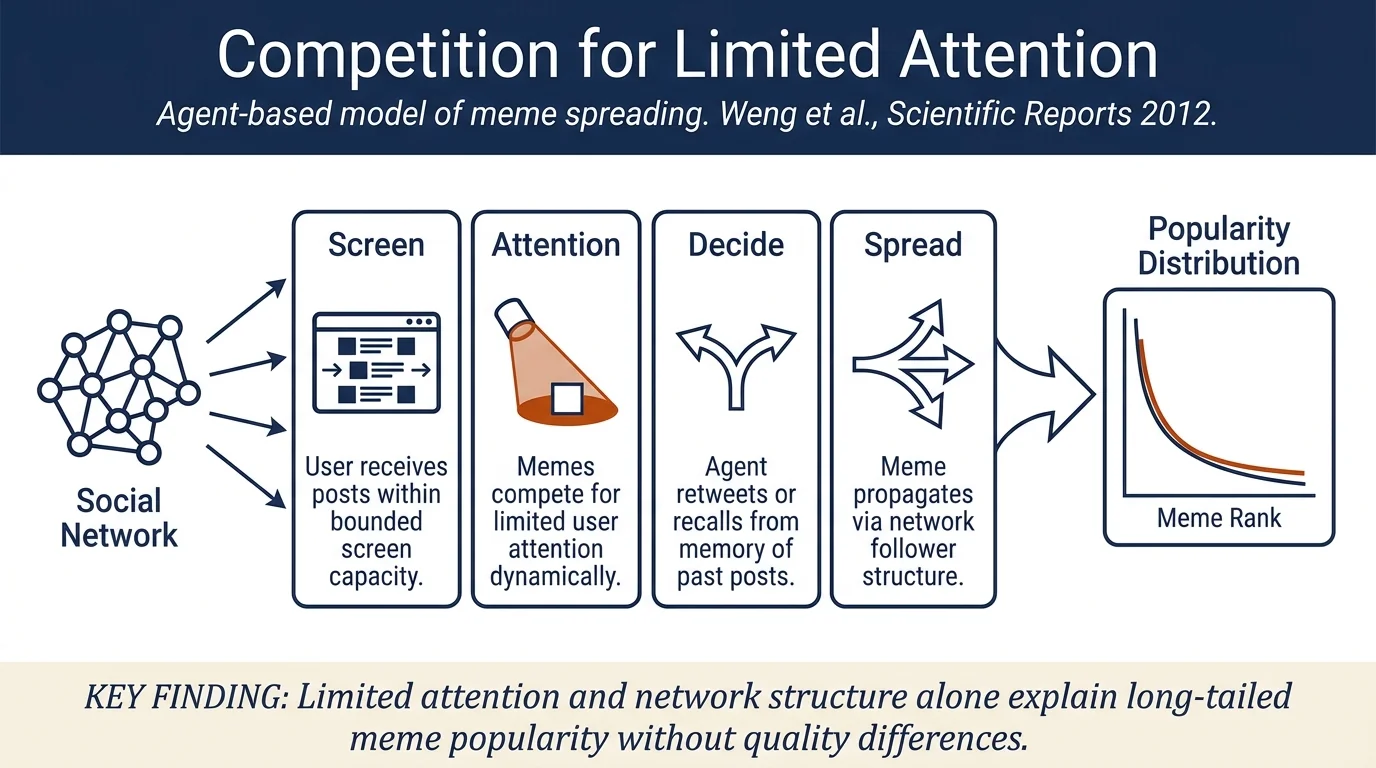
- First explicit agent-based model of meme competition for limited attention on social networks, showing it accounts for observed long-tailed distributions without exogenous factors
- Empirical validation that user attention breadth remains constant despite variation in system-wide information diversity (Shannon entropy analysis of 120M retweets)
- Demonstration that user interests (memory of past tweets) predict future retweet behavior (ρ = 0.98)
- Ablation studies showing both social network heterogeneity and competition for attention are necessary to reproduce empirical distributions; random networks or weak competition fail
Method
The authors build a discrete-time agent-based model on a directed social network (follower graph). Each agent maintains a bounded screen (displaying received posts) and memory (recording posted memes), both with finite capacity—posts disappear after one time unit. At each step, a randomly selected agent either posts a new meme with probability $p_n$ or scans the screen. Each on-screen meme attracts attention with probability $p_r$; the agent then retweets it (probability $1 - p_m$) or triggers a meme from memory (probability $p_m$). All parameters are estimated directly from Twitter data: $p_n = 0.45$, $p_r$ tuned per simulation, $p_m = 0.4$.
The model is simulated on a sampled Twitter follower network (10^5 nodes, ~3×10^6 edges) and also on random Erdős–Rényi networks. Meme lifetime, popularity, user activity, and user attention breadth are measured and compared to empirical distributions from the full Twitter dataset.
Results
- Model fit: Simulations on the real social network closely match empirical distributions of meme lifetime and popularity, user activity, and breadth of attention (entropy). Random networks produce far narrower distributions.
- Role of network structure: The heterogeneous degree distribution of real social networks—hub users with many followers—explains why some memes achieve high popularity. Random networks, with Poisson degree distributions, fail to reproduce observed extremes.
- Role of limited attention: Varying the time window $t_w$ in which posts are retained shows strong competition ($t_w < 1$) suppresses long-lived memes; weak competition ($t_w > 1$) fails to generate extremely popular memes. Standard competition ($t_w = 1$) reproduces all regimes.
- Role of user memory: Removing memory (setting $p_m = 0$) eliminates the concentration of users with narrow topical focus observed in data, suggesting endogenous interests are critical.
Notes
Strengths:
- Elegant parsimony: no exogenous factors (intrinsic meme quality, external media, user expertise differences) yet explains the data
- Large-scale empirical validation (120M retweets, 12.5M users) with transparent parameter estimation
- Rigorous ablations isolate the effects of network structure and attention limits separately
- Clear operationalization of memes (hashtags) and attention (screen/memory capacity) in Twitter context
Weaknesses:
- Model assumes frozen network and discrete time; does not capture network growth or continuous activity patterns observed in real platforms
- Hashtag-based proxy for memes may conflate distinct topics under single tags and misses cross-platform propagation
- Does not model explicit user influence (some spreaders may be more trusted); treats all users symmetrically
- Limited to 2010–2011 Twitter data; platform dynamics and user behavior have shifted significantly since
- Does not distinguish true information from false; implications for misinformation vs. authentic information diffusion remain implicit
Future directions:
- Extend to dynamic networks and continuous-time models
- Incorporate user credibility or topic-specific salience
- Test on contemporary platforms (TikTok, Instagram) with different attention dynamics
- Apply to false news / rumor propagation explicitly, measuring whether false claims face different attention curves than true claims