 Miriam Metzger
Contributions
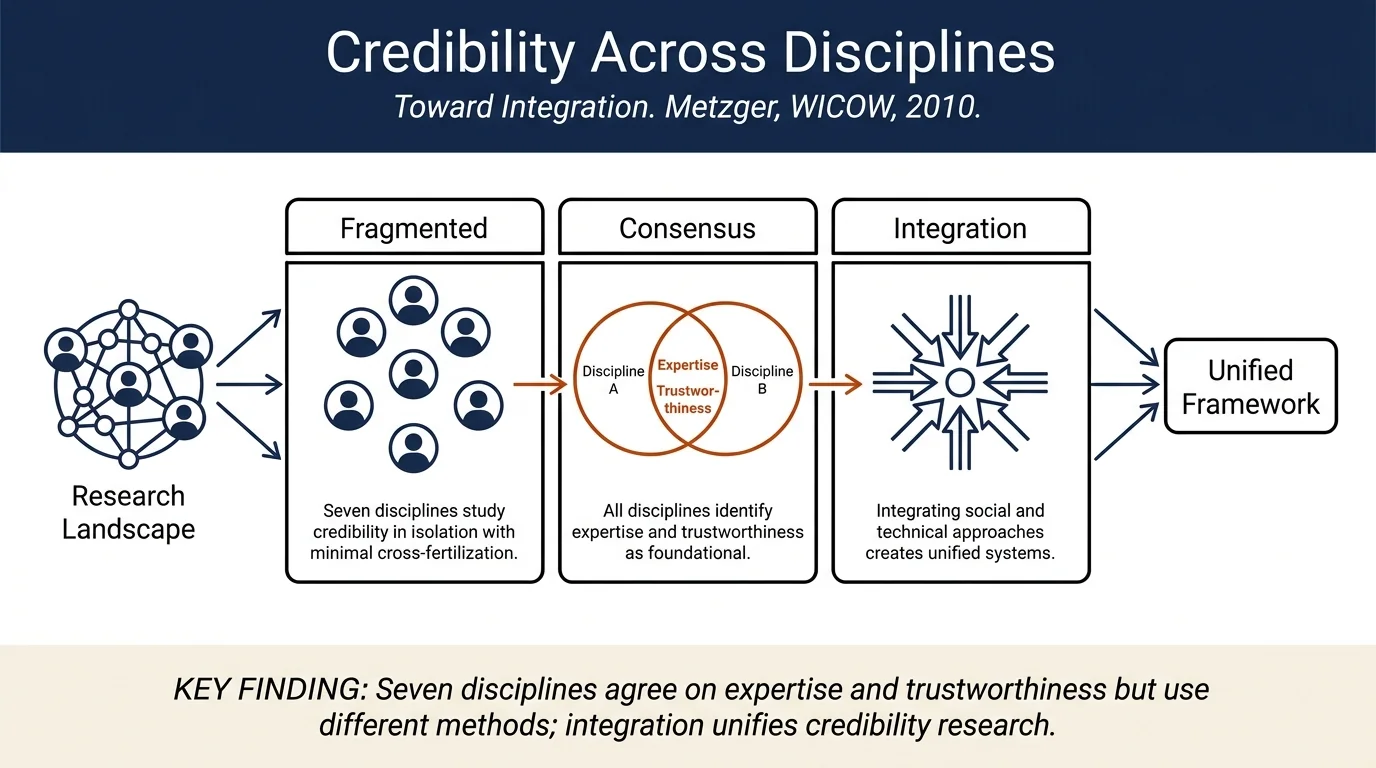
- Mapped the landscape of interdisciplinary credibility research, showing parallel theoretical development across fields with minimal cross-fertilization
- Identified common ground: most disciplines agree that expertise and trustworthiness are foundational dimensions of credibility
- Highlighted disjuncture: each discipline emphasizes different targets (institutional websites, search results, Wikipedia, health information, geographic data) and employs different methodologies
- Demonstrated that social-scientific approaches emphasizing subjective and social elements of credibility judgment could inform more effective technical credibility systems
- Positioned the Credibility@UCSB project as a bridge for interdisciplinary collaboration
Method
Synthesis and position paper based on research review across multiple disciplines, grounded in empirical findings from the Credibility@UCSB project (focus groups, lab experiments, and field studies on how users assess online credibility).
Results
The presentation reviews how different fields frame credibility evaluation:
Education and psychology focus on how individuals cognitively assess source trustworthiness and information quality, often examining developmental factors and individual differences in credibility judgment.
Communication research emphasizes social and contextual dimensions of credibility—how institutional affiliation, media type, presentation format, and social proof shape credibility perception.
Library and information science center on information intermediaries and tools that help users navigate credential evaluation (reference librarians, digital literacy instruction, credibility assessment frameworks).
Computer science and information retrieval develop technical systems to predict source credibility or detect unreliable information, often operationalizing credibility as measurable signals (source reputation, link structure, linguistic features) rather than subjective user judgment.
Health informatics tackle credibility in specialized domain contexts where misbelief has direct consequences, examining how health literacy and source expertise (professional vs. lay) affect risk perception.
Geography addresses credibility of volunteered geographic information (e.g., Wikipedia, Google Earth edits) where non-expert contributors generate publicly visible spatial data.
Notes
This keynote is prescient in arguing for interdisciplinary integration at a time (2010) when each field operated largely in isolation. The identification of parallel-but-separate theoretical development—especially the tension between subjective social-scientific models and technical information-retrieval approaches—remains relevant two decades later. The call to integrate social-scientific insights into technical systems has echoed through subsequent credibility and misinformation research. The Credibility@UCSB datasets cited here (from focus groups and experiments on user credibility evaluation) became influential in grounding subsequent work in empirical user behavior rather than pure algorithmic optimization. The observation that different fields emphasize different credibility targets (institutional authority vs. emergent peer-based assessment) foreshadowed the shift toward distributed credibility models in social media and user-generated content platforms.