 Miriam Metzger
Contributions
- Comprehensive synthesis of empirical research on actual user credibility evaluation behavior across multiple disciplines (communication, psychology, education, information science, library science)
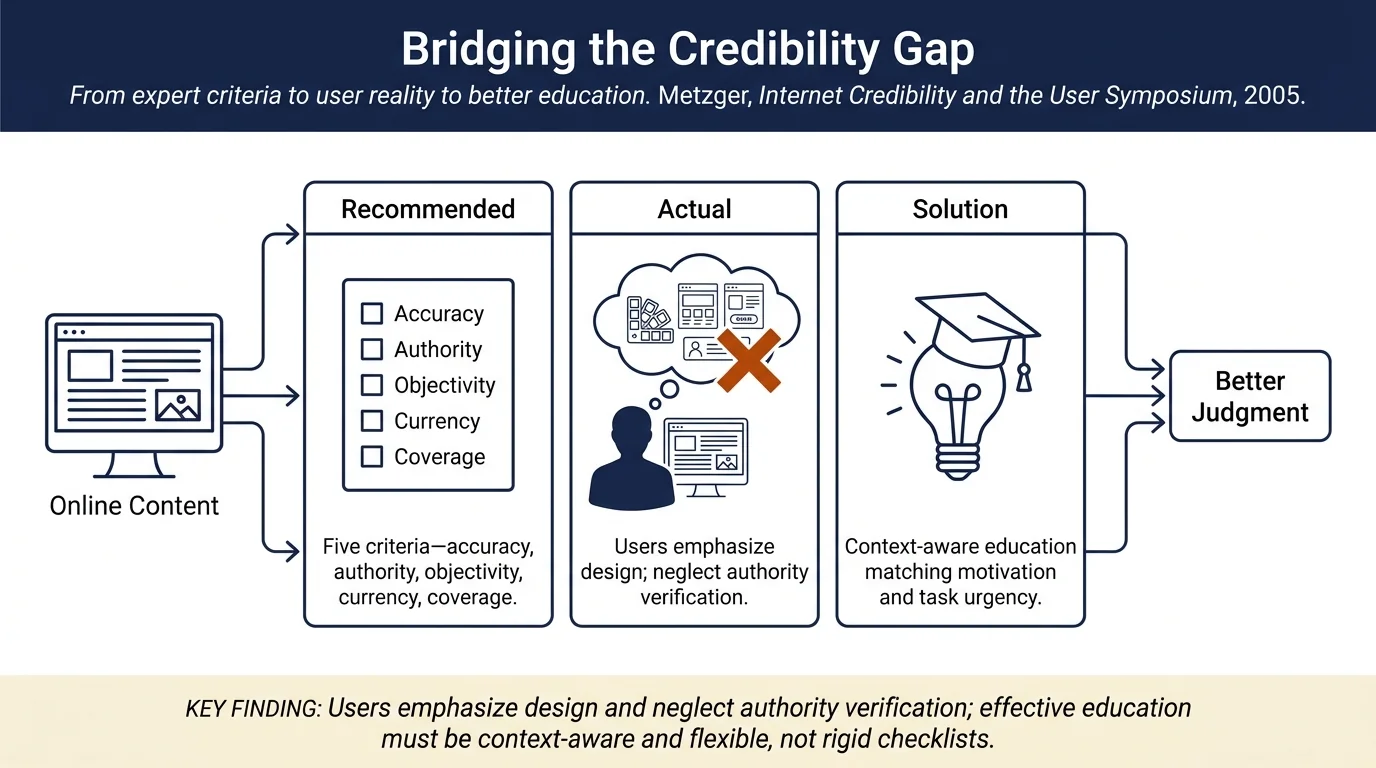
- Documentation of consistent discrepancy: users emphasize design/presentation (46% of comments in large-scale study), neglect authority verification despite it being foundational to credibility
- Identification of five key evaluation criteria drawn from prior literature and validated against user behavior: accuracy, authority, objectivity, currency, and coverage
- Review of four major theoretical models for credibility assessment: checklist approach, Fritch & Cromwell's cognitive authority model, Walthen & Burkell's staged model, and Meola's contextual approach
- Evidence that user motivation and information search task substantially moderate how rigorously users evaluate credibility; contextual factors matter as much as skill
- Recommendations integrating Elaboration Likelihood Model insights: proposing a dual-processing framework where users apply depth of evaluation based on motivation and ability
Method
Narrative synthesis of published empirical studies on Internet credibility assessment spanning 1999–2005. Studies reviewed include lab experiments with college students (Scholz-Crane 1998, Eysenbach & Kohler 2002, Rieh 2002), surveys of large user populations (Fogg et al. 2003 with 2,648 participants), and ethnographic observation (Metzger & Flanagin multi-year field studies). Focus on studies that directly examined user behavior in real or realistic information-seeking contexts, not just self-reported evaluation criteria.
Results
Recommended Evaluation Criteria
Literature consensus identifies five criteria users should employ:
- Accuracy: Information free from errors; corroborable offline; reliability of reported information.
- Authority: Author identity and credentials known; site contact information provided; qualifications verifiable.
- Objectivity: Site purpose is transparent; content is fact (not opinion); authorial goals/biases are identifiable.
- Currency: Information is up-to-date; timestamps present; information is maintained.
- Coverage: Information is comprehensive and in-depth; scope is clearly defined; relates meaningfully to user query.
Actual User Behavior
Empirical findings from multiple studies reveal systematic divergence from recommendations:
Flanagin & Metzger field studies (1999–2001): Survey of three samples (college students and general adults, n=274–718) found users reported checking all nine evaluation behaviors only "rarely" to "occasionally." Users checked currency (site currency), comprehensiveness, and objectivity most often; least often checked author identity, qualifications, or contact information. Worryingly, the least-practiced behavior—verifying author credentials—is "perhaps the most important for establishing credibility."
Scholz-Crane (1998): 21 college students writing essays evaluating two websites; content analysis revealed most used only 2 of 5 recommended criteria, overwhelmingly emphasizing scope/completeness and accuracy, with minimal attention to objectivity, authority, or contact verification.
Fogg et al. (2003): Large-scale experiment (n=2,648) examining what website features users actually noticed during credibility judgment. Results grouped features into four categories: site presentation (graphics, navigability, design quality, readability—46% of comments), information characteristics (organization, accuracy, bias, usefulness, clarity), site operator motives (advertising, selling intent, treatment of users), and source reputation (name recognition, past experience, affiliations with reputable organizations). Users applied four of five criteria, omitting currency; design/presentation elements were the most frequently used heuristic despite not appearing in formal recommendation frameworks.
Eysenbach & Kohler (2002) and Rieh (2002): Smaller studies with health-information seekers and academics confirmed that users applied heuristics diverging from checklist models—relying on ease of use, professional presentation, and site reputation rather than systematic credential verification.
Notes
This paper is striking for its honesty about the gap between educational prescriptions and behavioral reality. Many digital literacy programs in the mid-2000s promoted mechanical checklist approaches; Metzger documents empirically that users neither follow nor should be expected to follow such rigid models uniformly. The integration of the Elaboration Likelihood Model—suggesting that rigor of evaluation varies with user motivation—foreshadows later work on "good-enough" credibility heuristics and adaptive information-seeking strategies.
The finding that design elements disproportionately influence credibility judgment (without appearing in formal criteria lists) is sobering: it suggests users may be "easily duped by slick Web design," a vulnerability that bad actors would later systematize. The paper's recommendation for context-sensitive, motivation-aware education remains underexplored in curriculum development.
The paper also makes a useful distinction between the "free Web" (unvetted, requires user judgment) and "fee-based Web" (subscription databases, journals, news, which undergo editorial review)—a distinction increasingly blurred by hybrid paywalls and subscription services but still relevant for understanding credibility burden allocation.
The call for research methods beyond surveys (toward more naturalistic, unobtrusive observation to avoid response-bias) influenced subsequent ethnographic and log-analysis work on credibility behavior.