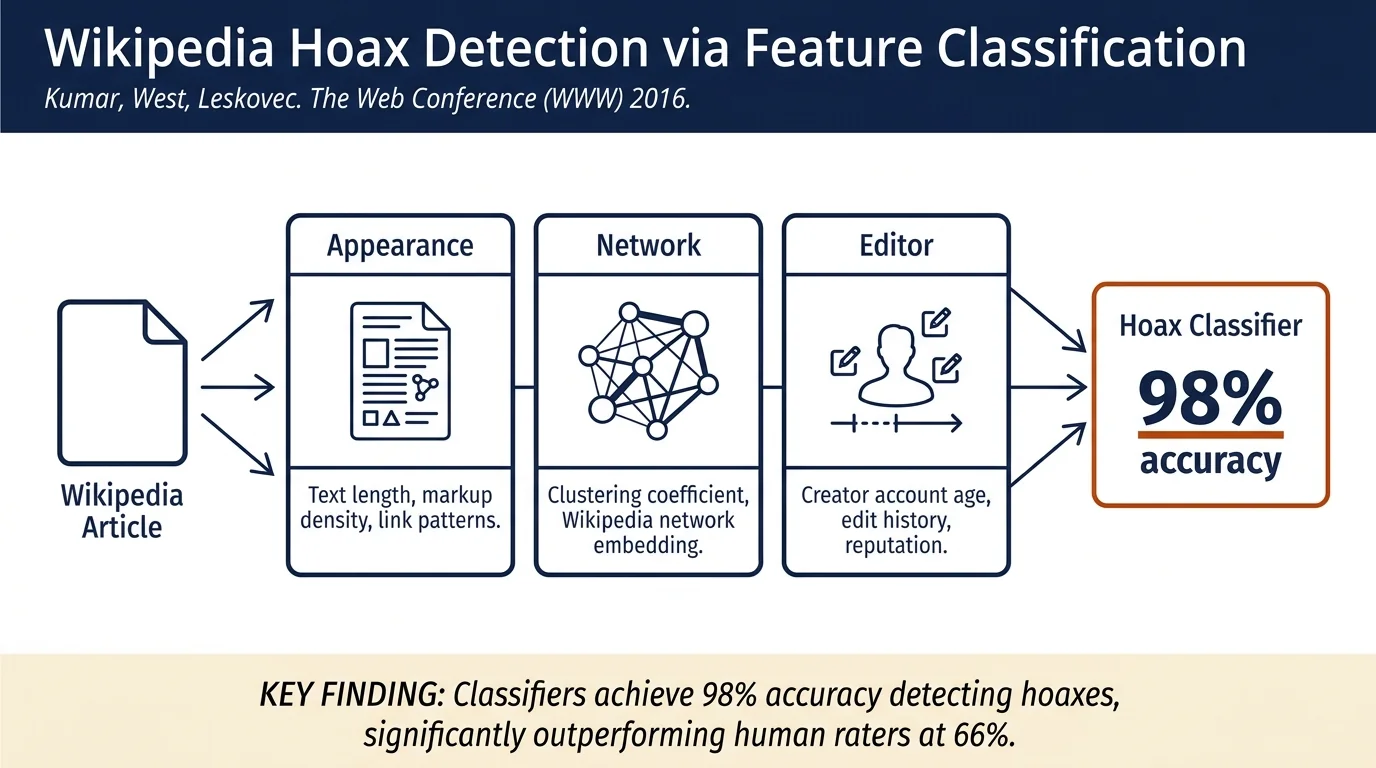
Wikipedia is a unique case study for online misinformation research: a large-scale, collaboratively-edited encyclopedia with decentralized authority, explicit policies against false content, and a large community of human editors and patrollers. Research on Wikipedia addresses questions of content quality, the mechanisms that catch and prevent false information, the characteristics of vandalism and hoaxes, and the dynamics of collaborative curation.
Key characteristics of Wikipedia as a platform
- Collaborative editing: Articles are edited by potentially thousands of contributors over time, with revision history tracking all changes
- Distributed moderation: Detection and removal of false content relies on community members ("patrollers") flagging suspicious articles; no centralized authority pre-screens contributions
- Transparency: Entire revision history, talk pages, and edit metadata are public; enables detailed auditing and forensic analysis
- Heavy-tailed impact: While most hoaxes and vandalism are caught quickly (within hours or days), some false articles survive for years and accumulate significant traffic
Key research directions
Content quality and reliability: Measuring article reliability via edit history, editor reputation, and article structure.
Vandalism and hoax detection: Identifying deliberately false or malicious edits via content features, network signals, and editor behavior patterns.
Edit dynamics and collaboration: Understanding how editor expertise, community norms, and revision patterns affect article quality and resilience to misinformation.
Key papers in this wiki
- 2016-kumar-wikipedia-hoaxes — Empirical study of Wikipedia hoaxes; measures real-world impact via pageviews and external citations; identifies distinguishing features (appearance, network, editor characteristics) and builds classifiers for automated hoax detection, achieving 98% AUC and outperforming human raters.
Related topics
- hoax-detection (methods for identifying false articles)
- content-moderation (platform approaches to managing false content)
- collaborative-editing (dynamics of multi-author content creation)