Contributions
- Identifies repetition as a fundamental mechanism underlying truth judgment for uncertain claims
- Demonstrates that the illusory truth effect operates equivalently for true and false statements
- Shows the effect generalizes across diverse knowledge domains (history, sports, politics, arts, etc.)
- Establishes frequency as a key attribute of memory affecting belief formation independent of actual accuracy
Method
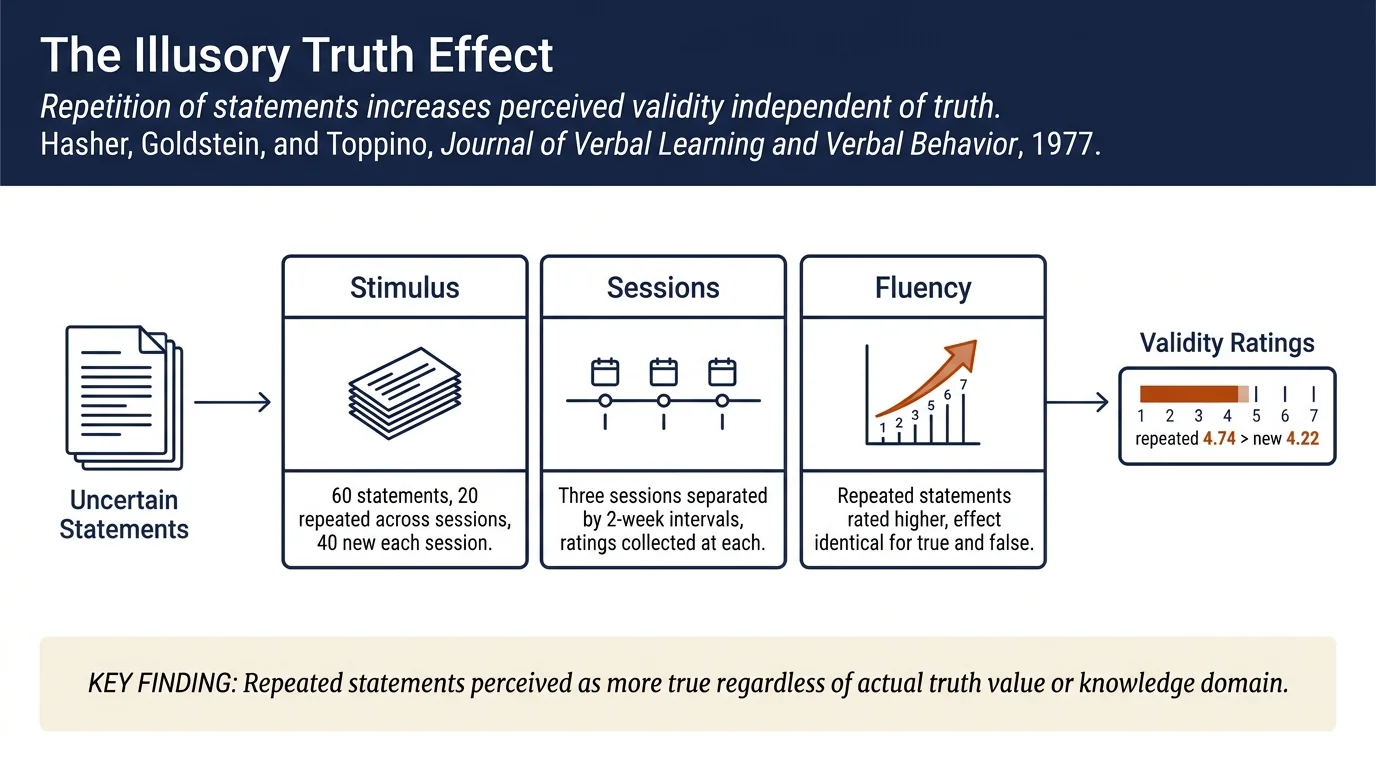
Subjects rated 60 plausible but uncertain assertions on a 7-point scale ("uncertain" to "definitely true") on three occasions separated by 2-week intervals. Twenty critical statements were repeated across all three sessions; the remaining 40 were new in each session. Statements were sampled from 10 knowledge domains and were selected to be plausible but not commonly known by college students. A 2 (repeated vs. non-repeated) × 3 (session) × 2 (true vs. false) within-subject factorial design compared validity ratings.
Results
Repeated statements showed significantly increased validity ratings across successive sessions (from M = 4.35 in session 1 to M = 4.74 in session 3), F(2, 78) = 16.34, p < .01. Non-repeated statements showed no significant change (M = 4.25, 4.22, 4.16 across sessions), F < 1. This repetition effect held equivalently for both true statements (F(2, 78) = 16.34) and false statements, and across all 10 knowledge domains. No significant difference existed between repeated and non-repeated items in the first session, ruling out pre-existing item differences.
Notes
This is the canonical empirical demonstration of what is now termed the "illusory truth effect" or "truth effect." The finding that frequency itself serves as a certitude cue independent of actual truth status has profound implications for understanding why repetition is such a powerful driver of false belief adoption. The authors note that subjects made validity judgments "in the absence of certain knowledge"—the paper does not address what happens when corrective information or strong prior knowledge is available, an important limitation. The equivalence of the effect for both true and false statements is striking and suggests the mechanism is not rational updating but a heuristic response to fluency. Modern neuroimaging and computational modeling work has since attempted to clarify the mechanisms, but this 1977 paper remains essential for documenting the basic phenomenon.