 Gordon Pennycook
 David Rand
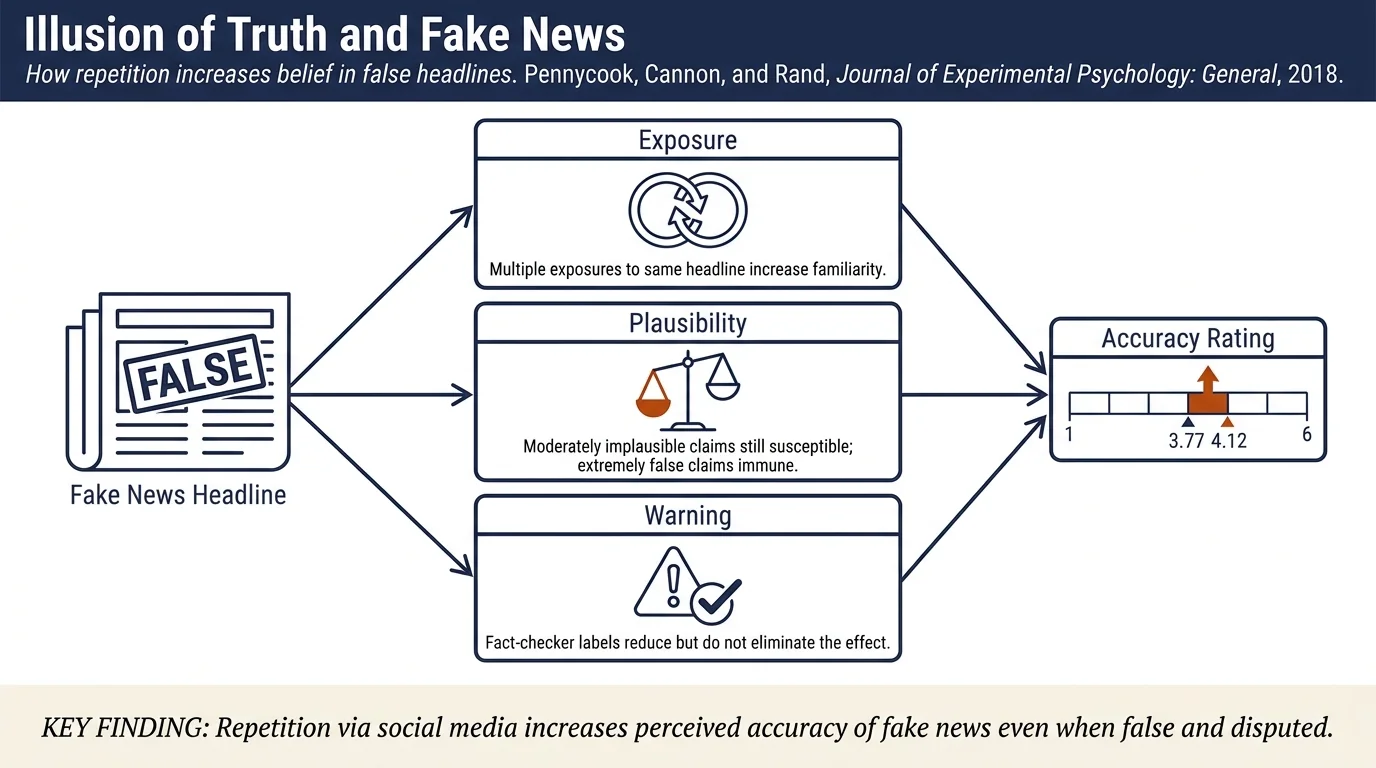
Contributions
- Demonstrates that the illusion of truth effect extends to fake news headlines, contrary to theoretical predictions that extreme implausibility would prevent the effect
- Identifies plausibility as a boundary condition: repetition increases accuracy judgments for moderately plausible false claims but not for obviously false statements
- Shows that fact-checker warnings ("Disputed by 3rd Party Fact-Checkers") do not eliminate the illusion of truth effect for repeated fake news
- Establishes that the effect occurs both within a single session and persists after one week
- Tests the effect across multiple studies with both synthetic and real political fake news headlines from the 2016 US election
Method
Three preregistered experiments tested the "illusion of truth" effect—the phenomenon that repetition increases perceived accuracy of statements. The key innovation was examining whether this classical effect from cognitive psychology applies to implausible and partisan fake news.
Study 1: Examined plausibility as a boundary condition. Participants rated "interestingness" of statements in a familiarization phase, then assessed accuracy. The study included four categories: known true statements, known false (extremely implausible) statements, and unknown true and false trivia statements. Repetition was manipulated by showing statements either once (novel) or twice (familiarized).
Studies 2 & 3: Tested real fake news headlines. Participants were randomly assigned to warning or control conditions. In the familiarization stage, they viewed six real news and six fake news headlines in Facebook-like format. Half received a "Disputed by 3rd Party Fact-Checkers" warning on fake news items; the other half saw no warnings. Participants then judged sharing likelihood and later accuracy of all headlines. The studies used Amazon Mechanical Turk with ~500 participants each (combined n=949 after exclusions).
Results
Study 1: Repetition significantly increased accuracy judgments for unknown (plausible) true and false statements, replicating the classical illusion of truth effect. However, repetition had no significant effect on accuracy judgments for extremely implausible statements ("The Earth is a perfect square"), confirming plausibility as a boundary condition.
Studies 2 & 3: Despite being implausible and partisan, repeated fake news headlines were judged as significantly more accurate than novel ones. Mean accuracy ratings increased from 3.77/6 (novel) to 4.12/6 (familiarized) for false trivia, t(408) = 6.65, p < .001. The effect was substantially larger for unknown than known items and persisted even when headlines were labeled as disputed or conflicted with readers' political ideology.
The "Disputed" warning reduced (but did not eliminate) the illusion of truth effect. Real news headlines showed similar repetition effects regardless of warning.
Notes
Pioneering work establishing that repetition via social media exposure drives belief in fake news through a well-established cognitive mechanism, not just content appeal or political ideology. The boundary condition finding (implausibility limits the effect) is crucial: it shows the effect is real but has realistic limits. The warning experiment is important for fact-checking interventions—the "Disputed" label provides some protection but is not sufficient to prevent the illusion of truth effect. The preregistration and replication across two independent samples strengthen confidence in the findings.