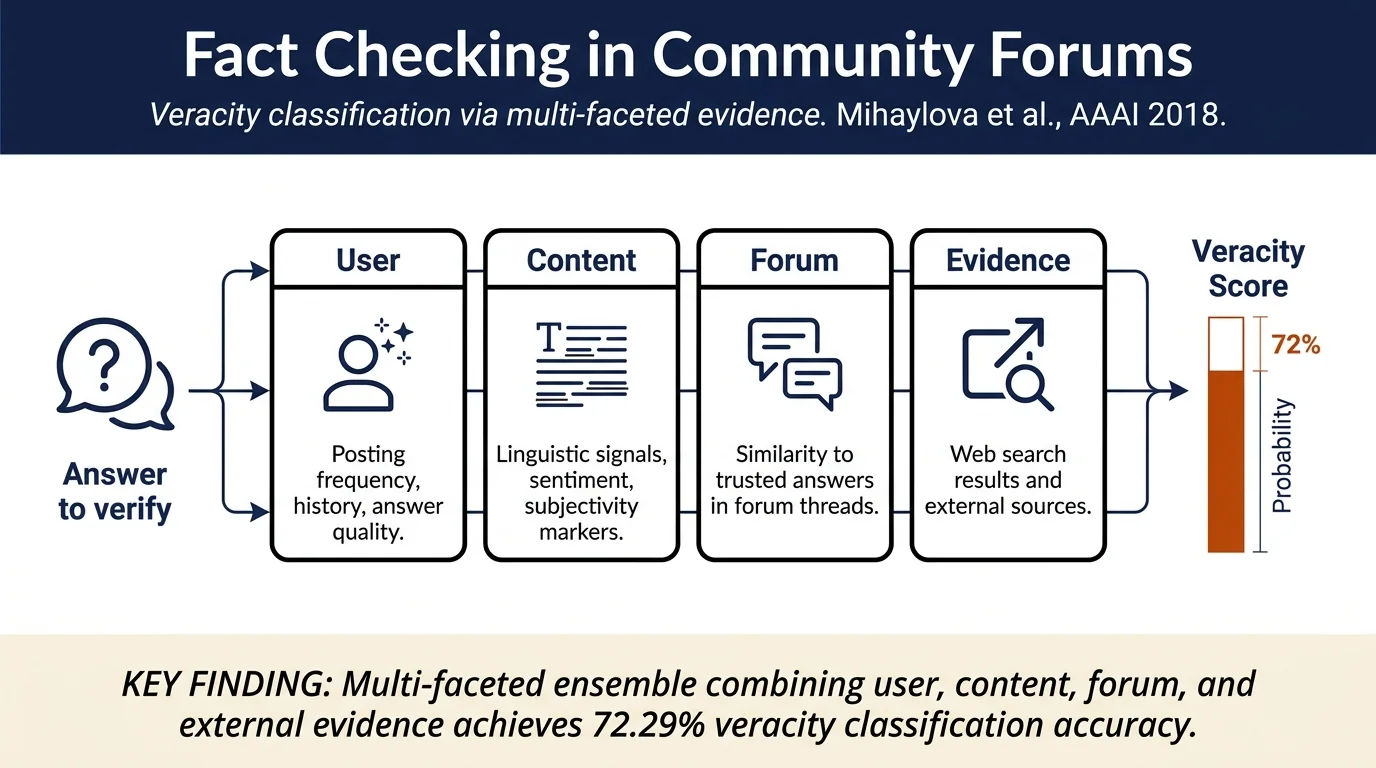
Veracity classification is the task of automatically assigning truth labels to unverified claims circulating on social media. The goal is to determine whether a source post expressing a claim is true, false, or unverifiable based on the claim text, community responses, and optionally external evidence.
Task definition
Veracity classification typically operates within the Rumour Verification pipeline as the final step, consuming the results of Stance Detection and other intermediate stages. The input is a source claim (usually a social media post), optionally accompanied by:
- Thread of community responses with stance labels (support, deny, query, comment)
- Temporal information (post timestamps, discussion duration)
- User credibility scores
- External knowledge (Wikipedia articles, news sources, fact-check databases)
The output is a discrete label: true, false, or unverified (also called "not enough information" or "unclear" depending on the annotation scheme).
Classification approaches
Source-only methods classify rumours using only the source post text, without replies or external information. These systems must distinguish veracity from linguistic markers alone (tone, sentiment, certainty, deictic language). Real-time applications require source-only approaches since replies accumulate over time.
Reply-based methods aggregate community responses using stance labels, reply counts, and temporal patterns (whether refutations arrive quickly). The intuition is that true claims accumulate support and corrections arrive late, while false claims attract immediate denials and refutations.
Knowledge-augmented methods retrieve external evidence (Wikipedia passages, fact-check claims, news articles) and use entailment or relevance scoring to verify claims against retrieved sources.
Ensemble approaches combine multiple signals: source text features (n-grams, sentiment), reply features (stance distribution), network features (user credibility, retweet patterns), and knowledge-based evidence.
Key datasets and benchmarks
The 2017-derczynski-rumoureval shared task introduced the first large-scale veracity classification benchmark with 325 Twitter rumours from 8 breaking news events (Charlie Hebdo, Ferguson, Germanwings crash, etc.), labeled true/false/unverified by journalists. 2017 task winner achieved 57.1% accuracy with feature-engineered SVM.
2019-gorrell-rumoureval extended the task with Reddit rumours and natural disasters dataset (RumourEval2019), with 22 participating systems. Pre-trained contextual embeddings (BERT, RoBERTa) substantially improved results, with best systems reaching 70%+ accuracy.
The PHEME dataset, introduced by Detection and Resolution of Rumours in Social Media: A Survey, contains 297 rumours with dense stance and veracity annotations enabling analysis of community response patterns.
Challenges
Insufficient information: Many rumours lack sufficient textual evidence for confident classification. False rumours may be elaborately constructed and locally consistent; true rumours may be reported vaguely.
Temporal evolution: Rumours develop over time. Early veracity judgements differ from post-resolution labels. Real-time systems must decide quickly despite incomplete information.
Domain variation: Medical claims, political claims, and financial rumors require different domain knowledge. Cross-domain generalization remains limited.
Annotation disagreement: Veracity is subjective; annotators disagree even with access to external sources. Inter-annotator agreement on RumourEval rarely exceeds 80%.
Key papers
- Rumour Verification through Recurring Information and an Inner-Attention Mechanism — inner-attention LSTM for source-only veracity classification using recurring terms
- RumourEval 2019: Determining Rumour Veracity and Support for Rumours — RumourEval 2019 shared task showing pre-trained LM advances
- All-in-one: Multi-task Learning for Rumour Verification — multi-task learning jointly training veracity, stance, and detection
- Detection and Resolution of Rumours in Social Media: A Survey — comprehensive survey covering veracity classification as final pipeline stage
- SemEval-2017 Task 8: RumourEval: Determining rumour veracity and support for rumours — original RumourEval with veracity classification benchmark
Related topics
- Rumour Verification — parent task encompassing detection, tracking, stance, and veracity
- Stance Detection — often used as a prerequisite feature for veracity classification
- Misinformation and fake news detection — broader detection of false or misleading information
- Fact-checking and corrections — systematic claim verification using evidence retrieval