 Preslav Nakov
 Alberto Barrón-Cedeño
 James Glass
Contributions
- First factuality dataset for cQA: CQA-QL-2016-fact, a manually-annotated dataset of 249 answers (128 factually true, 121 negative) from the Qatar Living forum with six-way veracity labels.
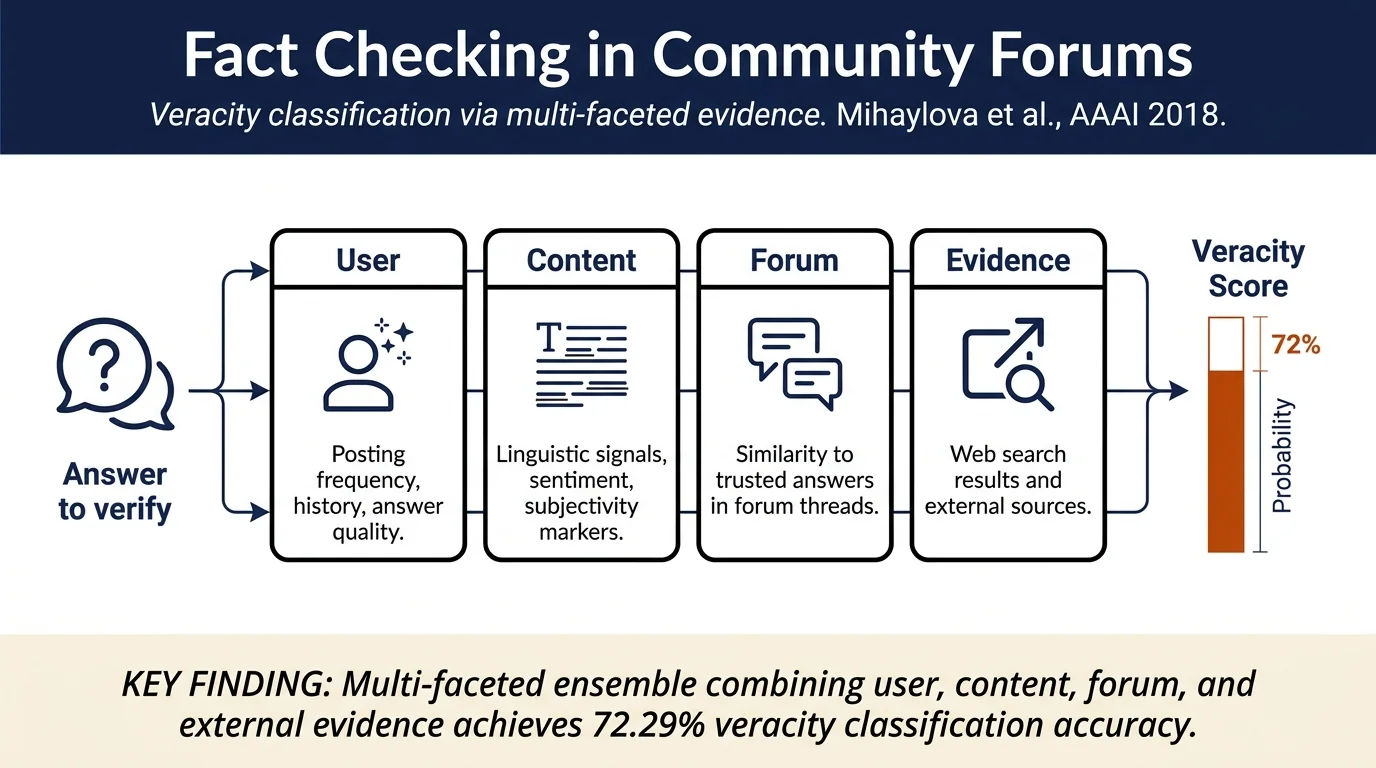
- Multi-faceted modeling: A unified approach integrating four complementary information sources: (i) user profile features (19–396 features capturing user history and activity patterns); (ii) answer content features (31+ features modeling linguistic bias, subjectivity, sentiment); (iii) intra-forum evidence (63 features from thread and forum-wide similarity); (iv) external web evidence (180 features from web search results).
- Linguistic feature analysis: Demonstrates importance of linguistic markers (factives, assertives, implicatives, hedges, modals) in signaling veracity, with strong subjectivity cues, implicatives, and modals ranking as top predictors.
- Empirical results: Ensemble system achieves 72.29% accuracy and MAP of 86.54, 21 points absolute above baseline (51.41% majority class).
Method
The paper frames veracity checking as a supervised binary classification task on community question-answer pairs. The system extracts four types of features:
User profile features (19–396 features): User activity (posting frequency, posting times, number of distinct categories), user posts quality (predictions from a GOOD/BAD answer classifier trained on historical cQA data, aggregating to 13 features), and user posts categories (397 features counting answers per Qatar Living category).
Answer content features (31+ features): Linguistic markers quantifying bias, subjectivity, and sentiment (factives, assertives, implicatives, hedges, negations, modals, strong/weak subjective cues, positive/negative sentiment); credibility features (URLs, images, emails, punctuation, word counts); and word embeddings (300-dim Google News embeddings, 100-dim Qatar Living embeddings computed by averaging word vectors).
Intra-forum evidence (3–60 features): Similarity of the answer to other GOOD answers in its thread (cosine with Google and Qatar Living embeddings, reciprocal rank); forum-level similarity searching all Qatar Living threads; and similarity to high-quality forum posts (38 trusted users who authored 5,230 high-quality posts), using query generation, vector similarity, and textual entailment re-ranking.
External evidence (180 features): Web search results from Bing queried with TF-IDF–weighted noun/verb/adjective terms. Features include cosine similarity (TF-IDF, Qatar Living embeddings, containment) computed between question/answer/question-answer pairs and search snippets/webpages, then aggregated over up to ten results. Features are replicated three times depending on source type (reputed sources, forum-type sites, other).
For high-quality posts, a three-step approach generates a query (Step 1), retrieves supporting evidence via vector similarity (Step 2), and re-ranks using textual entailment (Step 3). An SVM classifier trained on these features uses leave-one-thread-out cross-validation to respect thread structure.
Results
Feature-group ablations show:
- Intra-forum evidence from all Qatar Living performs best (65.46% accuracy, 83.97 MAP).
- External web evidence ranks second (63.45% accuracy, 71.65 F1).
- Linguistic features rank third (60.64% accuracy, 63.97 F1), confirming the importance of linguistic signals.
- Domain-specific embeddings (Qatar Living) substantially outperform general embeddings (Google News): 59.44% vs. 52.61% accuracy.
- User profile features alone perform poorly (accuracy ≤42.57%), suggesting that user trustworthiness does not directly correlate with factual accuracy in this forum.
Ensemble systems combining all features achieve:
- Optimizing for accuracy: 72.29% accuracy, 74.54 F1, 74.32 MAP (19 points improvement over majority baseline).
- Optimizing for MAP: 69.88% accuracy, 70.59 F1, 86.54 MAP (23 points improvement over chronological baseline of 63.75).
Ablation on high-quality posts reveals that query generation (Step 1) contributes 12 accuracy points and textual entailment re-ranking (Step 3) contributes 11 points, demonstrating the importance of both components. Linguistic feature analysis confirms that strong subjectivity cues, implicatives, modals, negatives, and assertives are the top-5 predictors of veracity.
Notes
Strengths:
- Novel problem formulation and high-quality dataset with rigorous human annotation (four independent annotators + consensus discussion), not crowdsourced.
- Rich multi-faceted representation captures complementary evidence sources; demonstrates that integrating forum context and external evidence substantially improves performance over content-alone approaches.
- Thorough ablation studies isolate contributions of each feature group and pipeline component (query generation, re-ranking).
- Practical applicability: veracity scores could be integrated into forum UX to warn users about unreliable answers.
Weaknesses:
- Small dataset: 249 examples (71 unique questions) limits training capacity and generalization. Authors acknowledge plans to extend with distant supervision and deep learning.
- User features underperform: Modeling users by their historical posts (quality, categories, activity) does not capture factuality; authors suggest improving this requires running the veracity classifier over all past user answers, which creates circular dependency.
- Limited scope: Evaluation on Qatar Living forum only; generalization to other cQA platforms (StackOverflow, Quora) unclear.
- Domain-dependent embeddings: Qatar Living embeddings outperform general Google News embeddings by 6.83 points, suggesting domain adaptation is critical but requires domain-specific corpora.
Open questions:
- How does the approach generalize to other cQA platforms with different moderation practices and user bases?
- Could distant supervision from known high-quality posts scale the dataset without manual annotation?
- How should user modeling be improved—by predicting veracity of their historical answers, or by modeling expertise per topic?
- What is the coverage of veracity evidence in cQA forums vs. news fact-checking?
Citation note: This dataset and source code are publicly available at https://github.com/qcri/QLFactChecking, enabling reproducibility and follow-up work.