Explore everything
Filter by research area, year and venue. Every filter is in the address bar, so you can share a view as a link.
 Psychology & interventionsDetection methods
Why People Believe Misinformation — and What We Can Do About ItJon Roozenbeek synthesizes eight years of misinformation research, examining why people believe false information and what interventions actually work. Grounding the analysis in the historical tobacco disinformation playbook, he argues that misinformation susceptibility stems not primarily from poor reasoning, but from media consumption…
 Psychology & interventionsFact-checking & verification
Psychological Inoculation Against MisinformationSander van der Linden surveys the psychology of misinformation susceptibility and defends the approach of psychological inoculation (pre-bunking) over fact-checking (debunking). He introduces the MIST (Misinformation Susceptibility Test), a psychometrically validated instrument for measuring individual variation in susceptibility to…
 Deepfakes & multimodalLLMs & generative AI
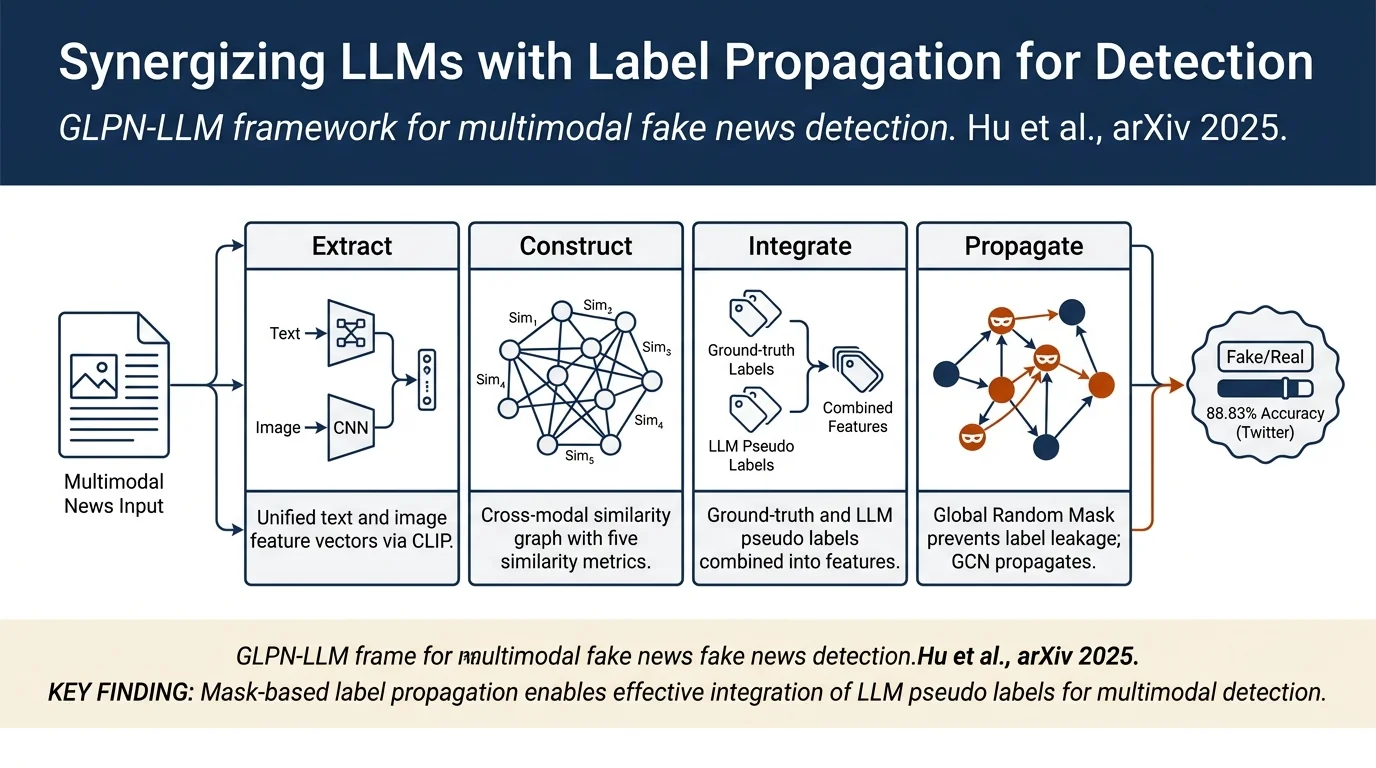
Synergizing LLMs with Global Label Propagation for Multimodal Fake News DetectionThis paper proposes Global Label Propagation Network with LLM-based Pseudo Labeling (GLPN-LLM), a framework for multimodal fake news detection that integrates LLM-generated pseudo labels with label propagation via graph neural networks. A mask-based global label propagation mechanism prevents label leakage during training while enabling…
 Detection methodsDatasets & evaluation
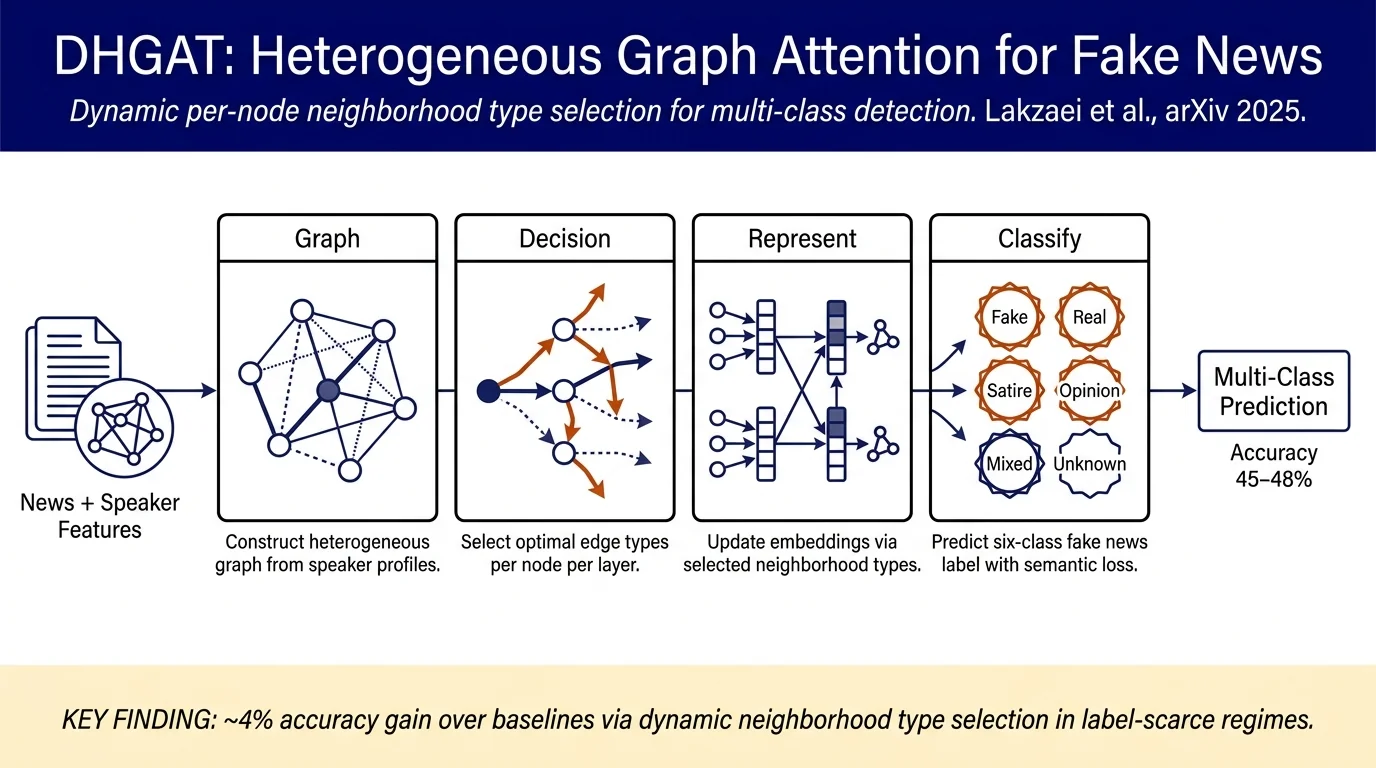
A Decision-Based Heterogeneous Graph Attention Network for Multi-Class Fake News DetectionProposes DHGAT (Decision-based Heterogeneous Graph Attention Network), a semi-supervised method for six-class fake news classification on the LIAR dataset. Unlike standard GNNs that apply uniform neighborhood aggregation, DHGAT models news as heterogeneous graphs with multiple edge types derived from speaker profiles and enables each…
 Detection methodsDatasets & evaluation
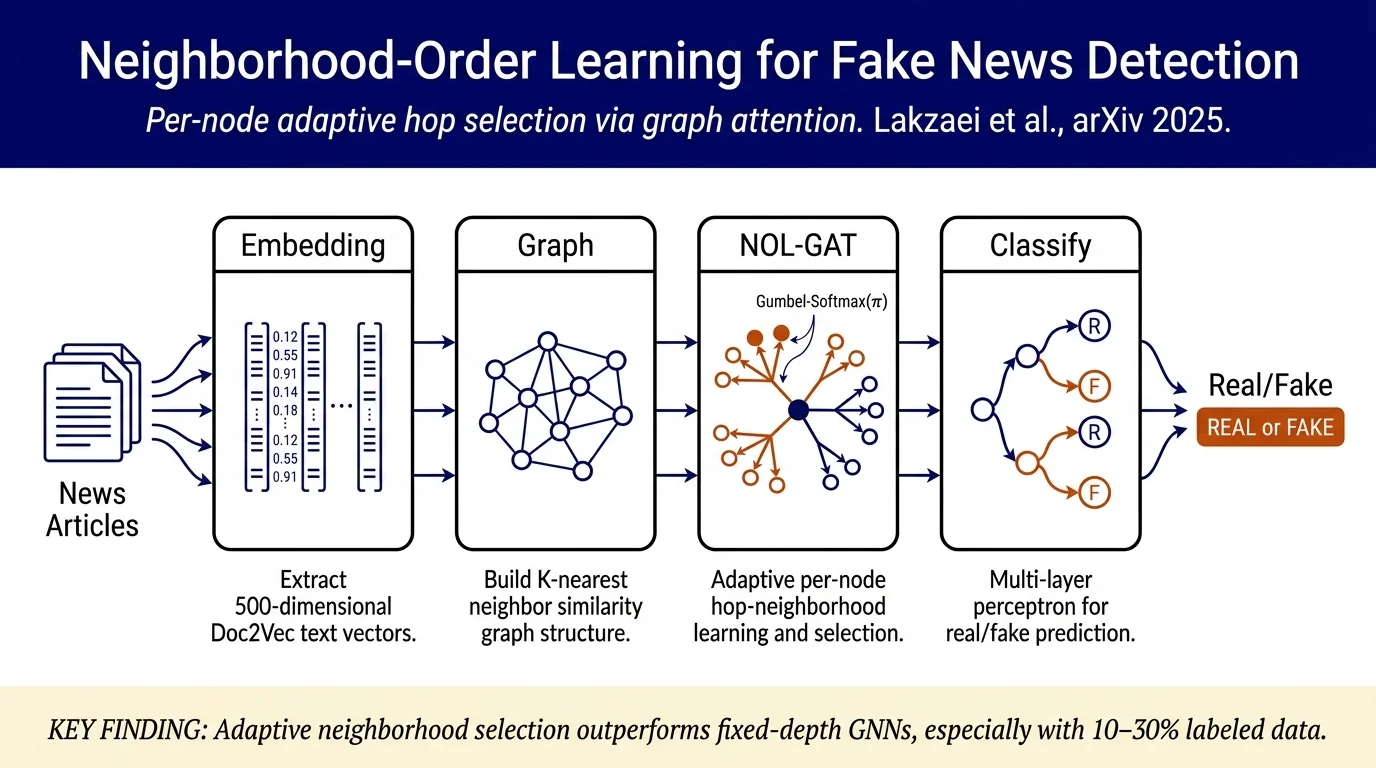
Neighborhood-Order Learning Graph Attention Network for Fake News DetectionProposes NOL-GAT (Neighborhood-Order Learning Graph Attention Network), a GNN architecture that allows each node to adaptively select its optimal hop-neighborhood at each layer, bypassing the fixed L-hop limitation of conventional message-passing GNNs. Evaluated on five fake news datasets, NOL-GAT outperforms baseline GNN methods,…
 LLMs & generative AIDetection methods
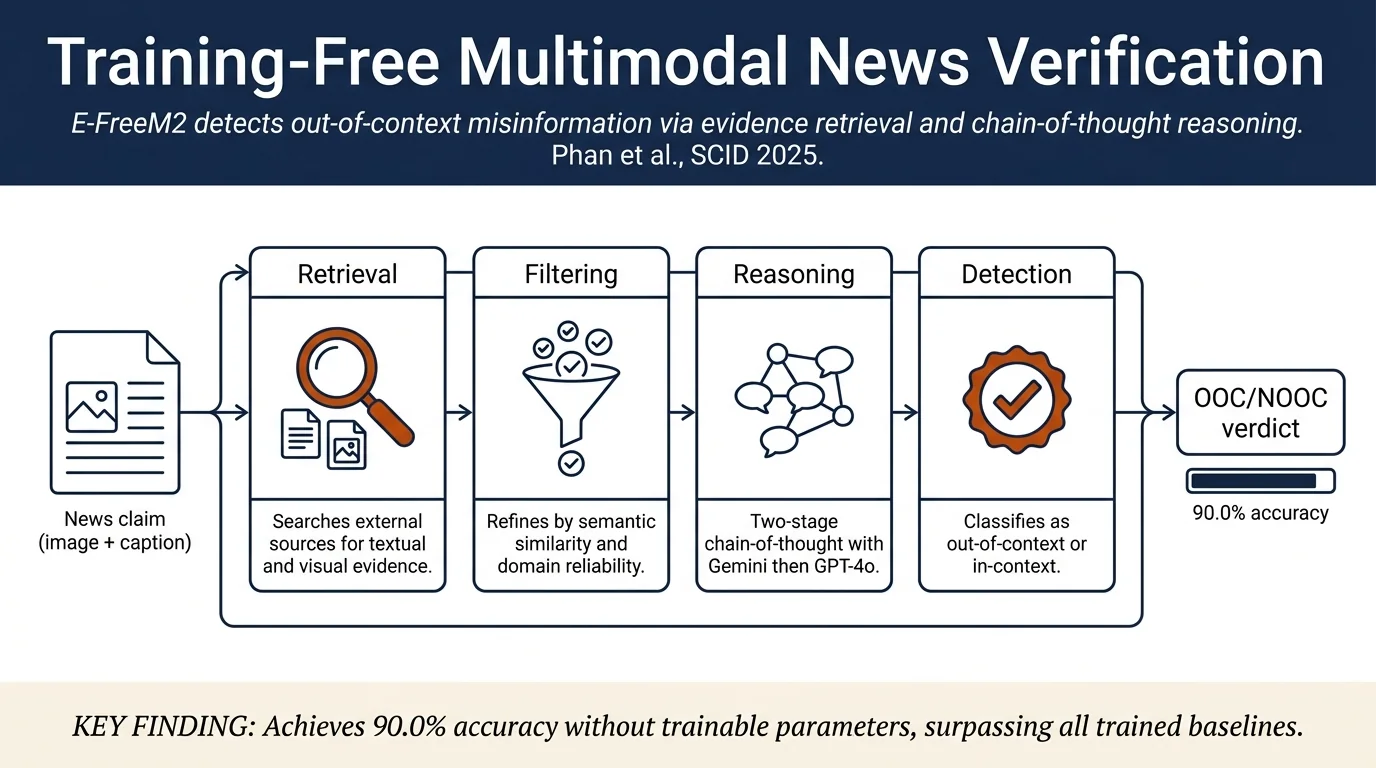
E-FreeM2: Efficient Training-Free Multi-Scale and Cross-Modal News Verification via MLLMsE-FreeM2 is a training-free, retrieval-based multimodal system for out-of-context (OOC) misinformation detection that leverages pretrained vision-language models (MLLMs) and two-stage chain-of-thought reasoning. By dynamically retrieving cross-modal evidence and ranking via visual similarity, the method achieves 90.0% overall accuracy on…
 Deepfakes & multimodalDatasets & evaluation
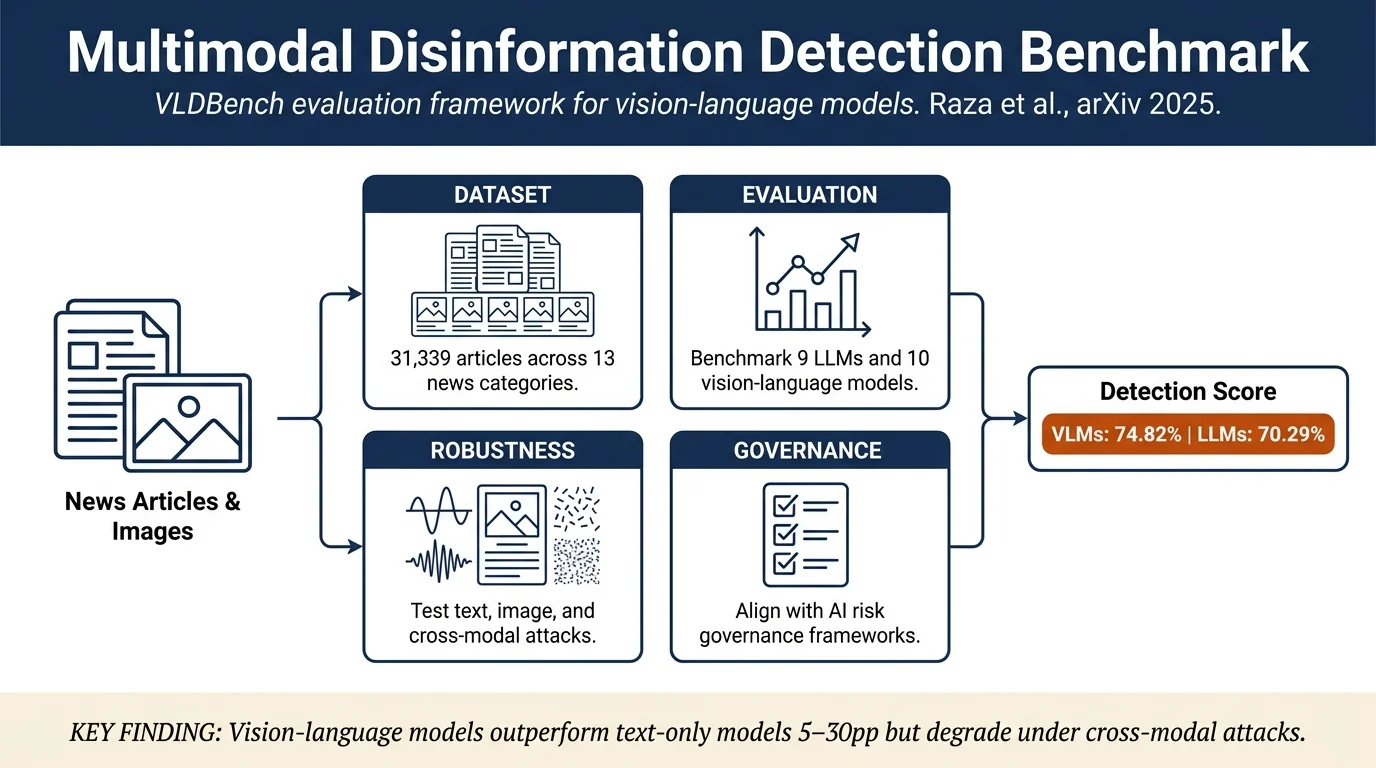
VLDBench: Evaluating Multimodal Disinformation with Regulatory AlignmentVLDBench is the first large-scale human-verified benchmark for multimodal disinformation detection, comprising 31,339 news articles paired with images across 13 topical categories. Evaluation of 9 LLMs and 10 VLMs shows vision-language models substantially outperform text-only baselines (e.g., LLaMA-3.2-11B-Vision: 74.82% accuracy), but…
 Datasets & evaluationDetection methods
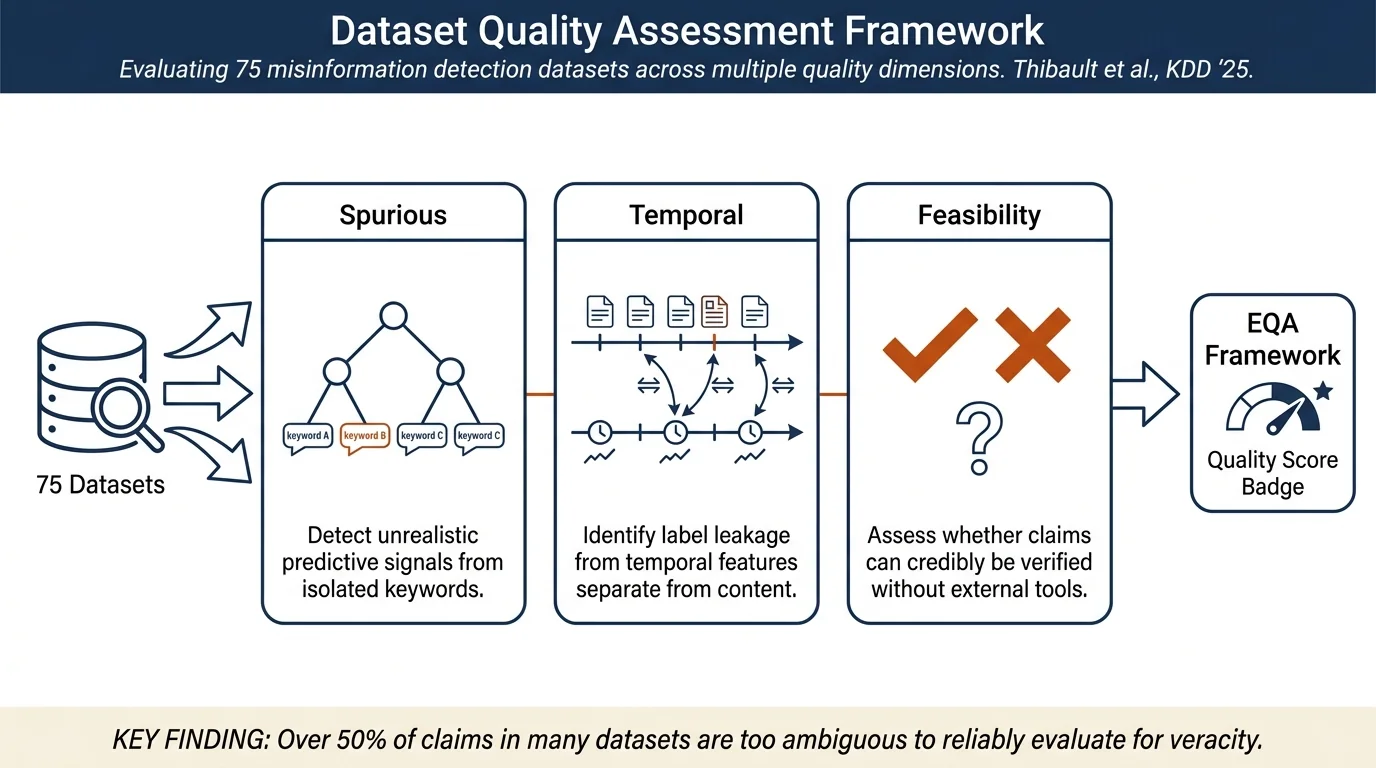
A Guide to Misinformation Detection Data and EvaluationThis work surveys the largest collection of misinformation detection datasets to date (75 datasets from prior literature) and evaluates dataset quality across multiple dimensions. The authors assess whether datasets enable reliable veracity evaluation by analyzing keyword correlations, temporal correlations, and feasibility of claim…
 Detection methodsLLMs & generative AI
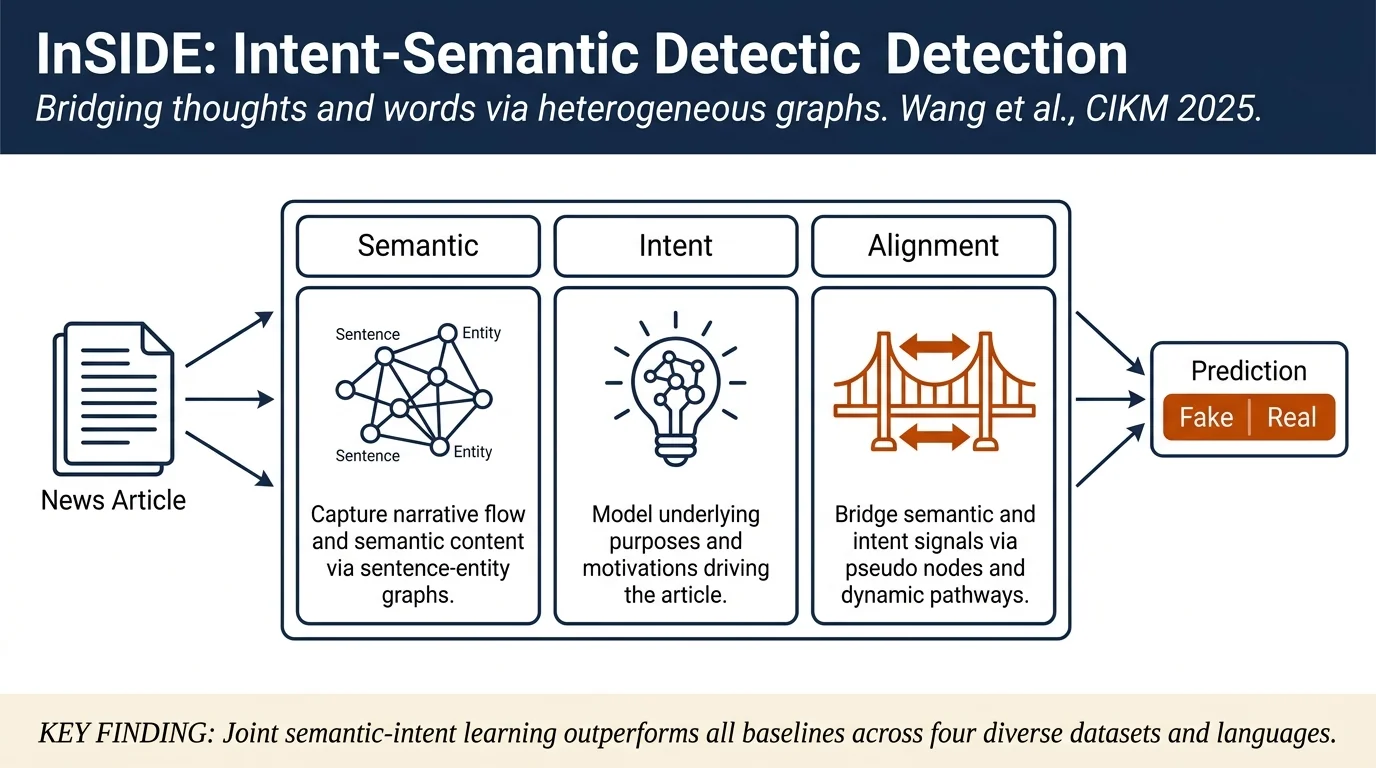
Bridging Thoughts and Words: Graph-Based Intent-Semantic Joint Learning for Fake News DetectionExisting fake news detectors rely on surface-level semantic patterns (emotional language, stylistic cues) and fail when writing styles shift. This paper proposes InSIDE, which combines semantic and intent signals via heterogeneous graphs: intent models the purpose behind an article (e.g., promoting a product), while semantics capture…
 Deepfakes & multimodalLLMs & generative AI
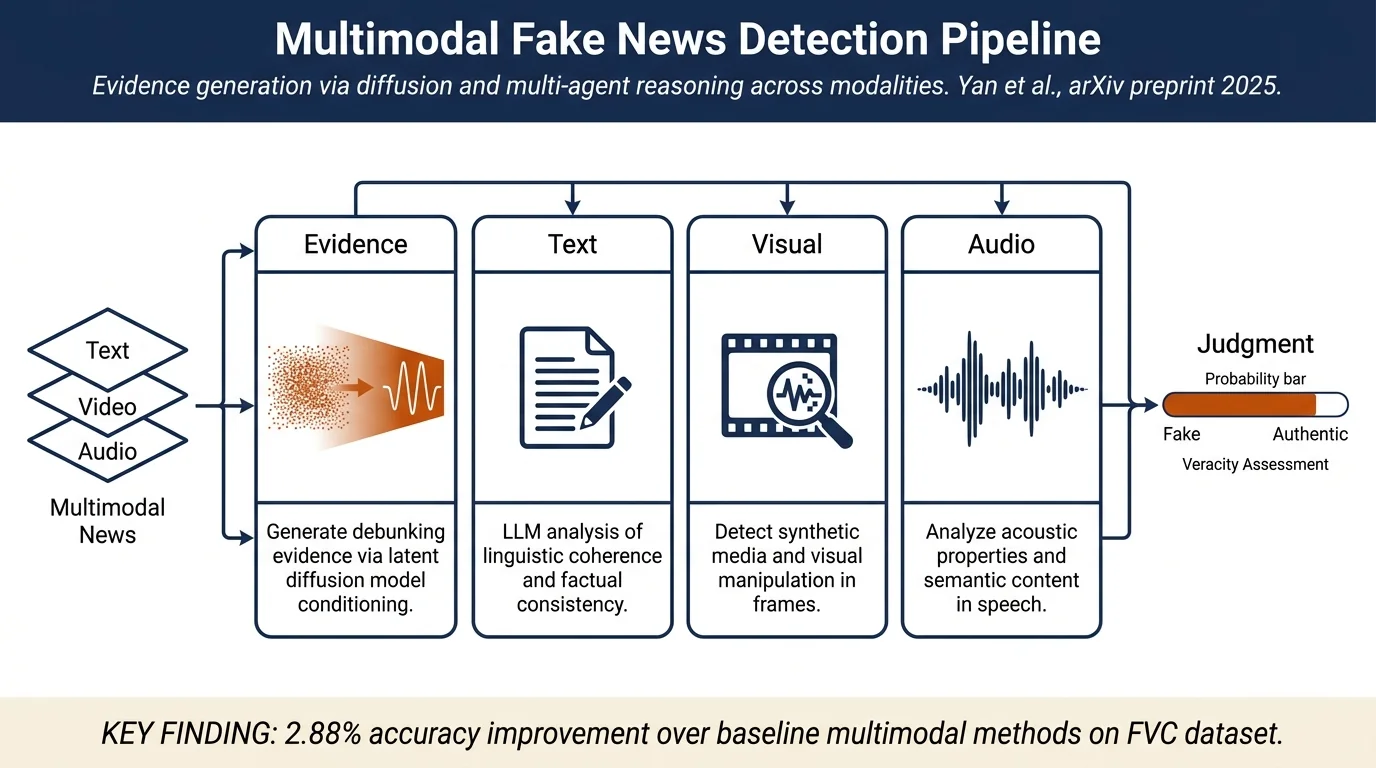
Debunk and Infer: Multimodal Fake News Detection via Diffusion-Generated Evidence and LLM ReasoningThis paper introduces DIFND, a framework for multimodal fake news detection that generates refuting/authenticating evidence via diffusion models and performs reasoning over multimodal content using large language models (LLMs). The approach uses a chain-of-debunk strategy where multiple MLLMs act as collaborative agents to assess news…
 LLMs & generative AIDetection methods
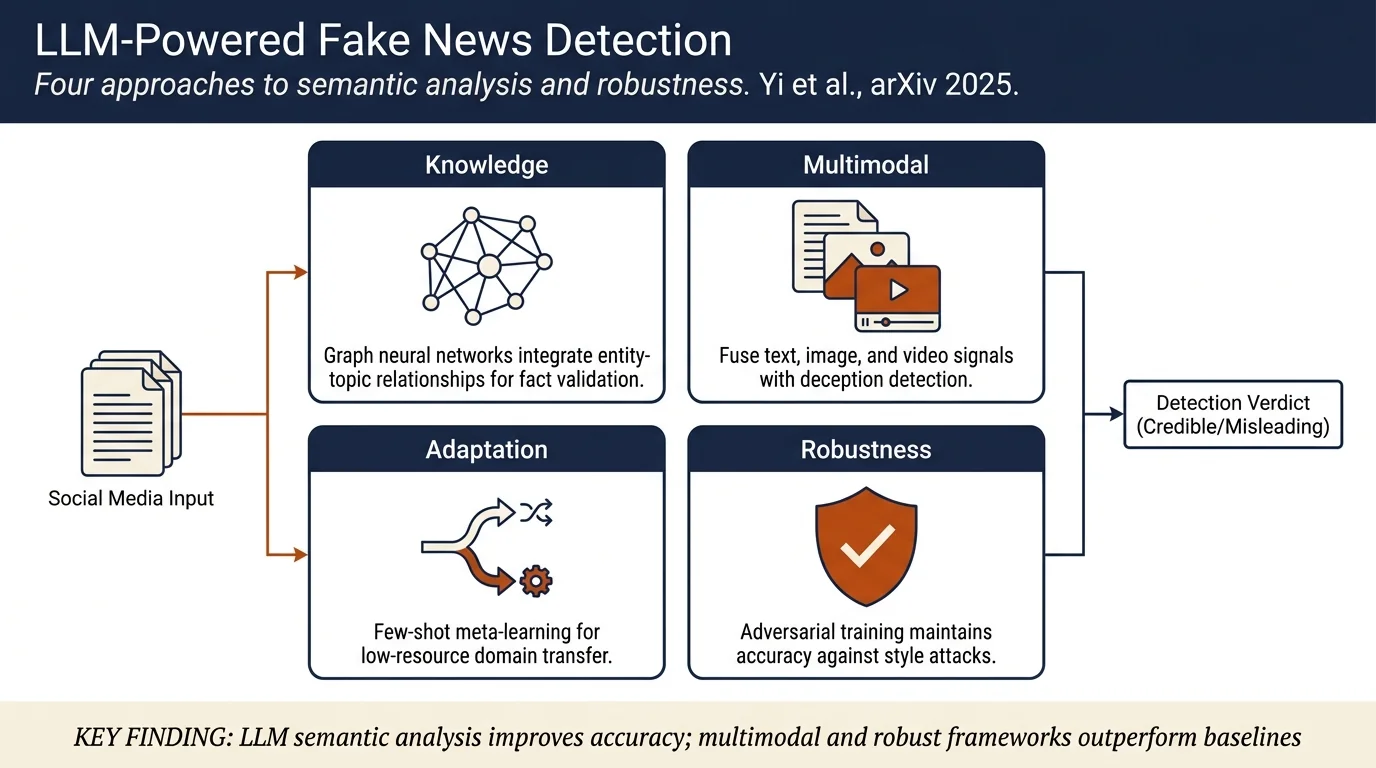
Challenges and Innovations in LLM-Powered Fake News Detection: A Synthesis of Approaches and Future DirectionsThis survey synthesizes recent advances in applying large language models to fake news detection on social media. The review covers four major LLM-based frameworks (MiLk-FD, FND-LLM, DAFND, SheepDog), identifies critical challenges around multimodal integration, adversarial robustness, scalability, and interpretability, and proposes…
 LLMs & generative AIDetection methods
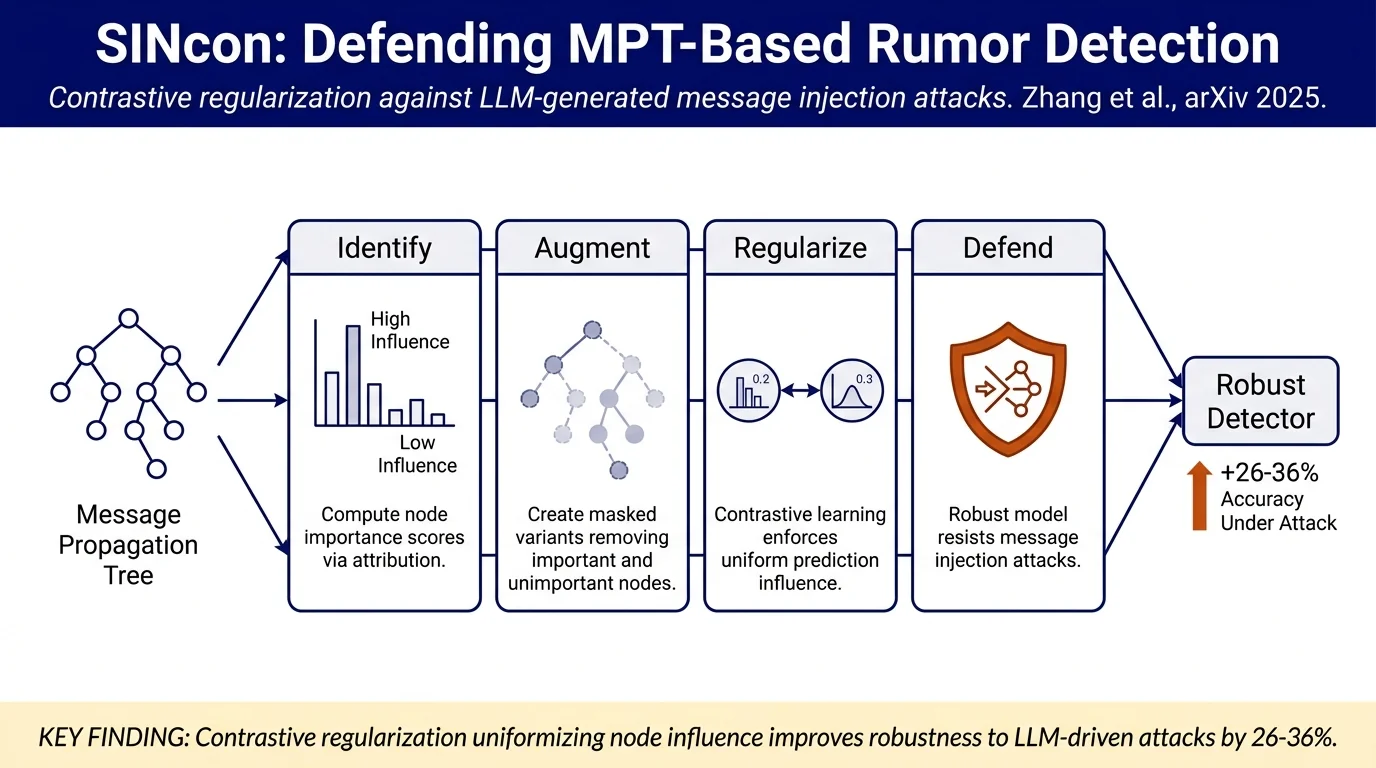
SINcon: Mitigate LLM-Generated Malicious Message Injection Attack for Rumor DetectionMessage Propagation Tree (MPT) based rumor detection models are vulnerable to LLM-generated malicious message injection attacks that alter tree topology and semantics. The paper proposes SINcon, a contrastive learning defense that regularizes models to assign similar predictive influence to nodes of different importance levels,…
 Detection methodsLLMs & generative AI
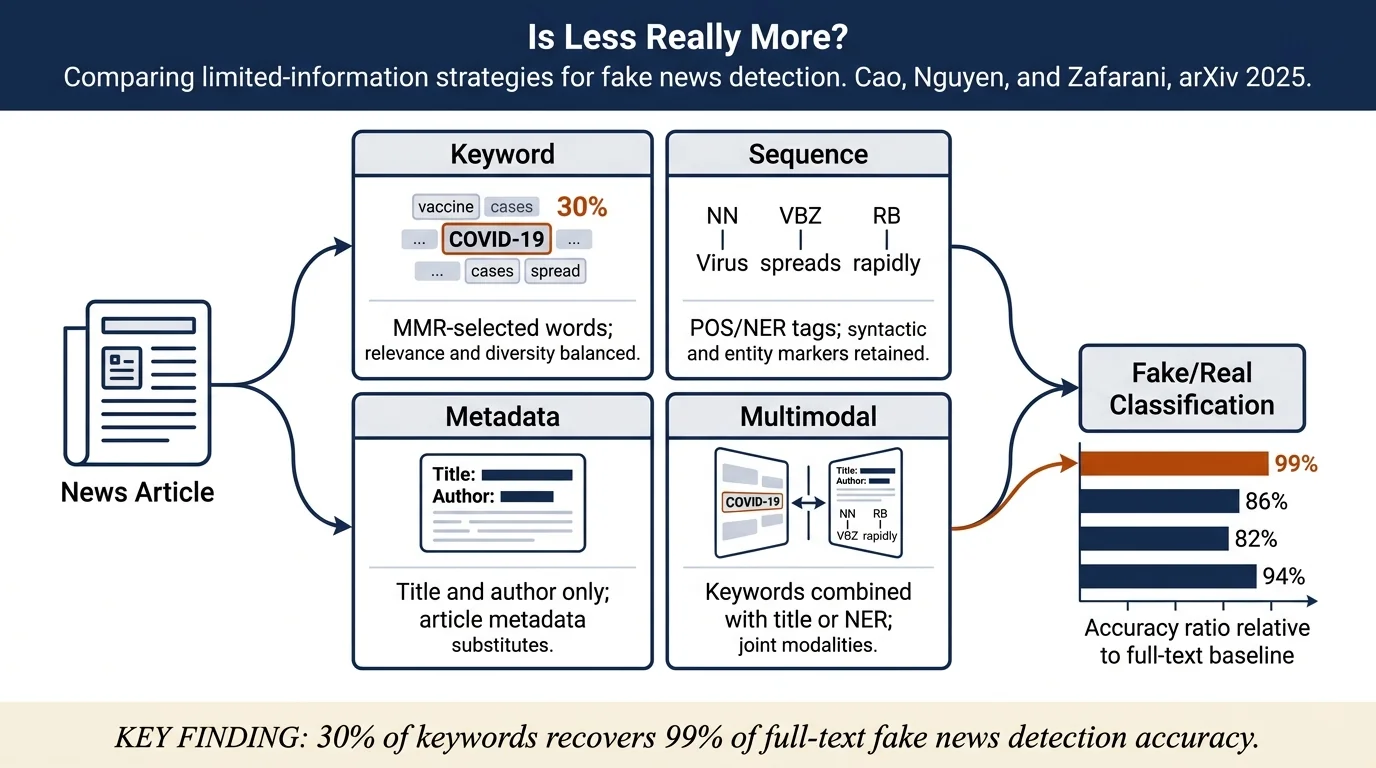
Is Less Really More? Fake News Detection with Limited InformationSLIM (Systematically-selected Limited Information) replaces full news article text with strategically chosen subsets — extracted keywords, POS/NER sequence tags, or textual metadata — to address the computational cost and data-sparsity limitations of full-text fake news detection. Information-theoretic measures (normalized Shannon…
Detection methodsLLMs & generative AI
Propasafe: A BERT-based offline tool for propaganda detectionOriginal privacy-focused, offline browser extension using fine-tuned BERT on the Propaganda Techniques Corpus for sentence-level propaganda classification. No online inference required; binary classification (propaganda or non-propaganda).