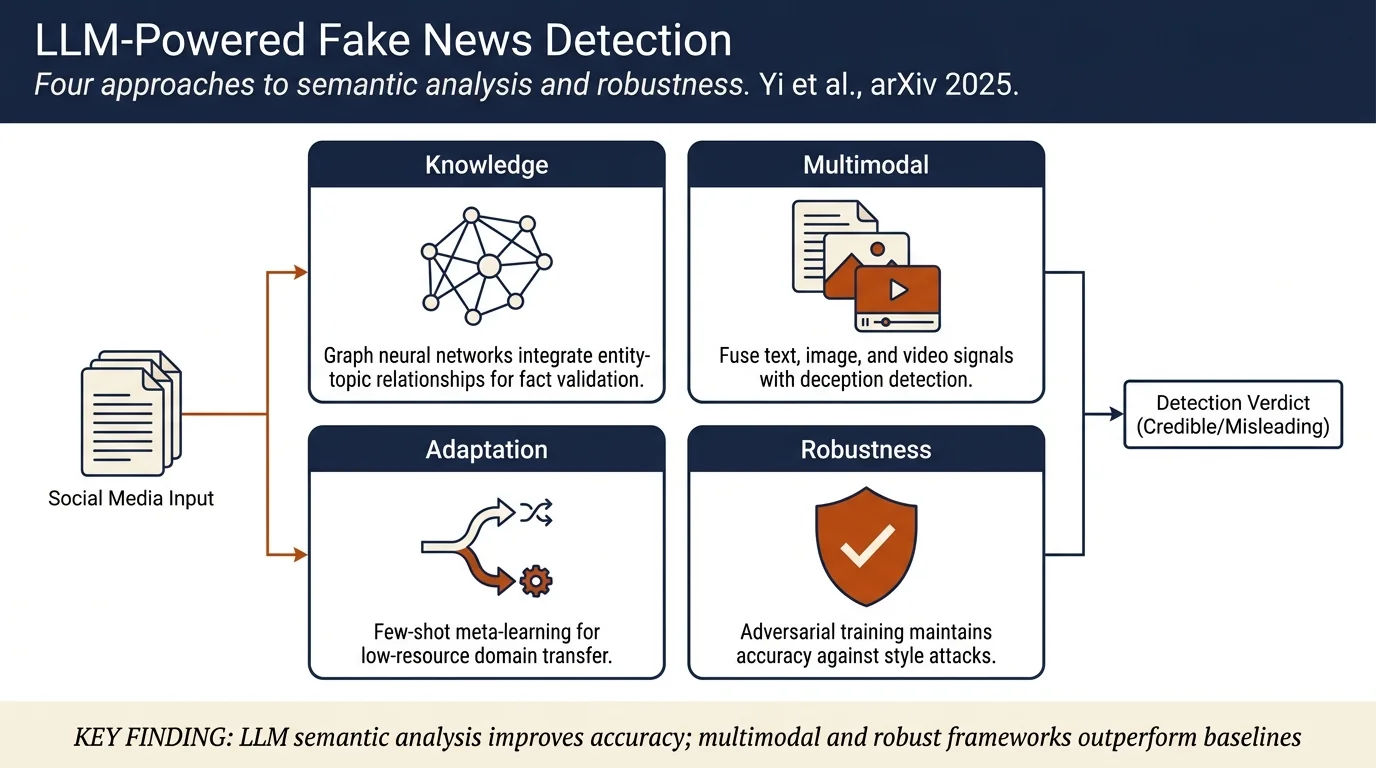
Challenges and Innovations in LLM-Powered Fake News Detection
Authors: Jingyuan Yi, Zeqiu Xu, Tianyi Huang, Peiyang Yu
Affiliation: Carnegie Mellon University, Information Networking Institute; University of California, Berkeley
ArXiv: 2502.00339
TL;DR
This survey synthesizes recent advances in applying large language models to fake news detection on social media. The review covers four major LLM-based frameworks (MiLk-FD, FND-LLM, DAFND, SheepDog), identifies critical challenges around multimodal integration, adversarial robustness, scalability, and interpretability, and proposes future directions including style-agnostic detection, cross-lingual capabilities, and ethical safeguards.
Contributions
- Taxonomy of LLM-based approaches: Systematizes detection methods from feature-based models through transformer architectures to modern LLM-enhanced frameworks integrating graph neural networks and multimodal reasoning.
- Four exemplar frameworks: Details MiLk-FD (knowledge graph integration), FND-LLM (multimodal with deception detection), DAFND (few-shot domain adaptation), and SheepDog (adversarial robustness against stylistic attacks).
- Comprehensive challenge assessment: Identifies over-reliance on textual features, vulnerability to adversarial attacks, data scarcity for low-resource languages, scalability bottlenecks, and lack of interpretability in black-box detectors.
- Future research directions: Proposes style-agnostic models, cross-lingual and cross-platform generalization, real-time processing at scale, and robust policies to prevent LLM misuse in generating misinformation.
Method
The paper is a literature review and synthesis organized chronologically through the evolution of detection approaches:
-
Early approaches (2010s): Hand-crafted linguistic features with classical ML (LR, SVM, decision trees).
-
Neural networks era: Introduction of LSTMs and CNNs leveraging pre-trained embeddings (Word2Vec, GloVe), then transformer models (BERT, RoBERTa) capturing semantic relationships.
-
Knowledge integration: Frameworks like MiLk-FD embed graph neural networks with LLMs to model entity-topic relationships and fact validation, leveraging structured knowledge bases.
-
Multimodal integration: FND-LLM processes text via LLMs, images via CNNs, and video via transformers, fusing cross-modal features with specialized deception detection.
-
Few-shot learning: DAFND applies meta-learning to transfer knowledge from high-resource domains to low-resource misinformation domains with minimal labeled data.
-
Adversarial robustness: SheepDog uses content-based veracity signals and adversarial training to remain robust against stylistic manipulations that fool traditional detectors.
The review emphasizes that detection relies on semantic understanding and contextual features, making LLMs natural candidates—but their limitations (ambiguous nuance handling, computational cost, vulnerability to adversarial prompts) require careful architectural design.
Results
Performance metrics on standard benchmarks for exemplar frameworks:
| Framework | Dataset | Accuracy | F1-Score | Precision |
|---|---|---|---|---|
| MiLk-FD | FakeNewsNet | 95.2% | 94.8% | 94.5% |
| FND-LLM | Politifact | 95.1% | 91.5% | 90.8% |
| DAFND | PAN2020 | 87.3% | 95.6% | 84.9% |
| SheepDog | COVID-19 | 88.9% | 88.5% | 87.6% |
Key findings: - LLM-enhanced semantic analysis significantly improves accuracy over textual features alone. - Multimodal integration (MiLk-FD, FND-LLM) outperforms unimodal baselines, especially on articles combining credible text with manipulated visuals. - Style-agnostic training (SheepDog) maintains high F1-scores even against adversarially rewritten content. - Few-shot learning (DAFND) achieves competitive performance on emerging misinformation domains despite minimal training data.
Challenges Identified
Limitations of current approaches
-
Over-reliance on textual features: Most models ignore visual and cross-modal cues critical for detecting deepfakes, manipulated imagery, and ambiguous metadata.
-
Vulnerability to adversarial attacks: Detectors fail against stylistic variations; SheepDog addresses this but broader robustness remains unsolved.
-
LLM-specific issues:
- Ambiguity in nuanced semantics (subtle context deviations)
- Hallucinations in fact verification
- High computational cost
-
Bias from training data
-
Data and resource constraints:
- Scarcity of labeled data for low-resource languages
-
Limited datasets for niche domains (pandemic-specific, localized propaganda)
-
Real-time scalability: Current models lack volume and velocity capabilities for live social media streams.
-
Interpretability gap: Black-box LLM decisions undermine adoption by policymakers and platform administrators.
-
Cross-platform generalization: Models trained on one platform (Twitter/X) fail to transfer to TikTok, Instagram, or localized platforms.
Ethical and safety issues
- LLMs can be weaponized to generate sophisticated misinformation.
- Unaccountable automated moderation erodes democratic discourse.
- Risk of bias against minority groups or non-English content.
Connections
- Semantic-based detection — textual feature extraction evolves toward LLM embeddings
- Multimodal detection — integrating image, video, and text signals
- Graph neural networks — structured knowledge representation for fact checking
- Adversarial robustness — defending against style-based evasion
- Few-shot learning — domain adaptation for emerging misinformation
- Fact-checking — knowledge-based verification complements semantic detection
- Zhou et al. (2020) SAFE — foundational multimodal architecture
- Wang et al. (2018) EANN — early event-aware neural networks
- Shu et al. FakeNewsNet — benchmark dataset widely used in LLM studies
- Zhou & Zafarani (2020) survey — comprehensive early taxonomy of detection methods
Notes
Strengths: - Timely synthesis of rapidly evolving LLM applications; bridges classic ML→neural networks→LLMs progression. - Identifies concrete, actionable challenges (scalability, interpretability, cross-platform transfer). - Concrete frameworks (MiLk-FD, FND-LLM, etc.) illustrate design trade-offs. - Ethical considerations (LLM misuse, bias, accountability) grounded in real-world deployment concerns.
Weaknesses: - Primarily focuses on English-language social media; limited coverage of non-English or closed platforms. - Benchmark performance numbers are scattered across papers; no unified evaluation on identical datasets. - Few-shot and domain-adaptation discussion remains abstract—DAFND is the only concrete example. - Does not deeply critique whether semantic understanding alone suffices or if social graph context is essential.
Open questions: - Can style-agnostic detection scale to millions of posts per minute while maintaining accuracy? - How do LLM-based detectors generalize across languages and cultural contexts? - What explainability techniques preserve both accuracy and human interpretability? - Is adversarial robustness fundamentally a cat-and-mouse game, or can principled defenses be designed?
Impact and relevance: This survey arrives at a critical inflection point. LLMs offer unprecedented semantic reasoning capabilities but introduce new vulnerabilities (prompt injection, hallucination, computational cost). The paper will be essential for researchers building detection systems and for policy researchers evaluating the role of AI in content moderation. The identified gaps (real-time scalability, cross-platform generalization, interpretability) define the research agenda for the next 2–3 years.