A Survey on LLM-Generated Text Detection: Necessity, Methods, and Future Directions
Authors: Junchao Wu, Shu Yang, Runzhe Zhan, Yulin Yuan, Derek Fai Wong, Lidia Sam Chao
Affiliation: NLP²CT Lab, Faculty of Science and Technology; Institute of Collaborative Innovation, University of Macau; Department of Chinese Language and Literature, Peking University (Yuan)
Venue: arXiv, 2023 — arxiv:2310.14724
*Co-corresponding authors: Yulin Yuan, Derek Fai Wong
TL;DR
As LLMs become ubiquitous, detecting machine-generated text is critical for mitigating risks of misinformation, academic dishonesty, and misuse. This survey comprehensively reviews detection strategies—watermarking techniques, statistical methods, neural-based detectors, and human-assisted approaches—along with datasets, evaluation metrics, and challenges including adversarial robustness and out-of-distribution generalization.
Contributions
- Systematic motivation for LLM-generated text detection from five perspectives: regulation, user trust, LLM development, scientific integrity, and human society
- Comprehensive taxonomy of detection methods: watermarking (rule-based and neural-based), statistics-based detectors (perplexity, linguistic features), neural-based detectors (fine-tuned language models), and human-assisted methods
- Review of training datasets (HC3, CHEAT, HC3 Plus, OpenLLMText, TweepFake, GPT2-Output, GROVER, ArguGPT, DeepfakeTextDetect) and evaluation benchmarks (TuringBench, etc.)
- Analysis of evaluation metrics: accuracy, precision, recall, F1-score, ROC-AUC
- Identification of critical challenges: out-of-distribution detection, adversarial attacks, real-world data issues, model size effects, and lack of comprehensive evaluation frameworks
- Future research directions: robust detector development, zero-shot detection enhancement, low-resource adaptation, detection beyond pure LLM text, and effective evaluation frameworks
Method
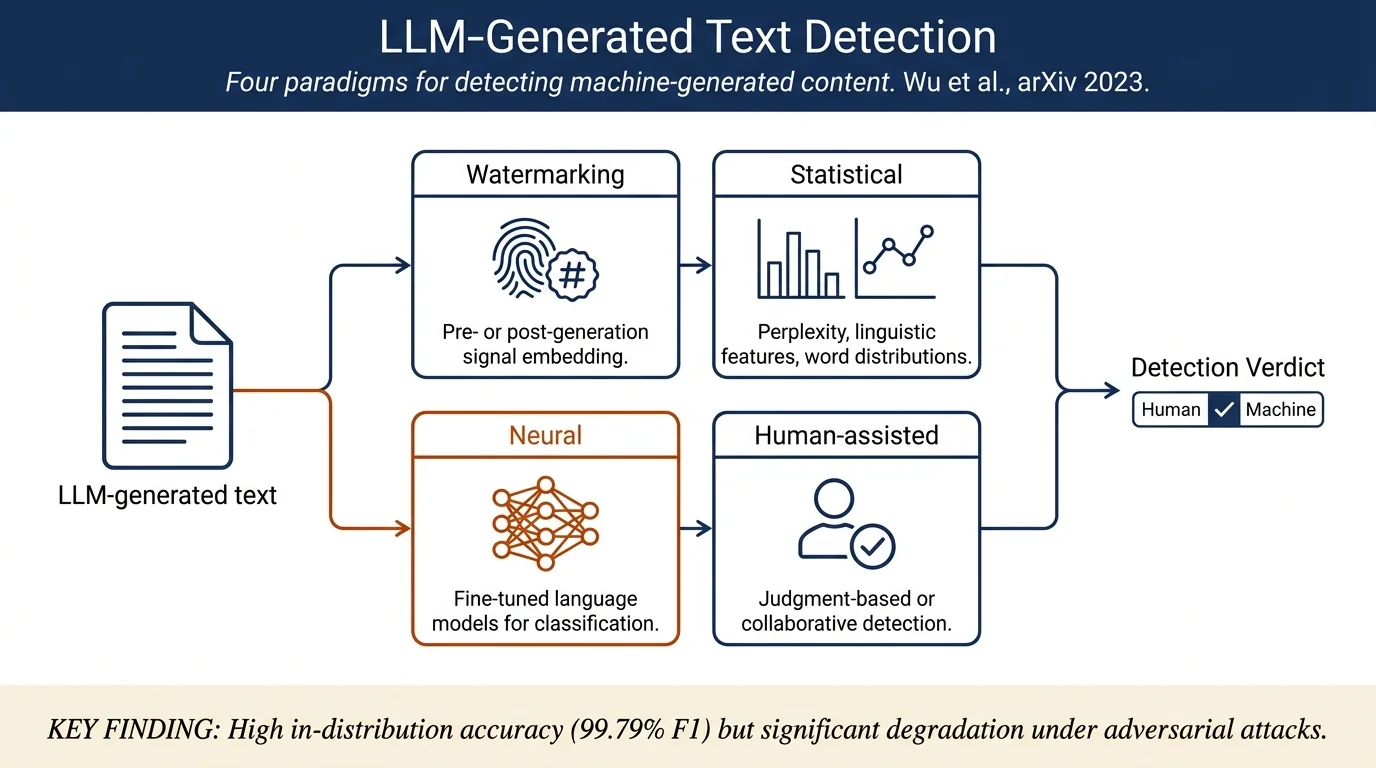
The survey organizes LLM-generated text detection around four detection paradigms:
Watermarking Techniques. Pre-generation watermarks embed signals during model training or deployment. Post-hoc watermarks apply after generation: rule-based methods modify syntactic/semantic structure; neural-based methods use encoder-decoder-discriminator architectures. Inference-time watermarking constrains token sampling by partitioning vocabulary into "green" and "red" lists using hash functions, embedding detectable traces.
Statistics-Based Detectors. These extract discriminative features from text without model access, relying on statistical disparities between human and LLM-generated text: perplexity scores, word-rank distributions (Zipfian coefficients), linguistic patterns (vocabulary diversity, part-of-speech tags, sentiment), and fact verification (hallucination detection). Traditional classifiers (SVM, random forests) or fine-tuned neural models classify based on these features.
Neural-Based Detectors. Fine-tuned pre-trained language models (RoBERTa, BERT, GPT-2) directly learn representations distinguishing human from machine text. Some approaches use zero-shot detection signals without fine-tuning.
Human-Assisted Methods. Leverage human judgment, either as annotation for model training or as collaborative classification alongside automatic detectors.
Results
Key benchmark results documented: - HC3 dataset: 99.79% F1 for paragraph-level ChatGPT detection; 98.43% at sentence level using RoBERTa - However, adversarial attacks (paraphrasing) significantly degrade performance: inference-time watermark detection drops from 97% to 80%; black-box detector true positive rate falls from 100% to 80% - Dataset coverage: 83 relevant publications identified through systematic literature review (majority published 2022–2023) - Trade-off between detector generalization and robustness as LLM capabilities improve and as open-source models become prevalent
Connections
- Extends Tang et al.'s earlier survey (2023) with more recent detection paradigms and deeper analysis of challenges
- Related to DetectGPT via zero-shot detection approaches
- Overlaps with work on LLM disinformation capabilities in addressing misuse concerns
- Shares dataset and benchmark discussion with Zhou et al. (2023) on linguistic style as detection signal
- Contextualizes detection needs within broader misinformation and synthetic content literature
Notes
Strengths: Exceptionally comprehensive, well-motivated, and structured review. The five-perspective framing (regulation, users, development, science, society) effectively justifies the detection task. Systematic coverage of diverse detection methods with clear exposition of trade-offs. Excellent discussion of practical challenges like out-of-distribution detection and the arms race between detectors and adaptive attacks.
Weaknesses: As a late-2023 arxiv paper, predates the most recent large-model releases and detector innovations. Limited empirical comparison across detectors on unified benchmarks; most evaluation inherited from cited papers. Confidence calibration and low-false-positive-rate requirements—critical for high-stakes applications—receive less treatment than warranted. The survey does not deeply address multilingual detection challenges despite mentioning them.
Follow-up questions: How effectively do detectors generalize across diverse LLM architectures and sizes? Can watermarking resist fine-tuning or distillation attacks? What evaluation frameworks best capture real-world detection difficulty? How should fairness and bias in detection systems be assessed across text domains and demographics?