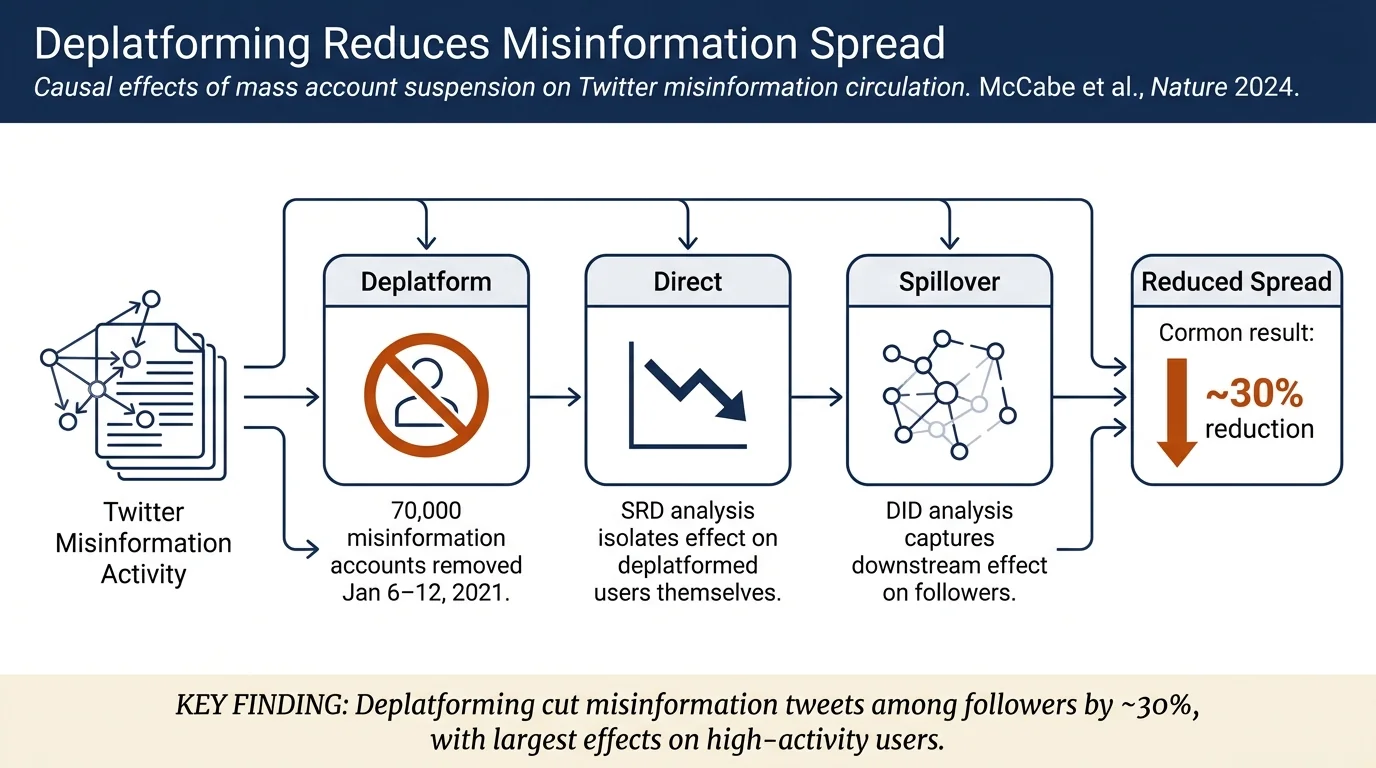
Deplatforming refers to the removal of user accounts from social media platforms and the suppression or reduction of their ability to distribute content. This is a form of platform enforcement used to address violations of terms of service, coordination of harmful activities, or systemic spread of misinformation and disinformation.
Deplatforming differs from other content moderation approaches (labeling, friction, algorithmic ranking) in its totality: rather than controlling what a user can say or how far their content spreads, deplatforming removes their ability to operate on the platform entirely. This creates both direct effects (the removed account cannot post) and spillover effects (users who followed the deplatformed account may have reduced access to misinformation).
Key questions and debates
Effectiveness: Does deplatforming actually reduce misinformation circulation, or do removed users simply migrate to alternative platforms?
Spillover vs. direct effects: How much of the benefit comes from removing a major source of misinformation (direct) versus reducing downstream sharing by followers of deplatformed accounts (spillover)?
Scale and targeting: When should platforms deploy broad deplatforming campaigns (mass removal of coordinated accounts) versus narrow enforcement against individual repeat violators?
Systemic consequences: How does deplatforming interact with user polarization, radicalization, and the migration of content to less-moderated platforms?
Equity and bias: Are deplatforming decisions applied fairly across different political perspectives, communities, and languages?
Key papers
- 2024-mccabe-post-january-sixth-deplatforming — Nature study of Twitter's deplatforming of 70,000 misinformation traffickers following January 6, 2021; uses quasi-experimental designs to isolate direct effects (deplatformed users sharing less misinformation) from spillover effects (followers of deplatformed users sharing less misinformation); provides quantitative evidence that targeted deplatforming reduced circulation and demonstrates platform capacity to control misinformation distribution.
Related topics
- content-moderation — broader platform governance approaches including labels, friction, algorithmic changes
- platform-accountability — governance and transparency in platform decision-making
- misinformation-spread — how false information propagates through networks
- political-polarization — echo chambers and partisan divides