A Survey on Computational Propaganda Detection
Authors: Giovanni Da San Martino, Stefano Cresci, Alberto Barron-Cedeño, Seunghak Yu, Roberto Di Pietro, Preslav Nakov
Venue: arXiv preprint, 2020 — arXiv:2007.08024
TL;DR
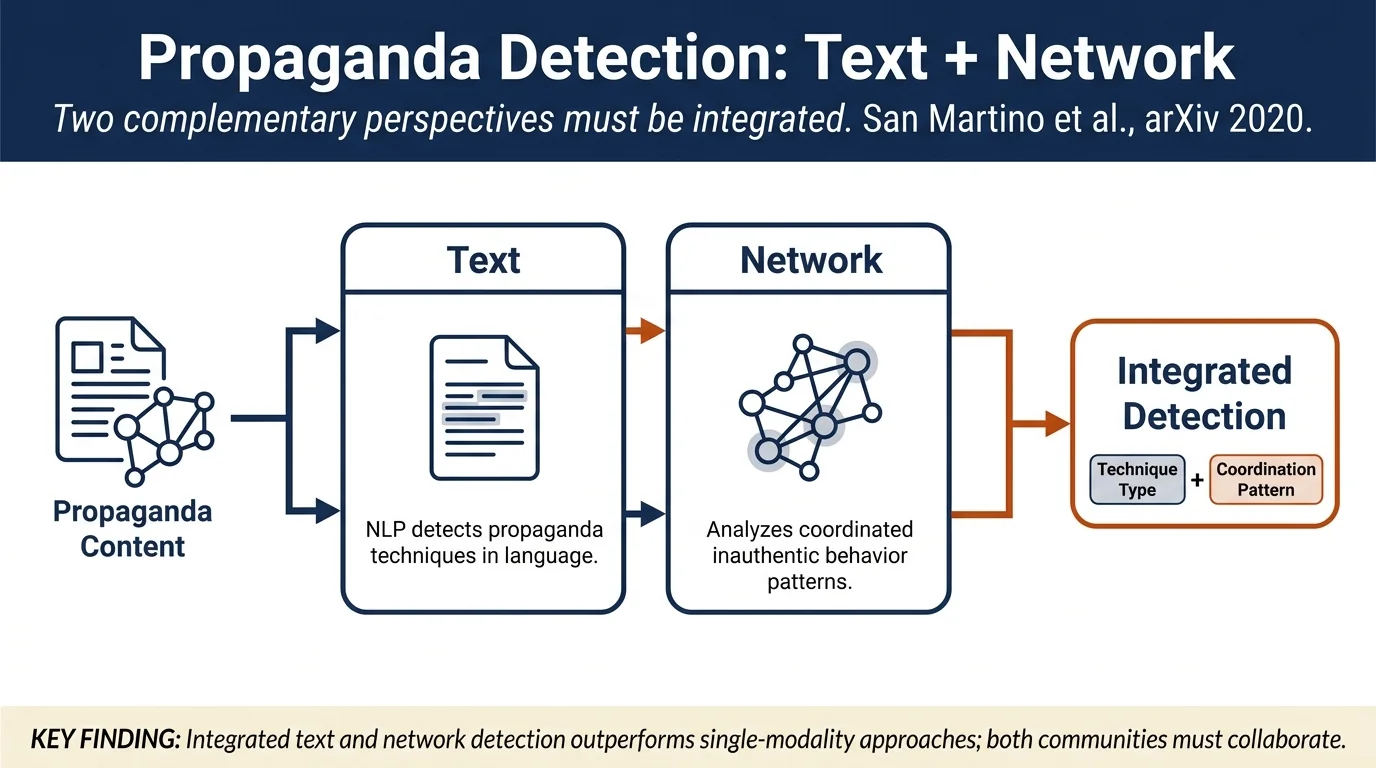
This survey comprehensively reviews computational propaganda detection from two complementary perspectives: text analysis (NLP) and network analysis. The authors argue that propaganda differs from misinformation/disinformation by focusing on persuasion techniques (emotional appeals, logical fallacies) rather than falsity. They identify a critical disconnect between NLP and network analysis communities, propose that fine-grained propaganda technique detection is more promising than document-level classification, and highlight challenges including multimodal propaganda, adversarial robustness, and explainability of detection systems.
Problem Definition
Computational propaganda is defined as "propaganda created or disseminated using computational (technical) means." Key distinctions:
- Propaganda vs. Disinformation: Propaganda aims to persuade and may use true or false claims; disinformation is specifically false and intends to harm. Propaganda uses rhetorical and psychological techniques (loaded language, appeal to authority, slogans, logical fallacies like straw man and whataboutism).
- Scale and impact: Differs from historical propaganda through social media's ability to micro-target users by geography, demographics, psychology, and political preferences; coordinated networks (botnets, cyborgs, troll armies) amplify reach.
Text Analysis Perspective (Section 3)
Available Datasets
Document-level annotation: - TSHP-17: 22,580 articles (5,330 propaganda), balanced across 4 classes (trusted, satire, hoax, propaganda) from 11 sources; uses distant supervision (media source labels). - QProp: 51,294 articles (5,737 propaganda), binary propaganda vs. trustworthy; uses distant supervision from Media Bias/Fact Check (MBFC); includes metadata (bias level, sentiment, publication date, location).
Fragment-level annotation: - PTC (Propaganda Techniques Corpus): 451 articles (7,385 propagandist snippets), manually annotated by professionals; 18 propaganda techniques (name calling, repetition, slogans, appeal to fear, doubt, exaggeration/minimization, flag-waving, loaded language, reduction ad Hitlerum, bandwagon, casual oversimplification, obfuscation, appeal to authority, black-and-white fallacy, thought-terminating clichés, red herring, straw man, whataboutism).
Text Classification Approaches
- Early work: word n-grams + logistic regression on TSHP-17; showed models overfit to news sources rather than propaganda.
- Improvement: Distant supervision with rich feature representations (writing style, readability, keywords) + SVM/logistic regression; shows robust features necessary but insufficient.
- Recommendation: Test data should come from news sources not in training set to avoid source modeling.
Fine-Grained Propaganda Technique Detection
More promising than document-level classification: techniques are well-defined in literature; PTC is manually annotated and has reasonable size (350K tokens, comparable to NER datasets); 2019 shared task (NLP4IF) showed BERT-based systems achieve best performance (0.63 F1 sentence-level, 0.25 F1 fragment-level).
Network Analysis Perspective (Section 4)
Early Approaches (Pre-2017)
Individual account classification: supervised machine learning analyzing each account in isolation, then clustering malicious accounts. Assumptions: malicious accounts have distinct features; supervised detection generalizes. Examples: Botometer (1,200+ features: profile, network structure, content, sentiment, temporal); other systems use only network, text, or profile features.
Limitations: - Ground truth is scarce and subjective; annotation biases present. - Malicious accounts evolve to evade detection. - Supervised detectors severely limited by training data availability and assumption of stationarity.
Modern Approaches (2017+)
Shift to group-based analysis targeting coordination as a key feature:
- Rationale: Malicious accounts act in coordination (botnets, troll armies); analyzing groups provides more data for AI; legitimate behavior is heterogeneous while inauthentic behavior is homogeneous.
- Methods:
- Network-based techniques: detect suspicious connectivity patterns (near-fully connected communities, dense blocks, spectral subspace patterns).
- Temporal approaches: detect anomalous patterns in tweeting/retweeting behavior using dynamic time warping or LSTM autoencoders for distance computation, then clustering.
- Inverse Reinforcement Learning (IRL): infer intent/rewards driving coordinated group behavior.
- Paradigm shift: From individual to group-based, from supervised to unsupervised/semi-supervised, from general algorithms to coordination-specific designs.
Key Lessons Learned (Section 5)
Text Analysis Lessons
- Distant supervision is problematic: Assumes all articles from a source are propaganda/non-propaganda, but propagandist sources periodically post objective content (boost credibility) and objective sources occasionally post content promoting agendas. Introduces noise.
- Fine-grained > document-level: Focus on detecting specific propaganda techniques rather than binary propaganda/non-propaganda labels.
Network Analysis Lessons
- Reactive approach disadvantage: New coordinated behavior detected → development of new detectors takes months → adversaries operate freely in the interim. Suggests proactive approaches needed.
- Non-stationary and non-neutral environments violate ML assumptions:
- Stationarity violated: Malicious accounts evolve (change characteristics and behavior).
- Neutrality violated: Adversaries actively try to fool detectors using AI techniques (GPT-2 for text, StyleGAN for images, deepfakes for videos).
- Solution: Adversarial machine learning to study vulnerabilities before adversaries exploit them. Recently applied to bot and fake news detection.
Disconnection Between Communities
NLP community focuses on text-based supervised approaches analyzing individual accounts; network analysis community uses group-based unsupervised/semi-supervised approaches. Few combined approaches exist. Combined efforts could lead to significant advances.
Challenges and Future Directions
Major Challenges
- Multimodal propaganda: Text not sole medium; images and videos convey stronger propaganda; little research on cross-modal propaganda detection.
- Explainability: Most recent propaganda detection uses deep learning, which lacks interpretability; crucial for transparency in account bans and content removal.
- Understanding campaign intent and strategy: Current work focuses on detection; understanding objectives and strategies of propaganda campaigns remains largely unsolved.
- Synthetic text generation: Language models (GPT-2) make automatic propaganda generation feasible; will be increasingly difficult to detect.
- Generalization across datasets: Most detectors evaluated on single dataset; capability to generalize in-the-wild unknown.
- Ethical considerations: Privacy protection when analyzing user-generated data; data sharing initiatives (e.g., Twitter information operations) need robust privacy-preserving mechanisms.
Forecasting
- Integration of text and network analysis: Future propaganda detection must move beyond single paradigm; if GPT-2 generates propaganda, linguistic features alone won't suffice; must also analyze network propagation patterns.
- Multimodal detection: Propaganda increasingly spreads via images/videos; research must span multiple modalities.
Connections
- Related to Findings of the NLP4IF-2019 Shared Task on Fine-Grained Propaganda Detection via shared focus on propaganda technique classification but different scope (survey vs. shared task).
- Shares network analysis perspectives with A Decade of Social Bot Detection.
- Cited and builds on propaganda definitions from Information Disorder: Toward an Interdisciplinary Framework for Research and and Lexicon of Lies: Terms for Problematic Information.
- Connects to 2022 Wang Detecting Propaganda for more recent propaganda detection work.
- Related to Misinformation Detection Methods, Bot detection, Coordinated inauthentic behavior as enabling techniques.
Notes
Strengths: - Comprehensive dual-perspective review bridging NLP and network analysis communities. - Clearly identifies disconnect between fields and proposes solutions. - Concrete evidence that fine-grained propaganda technique detection outperforms document-level classification. - Prescient warnings about synthetic propaganda via language models and adversarial robustness of detectors.
Gaps: - Limited empirical analysis comparing text-based vs. network-based approaches on same datasets. - Multimodal propaganda dismissed as out-of-scope but increasingly important. - Little discussion of propaganda in non-English languages or cross-cultural differences.
Follow-ups: - Integrated text+network detection systems (largely unexplored as of 2020). - Adversarial evaluation of propaganda detectors. - Multimodal propaganda detection benchmarks.