 Shaden Shaar
 Firoj Alam
 Giovanni Da San Martino
 Preslav Nakov
Contributions
- Two shared tasks addressing critical information integrity problems: COVID-19 infodemic detection and censorship prediction
- Multilingual COVID-19 misinformation datasets covering Arabic, Bulgarian, and English with 4,056, 3,707, and 1,338 tweets respectively
- Fine-grained annotation schema with seven questions: verifiable factual claims, false information, general public interest, harmfulness, need for fact-checking, harm to society, and policy-maker attention
- Sina Weibo censorship dataset covering censored and uncensored posts across ten sensitive topics
- Evaluation of transformer-based detection systems showing strong performance with BERT variants and multilingual models
Method
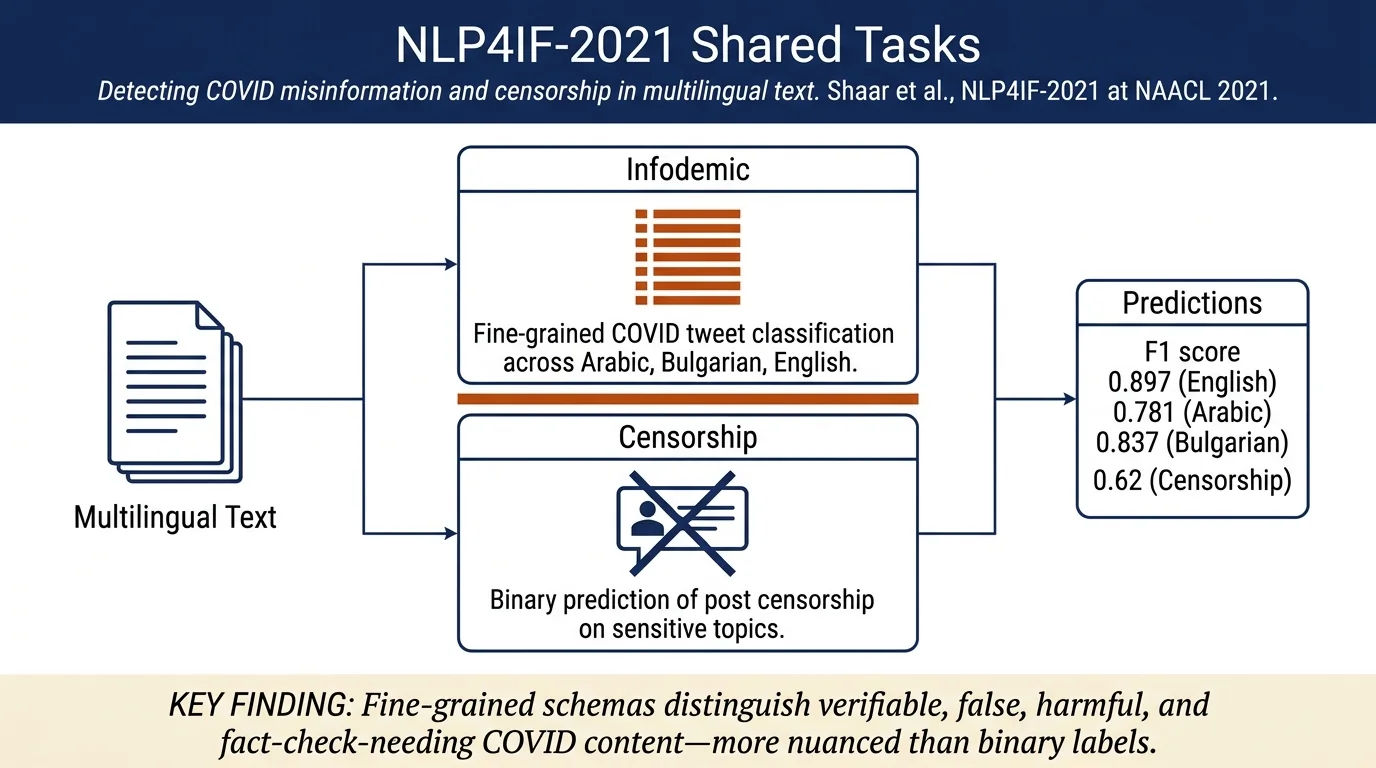
Task 1 (COVID-19 Infodemic): Participants predicted seven binary properties for input tweets: (1) whether a tweet contains a verifiable factual claim, (2) whether it contains false information (assessed without fact-checking), (3) whether it is of general public interest, (4) whether it is harmful to society, (5) whether it needs fact-checking by a professional, (6) whether it is harmful to society, and (7) whether it requires government attention. Tweets were annotated in Arabic, Bulgarian, and English using an annotation schema derived from prior work. Task evaluation used weighted F1 scores across the seven questions.
Task 2 (Censorship Detection): The task aimed to predict whether a Sina Weibo post will be censored based on its textual content. The dataset covered ten sensitive topics including cultural revolution, human rights, democracy, and censorship & propaganda. Censored and uncensored posts were collected over a four-month period (August 29 – December 29, 2018). Task evaluation used overall accuracy as the primary metric.
Results
Task 1 results (weighted F1 across seven questions):
- English: Team TOKOFOU achieved 0.897 F1 using an ensemble of BERT-based models fine-tuned on Twitter and COVID-themed data
- Arabic: Team R00 achieved 0.781 F1 using an ensemble of AraBERT, Asafaya-BERT, and ARBERT models
- Bulgarian: Team advex achieved 0.837 F1 using BERT variants with focused domain adaptation
Task 2 results (Sina Weibo censorship):
- Only one submission (NITK_NLP) achieved 0.62 F1 on censored content detection, outperforming the majority baseline (0.50 accuracy) but suggesting the task's challenge
Across all languages, participating systems substantially exceeded baselines, with most submissions using transformer-based architectures and multilingual models. Teams successfully adapted pre-trained models for in-domain COVID-19 detection and demonstrated that linguistic properties of censored content can be learned computationally.
Notes
This shared task successfully mobilized the community on two timely problems. Task 1's fine-grained annotation schema is more sophisticated than typical binary misinformation labels, capturing the nuance that content can be verifiable, false, harmful, or deserving of fact-checking in independent ways—a contribution beyond the specific datasets. Task 2's low submission rate (one team) suggests technical or scope challenges; the paper notes the difficulty of collecting Sina Weibo data due to API restrictions and the sensitivity of the topic. Both tasks were part of the broader Tanbih mega-project at QCRI aimed at combating "fake news," propaganda, and media bias.