Contributions
- First cross-national experimental evidence on fact-checking effectiveness outside North America, Europe, Australia.
- Demonstrates durability of correction effects over 2+ weeks in multiple countries.
- Tests 22 distinct fact-checks across 28 experiments (covering COVID-19, climate, local politics, crime, economics).
- Finds no evidence of backfire effects—no ideological group became more inaccurate after exposure to corrections.
- Shows effects are remarkably consistent across countries with stark differences in education, wealth, racial composition.
- Contributes to WEIRD generalizability debate in psychology: fact-checking effectiveness does not appear culturally contingent.
Method
Randomized experiments conducted simultaneously in September–October 2020 in partnership with local fact-checking organizations (Full Fact, Africa Check, Chequeado). In each country:
- 2,000 participants (n=1,000 in wave 2 for three countries: Argentina, South Africa, UK) recruited and weighted to match national demographics on age, gender, region, employment.
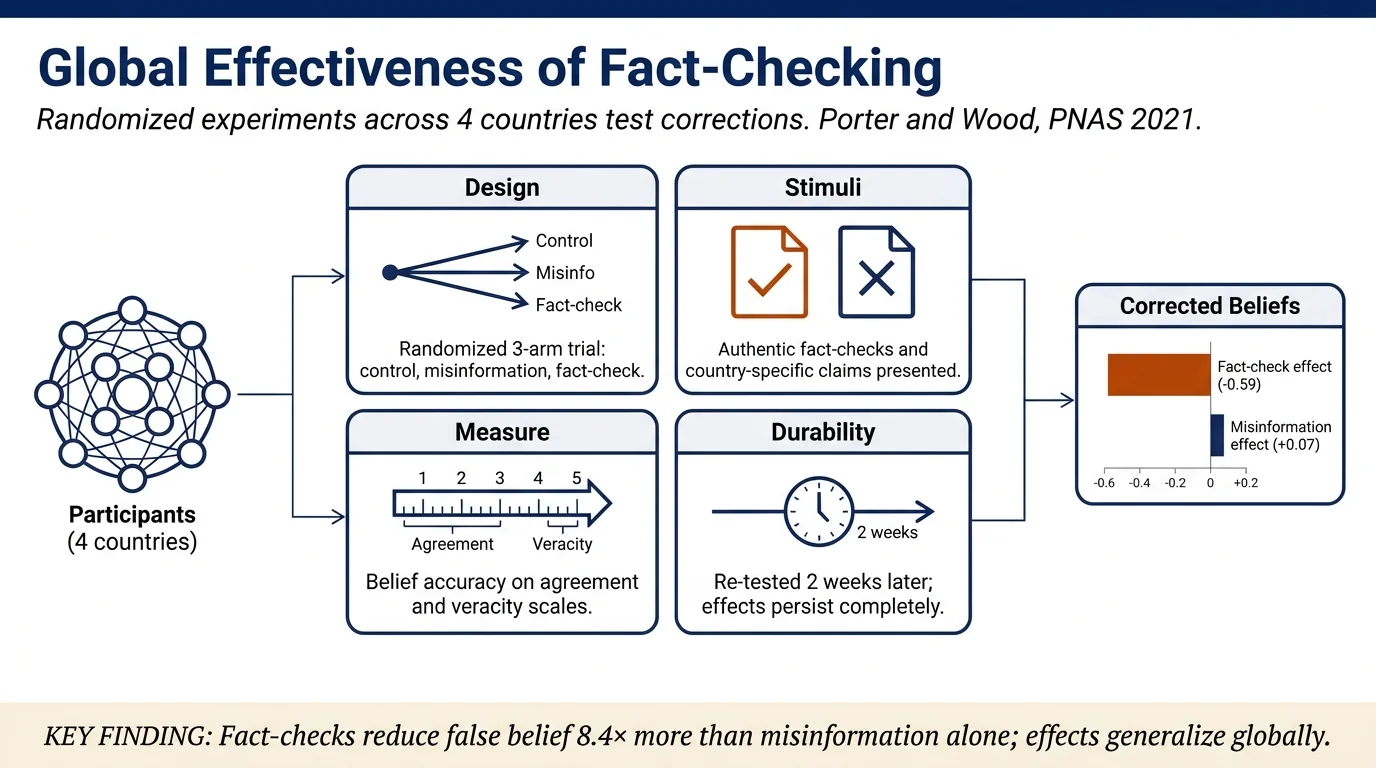
- Experimental design: Participants randomly assigned to (a) control (no stimulus), (b) misinformation only, or (c) misinformation followed by fact-check.
- Stimuli: Country-specific fact-checks (authentic, as published by local fact-checking organizations, with original graphics); two cross-national items (COVID-19 and climate change).
- Outcome measurement: Two veracity questions per claim (1–5 agree–disagree scale, then 1–5 true–false scale; outcome = mean of two items). Larger numbers = greater belief in inaccuracy.
- Design note: Participants randomized at item level; each saw between 0–7 of 7 country-specific items and both global items.
- Durability: Wave 2 recontacted subjects ~2 weeks later, asked outcome questions again without reminding them of earlier stimuli.
Statistical model: OLS regression of factual accuracy on experimental condition (three-level factor: control, misinformation, correction).
Results
Wave 1 (immediate effects):
- Meta-analysis across 28 experiments: fact-checks reduced false belief by 0.59 points on 5-point scale (p < 0.01).
- Misinformation increased false belief by only 0.07 points (p > 0.05, not significant).
- Fact-checks thus increased accuracy by 8.4× the effect of misinformation alone.
- Every fact-check produced more accurate beliefs than misinformation; no exceptions.
Wave 2 (durability, 2 weeks later):
- 9 of 15 country-specific correction effects and both global items remained significant.
- Most effects were detectable and in the direction of greater accuracy.
- Attrition: addresses by comparing first-wave effects between those completing both waves and those completing wave 1 only; effects were indistinguishable, reducing concerns about selective attrition.
Ideology (Fig. 3):
- While corrections did not yield identical effects across ideological spectrum, they provoked no backfire.
- Left, center, and right adherents all made more accurate by fact-checks on most items and both global items.
- Notably: global misinformation (COVID-19) affected right/center more than left; corrections worked across all groups.
Global items (Fig. 4):
- Climate change: corrections uniformly improved accuracy; misinformation did not uniformly degrade it.
- COVID-19: misinformation degraded accuracy in 3/4 countries; corrections improved accuracy in all 4.
Heterogeneity by topic:
- Grouped items into topics (government spending, health, crime, economic data).
- Correction effects and misinformation effects were indistinguishable by topic—no evidence that some issues are easier to correct.
Notes
Strengths:
- Geographic diversity. First rigorous cross-national test of fact-checking in non-WEIRD contexts; directly addresses external validity critique in psychology.
- Real stimuli. Fact-checks are authentic, as published by organizations; misinformation stimuli are brief summaries, which may underestimate misinformation's real-world impact.
- Durability. Testing 2-week persistence is rare in correction research; most prior work measures only immediate effects. Finding that effects persist partially dispels the "ephemeral survey response" concern.
- Scale of evidence. 28 experiments, 22 distinct fact-checks, ~2,000 per country, preregistered design.
- Null results are reported. No backfire observed; explicitly tested across ideology and found null. Important for the field, which has been haunted by conflicting claims about backfire effects.
Limitations and open questions:
- Online panels. Participants recruited via Ipsos MORI and YouGov; selection bias may inflate fact-checking effectiveness (e.g., panel members more receptive to experimental stimuli than ad-hoc social media users).
- Misinformation stimuli understated. Brief summaries lack source cues, visual elements, and social-proof signals (likes, shares) that amplify false claims in real contexts. True misinformation effects likely larger; study may report lower-bound estimate.
- Fact-checks lengthier than misinformation. Differential exposure time may favor corrections; not clear if effect size holds when matched for length.
- Countries with existing fact-checking orgs. Experiments only in countries with established fact-checking organizations; results may not generalize to contexts with weaker institutional infrastructure or vastly different political polarization, institutional trust, or media ecosystems.
- Sample composition. Stratified on demographics; prior research has identified demographic groups especially susceptible to misinformation; study does not disaggregate effects by demographic risk factors (education, age, conspiratorial thinking).
- Mechanisms unknown. Paper does not manipulate fact-check design (visual vs. text, tone, source credibility) to identify which features drive durability. Future work should investigate what makes effects durable.
Policy implications:
Fact-checking is a scalable tool for reducing false beliefs, but only for claims it reaches. By-design limitations remain: (1) fact-checkers can cover only a fraction of viral misinformation; (2) people preferentially consume misinformation over fact-checks on social media; (3) effectiveness does not translate to changed political attitudes or behavior, only to corrected beliefs; (4) durability after 2 weeks is unknown (does effect decay after a month?).
See also
- llm-fact-checking — emerging challenge of automating fact-checking as language model-generated misinformation scales.
- misinformation-interventions — fact-checking is one intervention type; broader discussion of inoculation, nudges, source credibility labeling.
- covid19-misinformation — major domain where fact-checking was deployed at scale during 2020–2021.