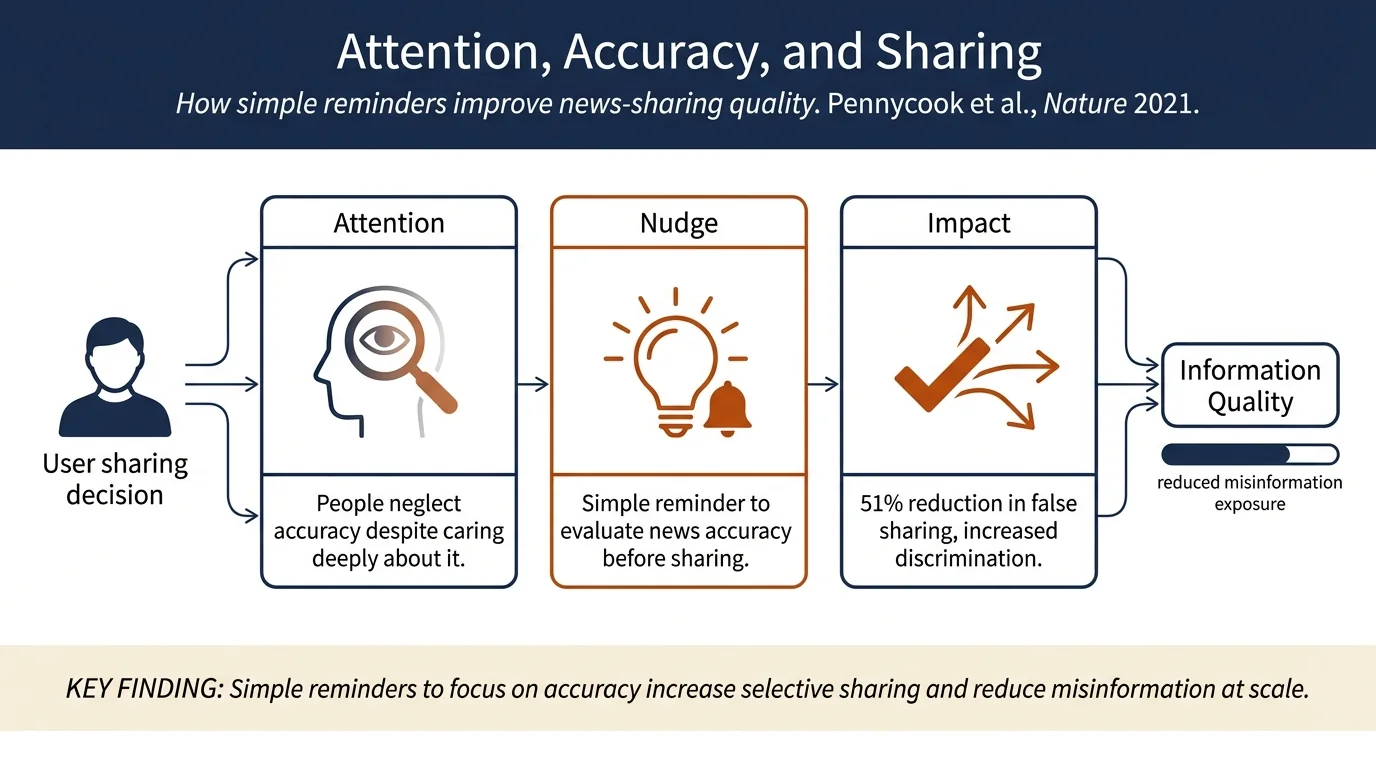
Shifting attention to accuracy can reduce misinformation online
Authors: Gordon Pennycook, Ziv Epstein, Mohsen Moseh, Antonio A. Archer, Dean Eckles, David G. Rand
Venue: Nature, Vol 592, 22 April 2021 — DOI
TL;DR
People share inaccurate news at high rates despite caring about accuracy, because they don't sufficiently attend to truthfulness when making sharing decisions. Through six survey experiments and a Twitter field experiment with 5,379 users, the authors show that subtle reminders to focus on accuracy significantly increase sharing of accurate news and decrease sharing of false news, suggesting that limited attention—not confusion or indifference—explains misinformation sharing online.
Contributions
- Demonstrates that headline veracity has minimal effect on sharing intentions despite significant effects on accuracy judgments, suggesting the dissociation between accuracy beliefs and sharing behaviors
- Shows that shifting attention to accuracy increases sharing discrimination across multiple experimental conditions
- Provides evidence that a limited-attention utility model better explains misinformation sharing than confusion-based or preference-based accounts
- Demonstrates scalability of attention-based interventions through a large-scale Twitter field experiment with replicable effects on news-sharing quality
Method
The paper presents seven studies investigating the relationship between attention, accuracy, and news sharing:
Studies 1–6 (Survey Experiments): Participants were recruited from MTurk (Studies 1–4) and Lucid (Studies 5–6), with sample sizes ranging from ~400 to 1,200 per study. Participants rated the accuracy of false and true news headlines (in Facebook format) and indicated sharing intentions. In Studies 3–6, some participants received a treatment condition where they were either asked to focus on accuracy at the beginning of the task, asked whether they wanted sharing to focus only on accurate news (importance treatment), or shown instructions highlighting accuracy. The key manipulation was minimal—a single statement asking participants to consider whether headlines were accurate. Analysis examined whether the treatment changed the effect of headline veracity on sharing intentions relative to controls.
Study 7 (Twitter Field Experiment): The authors created a list of real news websites with strong fact-checker ratings and sent direct messages to 5,379 Twitter users who had previously shared links to unreliable news sites. The message asked users to rate the accuracy of a single non-partisan headline. Treatment and control groups were compared on subsequent sharing quality using Twitter's API. The authors controlled for temporal effects, account characteristics, and ideology to isolate the treatment effect.
Results
Key findings across studies:
- Study 1: Accuracy judgments differed substantially between false and true headlines (55.9 percentage point difference), but sharing intentions showed only a 10.1 percentage point difference between politically concordant headlines, suggesting limited weight on accuracy in sharing decisions.
- Studies 3–5: Focusing attention on accuracy significantly increased sharing discrimination. In Study 3, the treatment increased the likelihood of sharing true headlines (d = 0.61, p < 0.001) and decreased sharing of false headlines (b = −0.056, p < 0.001).
- Study 5: Specifying that sharing should focus only on accurate content was most effective (the "importance" treatment), reducing sharing of false headlines by 51.2% in the treatment group relative to control (95% CI [38.4%, 62.0%]).
- Study 7 (Twitter): The accuracy reminder increased average quality of tweets shared by users in the treatment group, with effects persisting over the 24-hour post-message period. The treatment increased sharing of links to accurate news sources by 4.8% and decreased sharing to low-credibility sites by 4.0%.
Network-level simulations (agent-based models) show that individual-level interventions can cascade to produce large population-level effects through retweets and engagement dynamics, with up to 40% reductions in misinformation exposure under favorable network conditions.
Connections
- Extends prior work on accuracy nudges in COVID-19 contexts
- Related to inoculation approaches that prepare people against misinformation
- Complements psychological approaches to corrections
- Shares similar intervention framing with media literacy interventions
- Related to psychological drivers that explain sharing behavior beyond confusion
Notes
Strengths: The paper elegantly identifies a fundamental mechanism—limited attention rather than confusion or indifference—that explains why people share accurate-seeming content without deliberation. The intervention is minimal (a single sentence), scalable, and replicates across both lab and field settings. The Twitter experiment provides real-world validation of effects observed in controlled surveys. Network simulations demonstrate plausible population-level impacts.
Limitations: The Twitter experiment faced technical constraints (Twitter API limitations, potential selection effects in which accounts received messages). Participants who received the intervention may have been less receptive to such prompts than the general population. Effects are modest in absolute terms (4.8% increase in quality sharing, though 51.2% relative reduction for false headlines in Study 5), and long-term persistence beyond 24 hours is untested. The mechanism is framed as "limited attention," but the paper doesn't directly measure where attention is allocated during decision-making.
Significance: This work challenges the common framing of misinformation sharing as driven by motivation or polarization alone. The attention-based explanation suggests scalable, platform-implementable solutions—such as simple reminders before sharing—could improve information ecosystems without requiring radical changes to user behavior or platform design. The results resonate with prior work showing that most people do care about accuracy but fail to implement that preference in real-world decisions.