Contributions
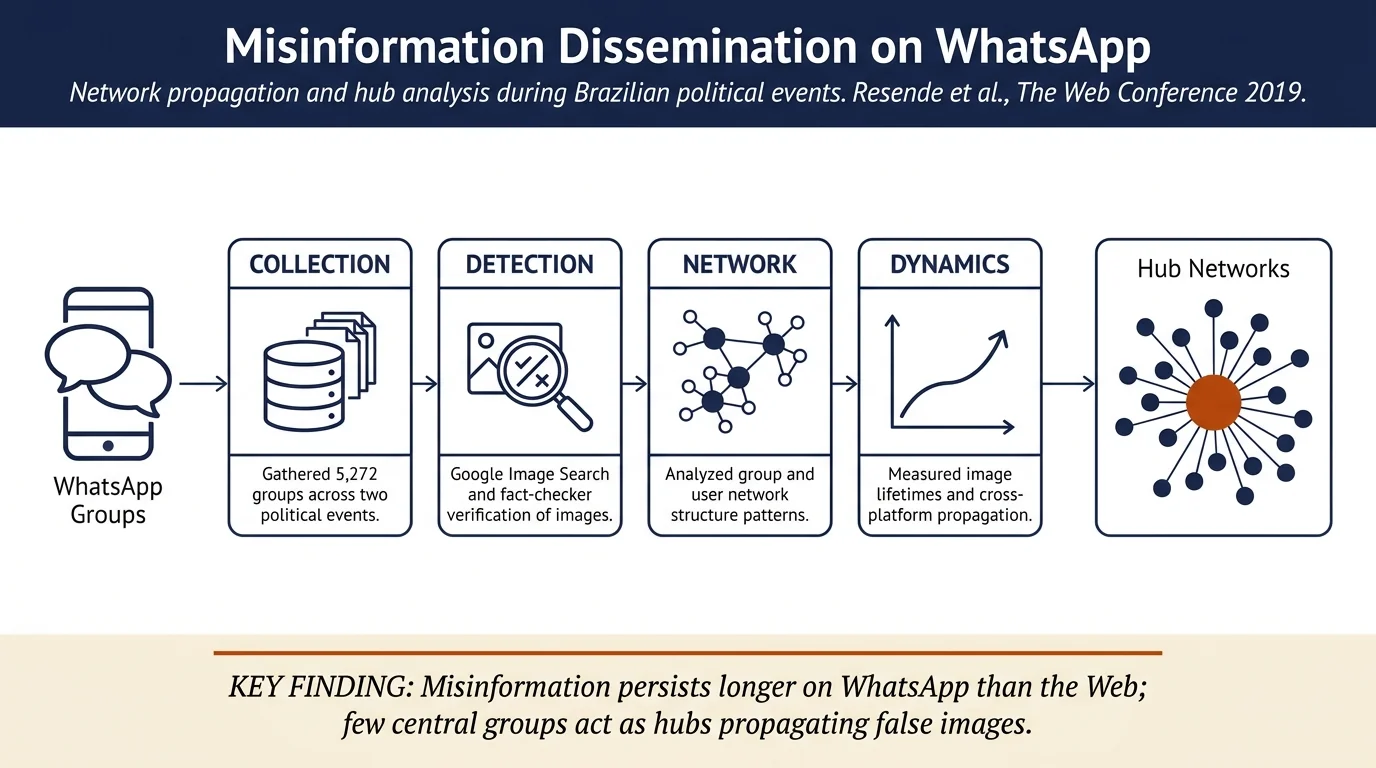
- Large-scale investigation of political-oriented WhatsApp groups in Brazil, collecting data across two major social mobilization events with 5,272 groups and 12.7M messages.
- Methodology for automated identification of misinformation images using Google Image searches and fact-checking agency verification.
- Analysis of network structure at group and user levels, characterizing interconnectedness and information flow between WhatsApp groups.
- Temporal propagation dynamics analysis comparing image lifetimes, burst patterns, and cross-platform movement (WhatsApp ↔ Web).
- Demonstration that WhatsApp serves as both a source and terminal node in information diffusion networks, with misinformation persisting longer on WhatsApp than on public Web platforms.
Method
Data Collection:
- Identified publicly accessible WhatsApp groups via web searches (Google, Twitter, Facebook) related to Brazilian politics, truck drivers' strike, and 2018 elections.
- Focused on two major social mobilization events: Truck Drivers' Strike (May 21–June 2, 2018) and 2018 Brazilian Presidential Elections (August 16–October 7, 2018).
- Monitored groups by joining using cell phones; collected all chat data including messages, images, videos, audio, external links, and user metadata.
- Dataset: 5,272 groups, 18.7M total users, 12.7M messages, 11.6K images, 9.7K videos, 4.9K audios, 11.7K URLs.
Misinformation Detection:
- Used Google Image Search API to check if images had been previously identified as fake by reverse image searching.
- Cross-referenced findings with Brazilian fact-checking agencies (Lupa.us, Boatos.org, E-Farsas.com) to confirm misinformation status.
- Manual annotation by journalists (BBC and BNews stories) to validate approach.
- Result: 85 images identified as misinformation, appearing in 157 groups and reaching 624 distinct users through 1,168 total shares (1.3% of all images shared).
Network Analysis:
- Built group-level networks where nodes are monitored groups and edges connect groups with shared image content.
- Built user-level networks where nodes are users and edges connect users sharing group membership.
- Calculated network metrics: degree, average path length, network diameter, density, size of largest connected component.
Propagation Analysis:
- Measured image lifetimes (time interval between first and last share within a group).
- Measured burst times (interval between consecutive shares).
- Compared temporal properties for images with misinformation vs. unchecked content.
- Analyzed cross-platform movement: tracked when images first appeared on WhatsApp vs. when they appeared on Web (via Google Image Search timestamps).
Results
Content Characteristics:
- Images most frequent media type (15 images per 100 messages during both periods).
- Text links and URLs: 11.7K URLs across all groups; during truck strike, 92% unique links; during election, 45% unique links.
- Video content: 9.7K videos total; 60% of messages contained videos in 65 days during strike.
- Audio messages: 4.9K audio messages collected.
Image Categories (Manual Annotation):
- Political content: 50% during strike, 80% during elections.
- Most frequent during election: satire (9%), activism (7%), inappropriate content (5%), opinion (5%).
- Fact-checkers identified: 47 images marked as factual misinformation, 12 images had misleading/inaccurate information, only 5 verified as true.
Network Structure (Table 4):
- Truck Drivers Strike Group Network: 136 nodes, 55 edges, 8,809 avg degree, 8 diameter, 2.978 APL, 0.008 density, 25 LCC.
- Election Campaign Group Network: 333 nodes, 842 edges, 5,057 avg degree, 8 diameter, 3.439 APL, 0.013 density, 206 LCC.
- User networks much larger: Election Campaign user network had 5,700 nodes, highly interconnected with multiple clusters and hub users acting as central connectors.
- Most groups weakly connected; few groups share members, suggesting isolated communities with limited external visibility.
Propagation Dynamics:
- Image lifetimes: ~20% under 1 hour; ~40% under 20 hours. Similar distributions for misinformation vs. unchecked content.
- Burst times: Both periods showed similar patterns; most images shared only a few times, with high variability in burst intervals.
- Cross-platform analysis: 14% images posted same day on Web and WhatsApp; 65% first shared on WhatsApp; most images stayed in system >10 hours.
- Misinformation images: Shorter lifetimes than unchecked images on average (median ~2-30 hours vs longer for unchecked); faster burst times suggesting rapid initial dissemination.
- Web vs. WhatsApp: Misinformation images persisted in monitored groups for longer than on public Web (positive time differences suggesting WhatsApp as terminal node for information), contrasting with unchecked content where Web persistence was longer.
Key Finding: Network analysis revealed few WhatsApp groups are responsible for spreading large fractions of misinformation. Largest misinformation hubs ("ARAGUIANA BOLSONARO 1" and "BOLSONARO PRESIDENTE") shared 320–1,320 images with many other groups, demonstrating role of central hubs in information diffusion.
Notes
Strengths: Large-scale empirical dataset across two distinct Brazilian political events; novel dual network analysis (group-level and user-level); careful validation of misinformation labels using fact-checking agencies; temporal cross-platform analysis revealing WhatsApp's role as information terminal node.
Limitations: Sample limited to publicly accessible groups with English/Portuguese language support; researchers' presence in groups may have affected sharing behavior; fact-checking agencies may miss emerging misinformation; Google Image Search API has limitations for finding first source of images.
Significance: First systematic study documenting misinformation life cycles and network propagation on WhatsApp; demonstrates that messaging apps enable both rapid initial spread and prolonged persistence of false information. Provides foundation for platform-specific countermeasures and highlights need for content moderation tools adapted to encrypted messaging.
Open questions: How do user social ties within and across groups influence misinformation spread? Do users forwarding misinformation differ in trust signals or social position? What role does group administration play in moderating vs. amplifying content? How would platform-level interventions (warnings, reduced forwarding limits) affect propagation patterns?