Contributions
- First in-depth legal and policy assessment of deepfakes across causes, consequences, and responses—covering a broader range of harms and remedies than prior technology-focused work.
- Systematic taxonomy of deepfake harms: Individual harms (exploitation, sabotage, identity theft), societal harms (democratic distortion, institutional erosion, national security threats), and the "liar's dividend" (bad actors invoking deepfakes to dismiss authentic evidence).
- Comprehensive survey of remedies: Technological solutions (detection, authentication), criminal and civil liability frameworks, regulatory agency actions (FTC, FCC, SEC), military/covert responses, market solutions (immutable life logs, authentication services), and limitations of each approach.
- Evidence-based threat framing: Distinguishes realistic near-term risks (non-consensual intimate imagery, political manipulation within elections, fraud against organizations) from speculative or distant risks (mass societal collapse of trust).
Method
The paper employs legal and policy analysis, reviewing technological literature on deepfake creation and detection, examining U.S. and international legal frameworks (criminal law, civil tort liability, agency authority), surveying existing platform policies, and analyzing case studies of deepfake incidents (e.g., the Emma González/Parkland shooting and falsified video, the Zelensky deepfake during Russia-Ukraine tensions, non-consensual intimate imagery campaigns).
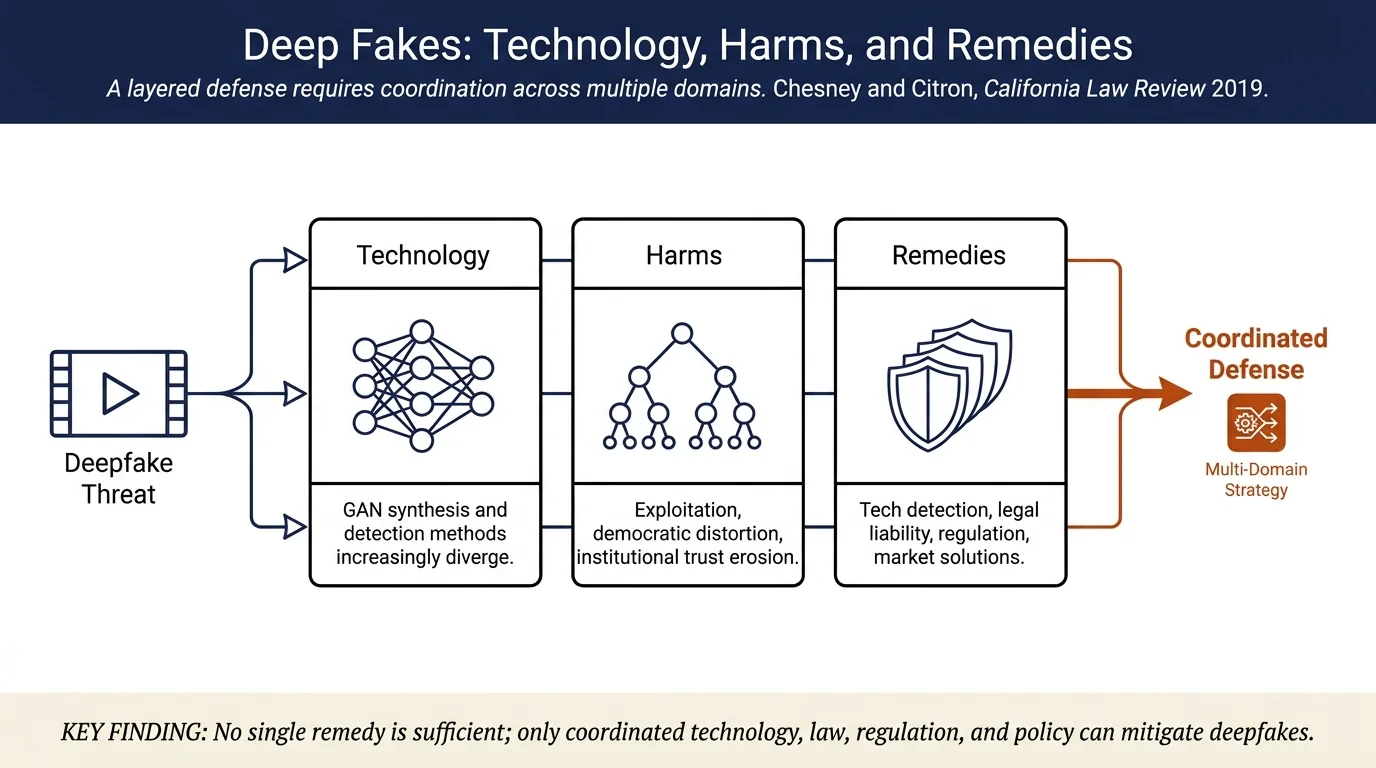
The authors organize the problem space across three dimensions:
- Technological Foundations (Part I): How deep learning, GANs, and neural networks enable realistic video and audio synthesis; why detection lags generation; how deepfakes will likely become more convincing and easier to create as tools democratize.
- Costs and Benefits (Part II): Beneficial uses (education via historical figure resurrection, art and entertainment, accessibility); costly uses subdivided into individual harms (exploitation of specific people) and societal harms (democratic discourse distortion, institutional trust erosion, national security damage).
- Responses (Part III): Technological mitigation (detection, authentication), legal (criminal liability, civil torts, platform duty of care), regulatory (FTC consumer deception authority, FCC broadcast standards, SEC securities fraud), military/covert action, market solutions, and candid assessment of limitations and gaps in each.
Results and Findings
Technology trajectory: Deepfakes will become more realistic and harder to detect. Current detection methods are already fragile and lag behind generation capabilities. Tools for creating deepfakes are already in the wild and will continue to democratize.
Harms are real and asymmetric:
- Individual harms: Non-consensual intimate imagery (predominantly targeting women and journalists), identity impersonation for fraud, sabotage (e.g., fabricated statements attributed to executives or political candidates).
- Societal harms: Manipulation of elections through synthetic statements from candidates; erosion of trust in authentic video evidence during critical moments (e.g., police violence); international tensions (e.g., deepfake audio attributed to political leaders); undermining diplomatic credibility.
- The liar's dividend: Once deepfakes are known to exist, bad actors can invoke deepfake claims to dismiss authentic evidence ("that video is obviously a fake"). This is especially dangerous for marginalized communities (e.g., dismissing evidence of police violence) and high-stakes events (e.g., elections, national security incidents).
No single solution is sufficient:
- Detection methods are improving but remain imperfect; attackers can engineer around detectors; detection does not scale to billions of videos on social platforms.
- Legal liability (criminal law, tort law) is useful for deterrence and accountability but faces evidentiary burdens and jurisdictional limits; holds creators liable but not necessarily the platforms that distribute deepfakes or the bad actors who commission them.
- Regulatory action (FTC authority over deceptive practices, FCC authority over broadcast standards, SEC authority over securities fraud) can address specific high-stakes contexts but is narrow in scope.
- Market solutions (immutable life logs, authenticating video sources) require infrastructure investment and consumer adoption unlikely in the near term.
- Military/covert response (classified research, international agreements) may be appropriate for certain state-actor threats but cannot address the full range of civilian misuse.
Policy recommendations: The authors recommend layered defenses: improved technical detection (especially for political deepfakes); criminal and civil liability frameworks adapted for deepfakes; FTC/FCC authority strengthened; platform design changes to slow viral spread; authentication infrastructure where feasible; and public education. They explicitly warn against regulation that would stifle beneficial uses (education, art, research).
Notes
Strengths:
- Comprehensive scope: This is one of the first papers to systematically survey deepfakes from multiple angles (technology, law, policy) rather than focusing on detection or creation alone.
- Honest about trade-offs: The paper does not oversell solutions; it clearly identifies limitations of each remedy (detection is fragile, legal liability is slow and hard to enforce, regulation is narrow in scope).
- Real-world grounding: Uses concrete case studies (Emma González, Zelensky, non-consensual imagery campaigns) to ground abstract threats in actual incidents.
- Practical policy recommendations: Avoids both alarmism (suggesting deepfakes will instantly collapse democracy) and dismissiveness (suggesting deepfakes are merely entertainment); instead proposes calibrated, evidence-based policy responses.
Limitations and gaps:
- The paper was published in 2019, before many recent advances in deepfake generation (e.g., text-to-video, diffusion models, 3D face manipulation) and detection. Some technical assessments are now outdated.
- Limited discussion of deepfakes in non-English languages, despite their proliferation globally; policy recommendations focus heavily on U.S. legal frameworks.
- The "liar's dividend" concern is theoretically important but empirically understudied in the paper; how often bad actors actually invoke deepfake claims to dismiss authentic video remains an open question.
- Limited empirical data on prevalence of different deepfake types (e.g., how many non-consensual deepfakes actually exist vs. political deepfakes); relies partly on extrapolation from pornography trends.
- Does not deeply engage with platform incentives (why platforms might slow or allow deepfake spread) or with adversarial dynamics (how to avoid detection arms races).
Significance for the field: This paper established many of the conceptual frameworks (individual vs. societal harms, liar's dividend, assessment of remedies) that subsequent work on deepfakes and synthetic media has built upon. It remains a canonical reference for policy-oriented deepfake research and for understanding the full landscape of deepfake threats beyond the technical.