Contributions
- First application of knowledge graph embedding and incomplete/imprecise knowledge graphs to content-based fake news detection
- Single TransE model training on extracted triples with average and max bias classification methods
- Binary TransE (B-TransE) model pairing negative and positive models to handle triples with large biases
- Hybrid approach using early fusion of feature vectors from multiple models
- Evaluation on Kaggle Fake News and BBC News datasets showing improvements over baseline
Method
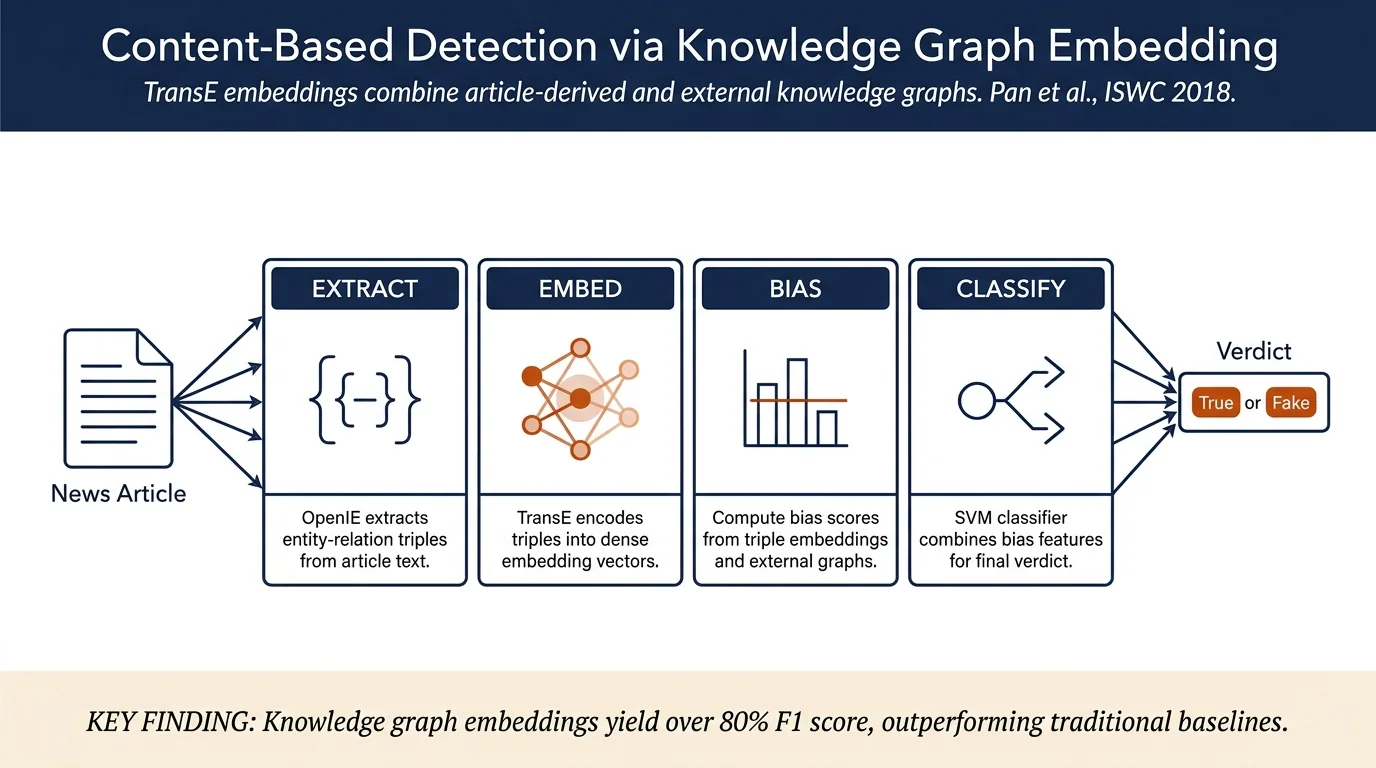
The approach extracts entity-relation triples from news article content using OpenIE, then encodes them via knowledge graph embedding. Three types of knowledge graphs are constructed: one from article base (fake or true), one from open knowledge graph (DBpedia), and one from the union. TransE encodes triples as vectors and computes bias scores to classify whether a news item is true or false.
For single TransE models, two bias functions are used: average bias across all triples (Avg Bias) and maximum bias from any triple (Max Bias). The binary approach trains separate models on true and false articles, computing classification functions that compare biases across both models. A hybrid approach concatenates max bias vectors from multiple models and uses SVM with different kernels (polynomial, linear, RBF) for final classification.
Results
Single TransE with TML-D4 (DBpedia-based model with max bias) achieves 0.79 F1 score. Binary TransE with FML+TML-D4 achieves 0.83 F1. The hybrid approach with RBF kernel reaches 0.81 accuracy on combined feature vectors. TransE-based models consistently outperform the Knowledge Stream baseline on the same datasets.
Notes
The paper is novel in combining content-based detection (which focuses on article text) with knowledge graph embeddings. The main limitation is dependency on high-quality triple extraction; OpenIE extraction quality affects downstream classification. The work assumes relevant knowledge can be encoded as entity-relation triples, which may miss nuanced linguistic or pragmatic features of misinformation. Future work should combine with style-based approaches for complementary signals.