Contributions
- Provides clear definitions distinguishing fake news from rumors and other forms of misinformation on the web.
- Surveys data collection strategies for both fake news and rumors, including sources and annotation approaches.
- Reviews feature extraction methods across content-based approaches (lexical, syntactic, semantic) and context-based features (user-based, network-based).
- Comprehensively analyzes detection techniques: machine learning methods (SVM, decision trees, random forests, logistic regression) and deep learning methods (RNN, LSTM, CNN, and hybrid architectures).
- Catalogs publicly available benchmark datasets for fake news and rumor detection.
- Identifies future research directions including need for better benchmark datasets, multimodal approaches, and real-world deployment considerations.
Method
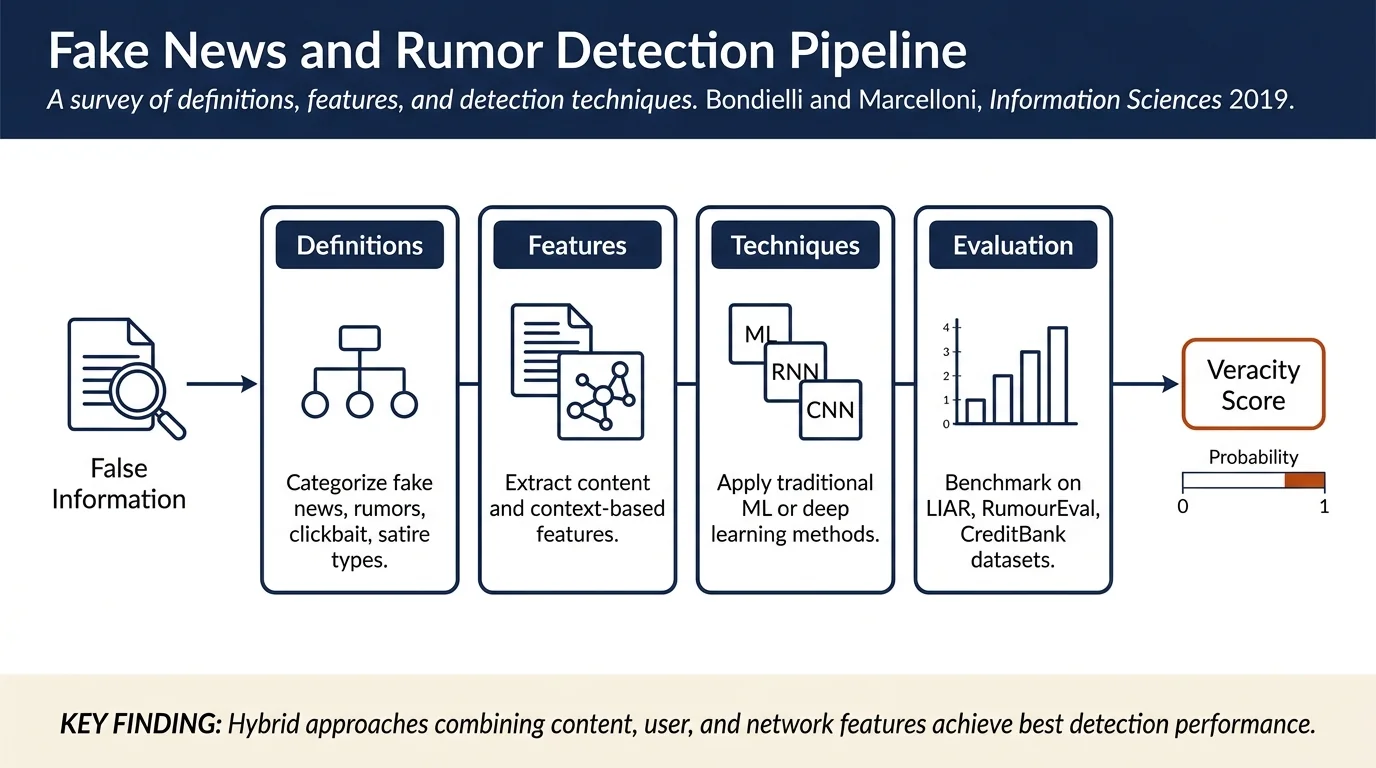
The survey follows a structured review of the literature on fake news and rumor detection. The authors organize their analysis around five main aspects:
False Information Definitions: Distinguishes between fake news (intentional misinformation in news articles), rumors (unverified information spread on social media), and other types (clickbait, satire, social spam). Discusses how each type is typically detected and the challenges in creating reliable datasets given overlapping characteristics.
Data Collection: Reviews top-down approaches (collecting known rumors via keyword searches or existing debuking websites) and bottom-up approaches (collecting breaking news and then annotating for veracity). Discusses annotation schemes and the challenges of obtaining ground-truth labels for veracity classification.
Feature Extraction: Categorizes features into content-based (lexical cues, syntactic patterns, semantic features from embeddings) and context-based (user-based characteristics like account age and network metrics like retweet patterns and user credibility).
Detection Techniques: Analyzes traditional machine learning approaches (SVM, decision trees, random forests) and deep learning methods including RNNs, LSTMs for sequential data, and CNNs for learning latent representations. Also covers hybrid approaches combining multiple architecture types and ensemble methods.
Datasets and Benchmarks: Surveys publicly available resources including LIAR, Pheme-Tweet, RumourEval datasets and discussions of collection methodologies.
Results
The paper reports that:
- Deep learning techniques show state-of-the-art performance but require more labeled data and feature engineering than traditional machine learning approaches
- Hybrid models combining content and context features outperform single-feature approaches
- Network-based features (propagation patterns, user credibility) are increasingly recognized as critical for rumor detection
- User-based features are consistently effective for fake news detection on social media
- Performance varies significantly across datasets, with accuracy, F-measure, and precision-recall varying based on data source and task definition
- No single universally accepted benchmark dataset exists for fake news (unlike rumors, where RumourEval is becoming standard)
Notes
This is a foundational survey that captures the state of the field circa 2019, providing clear taxonomies and distinguishing the detection of fake news from rumor detection (often conflated in earlier work). The comprehensive coverage of both traditional machine learning and deep learning approaches makes it useful as a reference for understanding the evolution of detection methods. The emphasis on the importance of multimodal and hybrid approaches prefigures later trends in the field. Some limitations: the paper focuses primarily on text and social-media metadata (limited coverage of multimodal approaches including images/video), and the rapid pace of deep learning development has likely made some benchmarks and best practices outdated since publication.