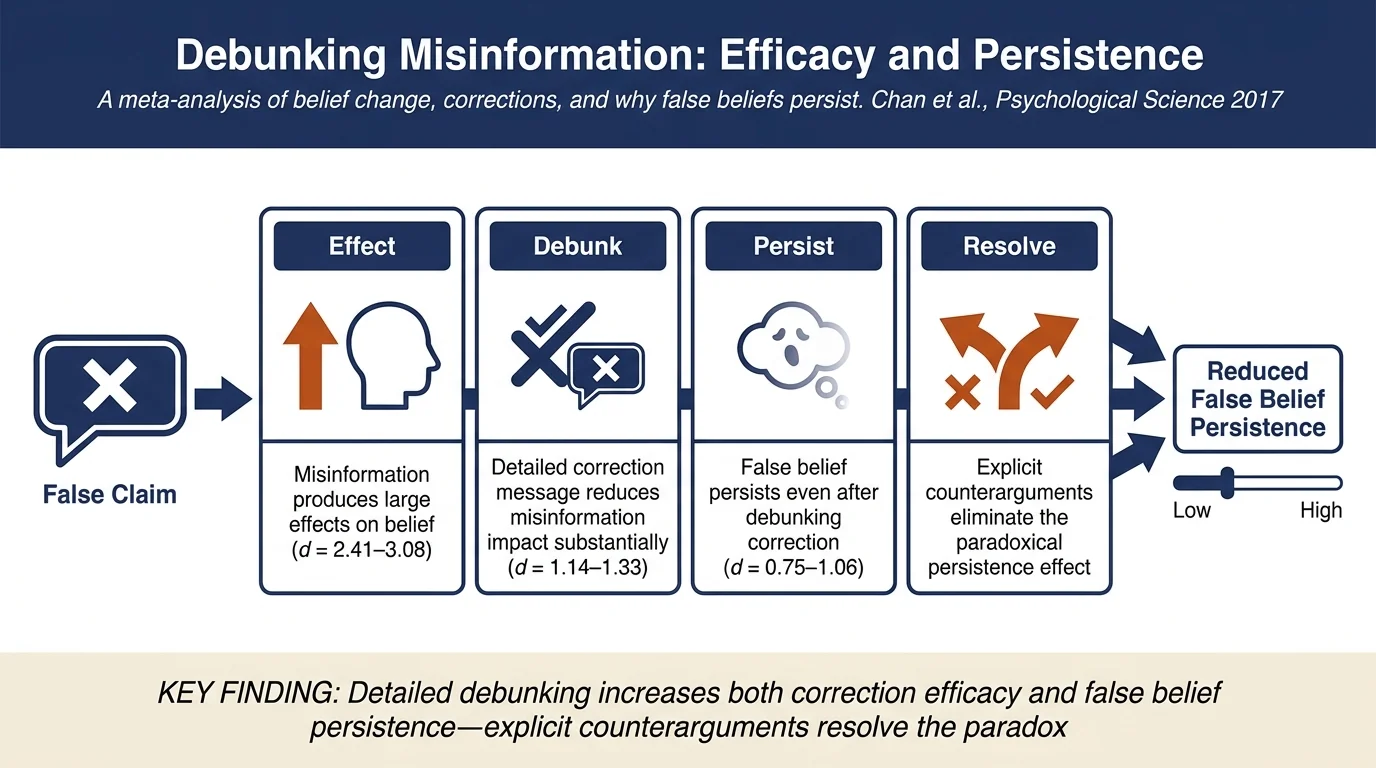
The phenomenon wherein people maintain false beliefs even when confronted with evidence that contradicts them. This includes the continued influence effect (continued reliance on discredited information), belief perseverance (reluctance to give up beliefs despite disconfirming evidence), and psychological mechanisms that protect worldviews and group identity against factual correction.
Psychological mechanisms
Source confusion. People may forget that information came from a discredited source, continuing to rely on the information while forgetting why it was shown to be false.
Mental model integration failure. Corrections may be processed consciously but fail to update the underlying mental models that guide reasoning and memory retrieval.
Identity protection. Beliefs tied to group identity, ideology, or worldview are protected against contradicting evidence through motivated reasoning and selective acceptance of information.
Cognitive inertia. The mental effort required to revise an established belief and reorganize related knowledge makes belief change costly, particularly under time pressure or distraction.
Key papers
- 2017-chan-debunking-misinformation — meta-analysis documenting the paradox that detailed debunking messages increase both debunking efficacy and persistence of the original false belief; shows that elaborated counterarguments moderate this paradoxical effect.
- 2022-ecker-psychological-drivers-misinformation — comprehensive review of mechanisms explaining persistence and evidence-based interventions including design principles for effective corrections.
- 2012-lewandowsky-misinformation-correction — foundational review synthesizing literature on why false beliefs persist and evidence-based debiasing strategies.
Related topics
- continued-influence-effect — the specific phenomenon of reliance on discredited information after correction
- misinformation-psychology — broader psychological mechanisms in misinformation susceptibility and resistance
- fact-checking — correction and debunking as strategies to counter persistent false beliefs