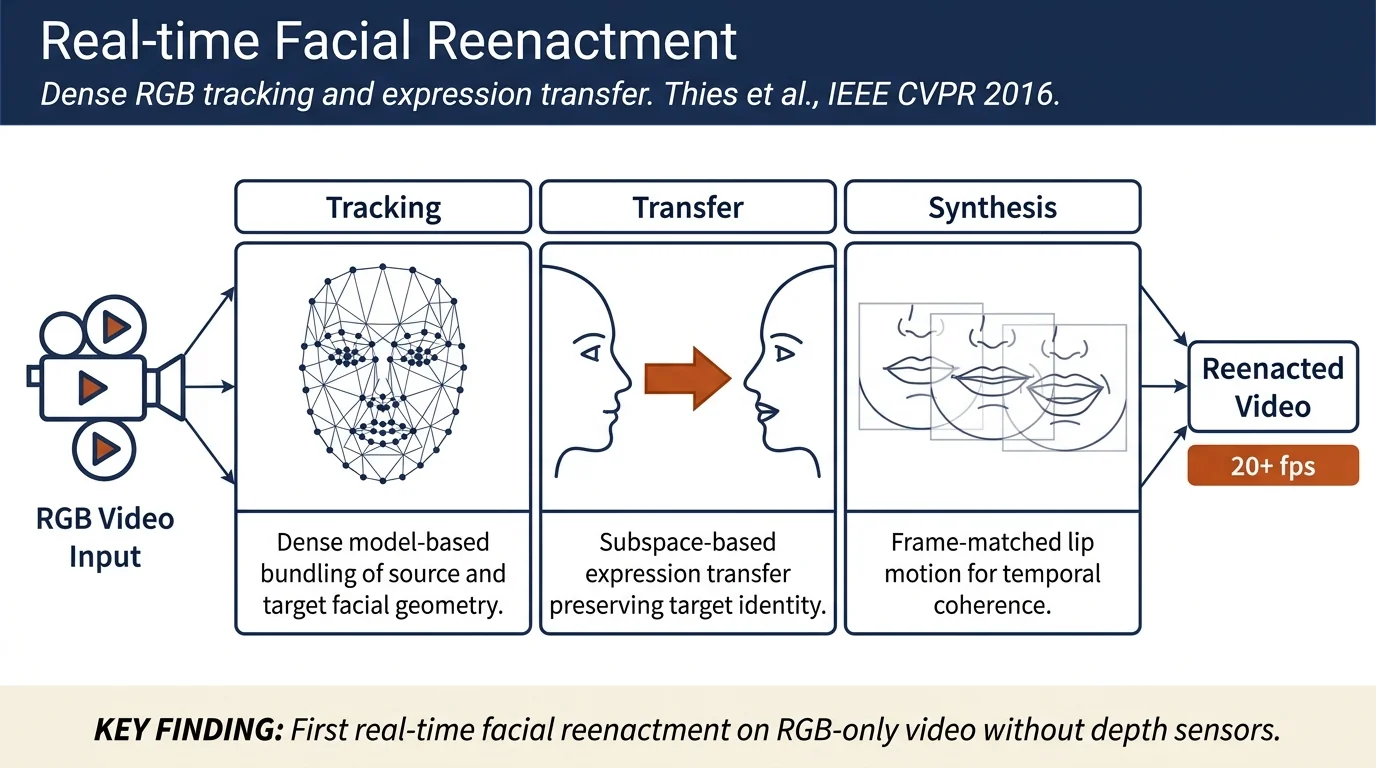
Contributions
- Dense, global non-rigid model-based bundling approach for robust facial reconstruction from monocular RGB video
- Real-time tracking of facial pose, illumination, and expression parameters in unconstrained live video
- Novel subspace-based expression transfer technique that preserves per-person facial identity while adapting expressions
- First real-time reenactment system operating on RGB-only input (prior work required depth sensors or RGB-D data)
- Appearance-aware mouth synthesis to ensure temporal coherence and realistic lip motion
Method
The approach uses a multi-linear PCA model to parameterize facial identity, expression, and reflectance. For each video frame, the method jointly estimates identity parameters (shape α, reflectance a_sh, a_diff), expression parameters β, rigid pose (R, t), and illumination parameters γ by minimizing a robust non-linear objective combining three terms:
- Photo-consistency: L₂-norm distance between synthesized and input RGB images, enforcing pixel-level fidelity
- Feature alignment: Landmark tracking ensures salient facial features match ground truth
- Statistical regularization: Normal-distribution priors on shape and expression parameters prevent unrealistic deformations
The optimization uses an iteratively reweighted least-squares (IRLS) solver with efficient GPU acceleration. At runtime, the system tracks both source and target actor simultaneously; the source expression parameters are then transferred to the target identity in the reduced subspace, preserving the target actor's appearance while applying the source's facial movements. For mouth regions, the method retrieves best-matching frames from the target video using a frame-to-cluster matching strategy and appearance graphs, ensuring temporal coherence and natural lip motion.
Results
The system achieves real-time performance (20–27 fps depending on sequence complexity) on 1280×720 resolution video using a single GPU (NVIDIA Titan X). Qualitative results demonstrate convincing facial reenactment across diverse subjects, including political figures and actors. Comparisons to prior work (Cao et al. 2014 RGB-D tracking, Shi et al. 2014 markerless capture, Thies et al. 2015 coarse RGB-D reenactment, Garrido et al. 2012 offline reenactment) show that the method produces comparably high-quality reconstructions and expressions while being the only approach to operate in real-time on RGB video alone.
Notes
Significance: Face2Face is the canonical real-time facial reenactment paper and is widely recognized as having demonstrated the feasibility of creating convincing face-swap deepfakes without specialized hardware. Its release prompted significant work in deepfake detection, and the technique remains important in forensics literature both as a threat model and as a baseline manipulation method. The paper's combination of dense tracking, appearance modeling, and real-time performance was technically impressive for 2016 and remains influential.
Strengths: The method is general-purpose (applies to any video, not just single identities), operates on commodity hardware, and produces temporally coherent results. The statistical regularization and landmark tracking make it robust to unconstrained video.
Limitations: Assumes Lambertian surfaces and smooth illumination; struggles with hard shadows or specular highlights. Works best on frontal faces; severe occlusions (long hair, beards) degrade performance. Mouth synthesis can fail on short sequences or when the target's mouth region is static. The method requires careful setup (capturing source and target streams simultaneously at matching resolution). The paper does not address detection of its own manipulations, a gap that motivated much subsequent work.