Contributions
- First neural network method to synthesize photorealistic talking-head video from audio alone, trained on unconstrained video rather than lab-captured data
- Recurrent LSTM architecture that maps audio (phoneme-based MFCC features) to sparse mouth shape in real time
- Facial texture synthesis approach that generates high-frequency details and temporal smoothness
- Video re-timing and compositing techniques that handle natural head motion and blink patterns
- Evaluation on multiple target videos and comparison with traditional AAM-based synthesis methods
Method
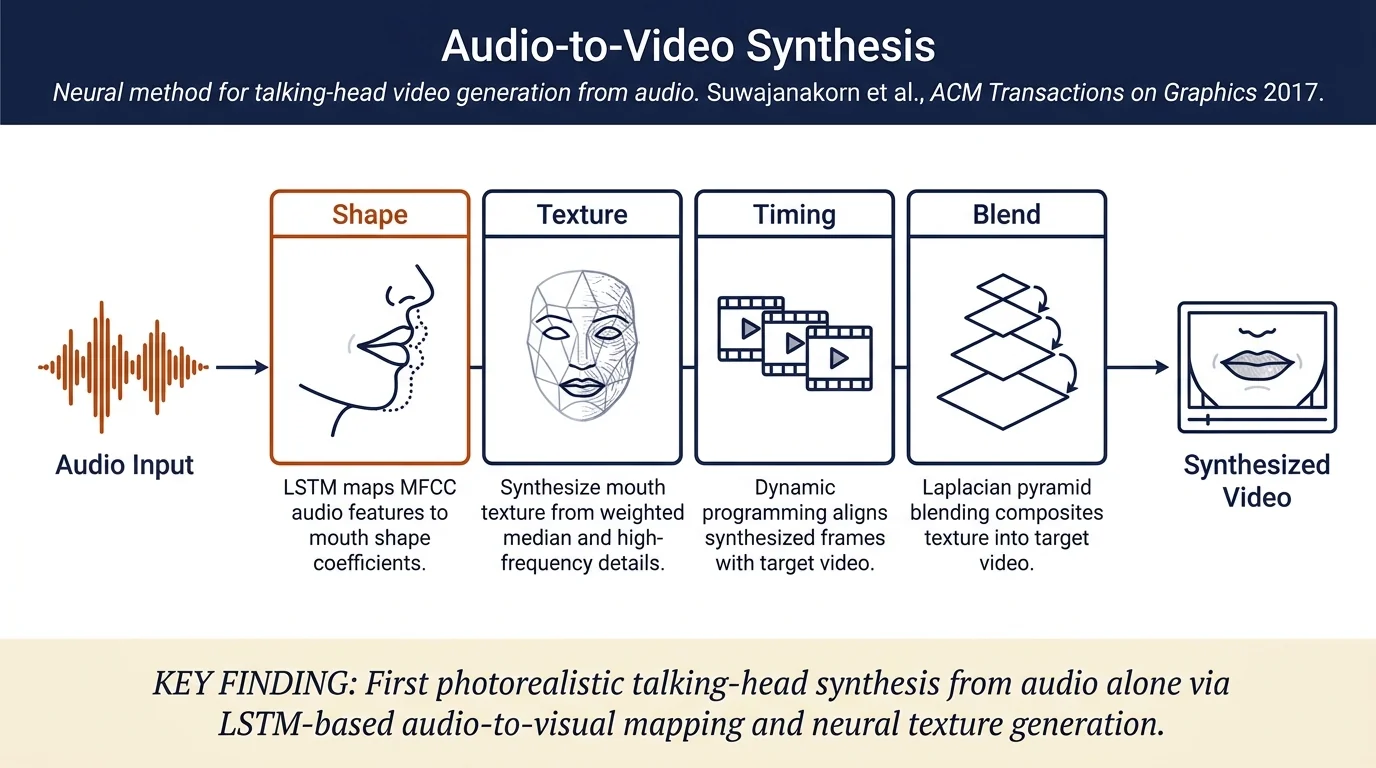
The system operates in four stages:
1. Audio-to-mouth-shape mapping: An LSTM network with 60-dimensional cell state is trained on 300 weekly presidential addresses (17 hours of video over 8 years). Input is 30-dimensional MFCC features extracted at 10ms intervals. The network outputs a 18-dimensional PCA-reduced mouth shape coefficients per frame, capturing the full lower-face geometry. A 200ms time delay is incorporated to improve validation loss and capture anticipatory mouth movements.
2. Mouth texture synthesis: Rather than synthesizing pixel values directly, the method decomposes the synthesis into a median weighted texture (combining candidate frames selected via landmark-weighted voting) and high-frequency details (synthesized via Gabor filters and sharpening). Candidate frames are selected by finding frames where visible teeth landmarks best match the target utterance. The teeth proxy is manually chosen from frames with frontal-facing teeth clearly visible.
3. Video re-timing: A dynamic programming approach aligns N synthesized mouth animation frames with M target video frames to handle asynchrony between audio and visual pauses. The objective prefers more motion during utterance and minimal motion during silence, while ensuring no skipped frames and limiting repetition to at most 50%.
4. Final composite: Mouth texture is blended into target video using Laplacian pyramid blending, combining the lower face texture, neck region, and shirt from the target frame. A jaw-correction step handles misalignment by computing optical flow between the lower-face texture and target video, then using that flow to warp the texture to fit naturally.
Results
- Generates convincing lip-synced video with good phoneme overlap between target and generated audio (82.9%, 35.7%, 12.1%, 4.9% for top-4 detected phonemes respectively)
- Outperforms Active Appearance Model (AAM) synthesis baseline in visual quality and temporal smoothness
- Shows significantly better results than the recent Face2Face video-reenactment method when both use the same input audio
- Demonstrates strong generalization: 20% held-out validation set produces similar quality to training set
- Qualitative results on multiple target videos show robust handling of different lighting, head poses, and speaking styles
- Identified limitations: method requires sufficient mouth shapes in target video, fails with profile poses, doesn't handle extreme expressions
Notes
This is a landmark paper in the deepfakes literature. While focused on a single public figure (Obama), the method is general and can theoretically generalize to other subjects with sufficient training data. The authors explicitly discuss the dual-use implications and later published work addressing detection. The paper's strength lies in demonstrating photorealistic synthesis from minimal input (audio alone) using unconstrained real-world video rather than lab-captured footage. Key technical contributions include the mouth-shape PCA decomposition, weighted median texture synthesis for temporal smoothness, and the dynamic programming re-timing approach that avoids visible artifacts. The 200ms time delay was a crucial empirical finding for improving generalization.