 Briony Swire-Thompson
 Ullrich K. H. Ecker
 Lisa M. Fazio
 Emilio Ferrara
 Andrew J. Flanagin
 Alessandro Flammini
 Nir Grinberg
 Kathleen Hall Jamieson
 Alice Marwick
 Filippo Menczer
 Miriam Metzger
 Stephan Lewandowsky
 Gordon Pennycook
 Ethan Porter
 David Rand
 Onur Varol
 Thomas Wood
Measurement and design challenges
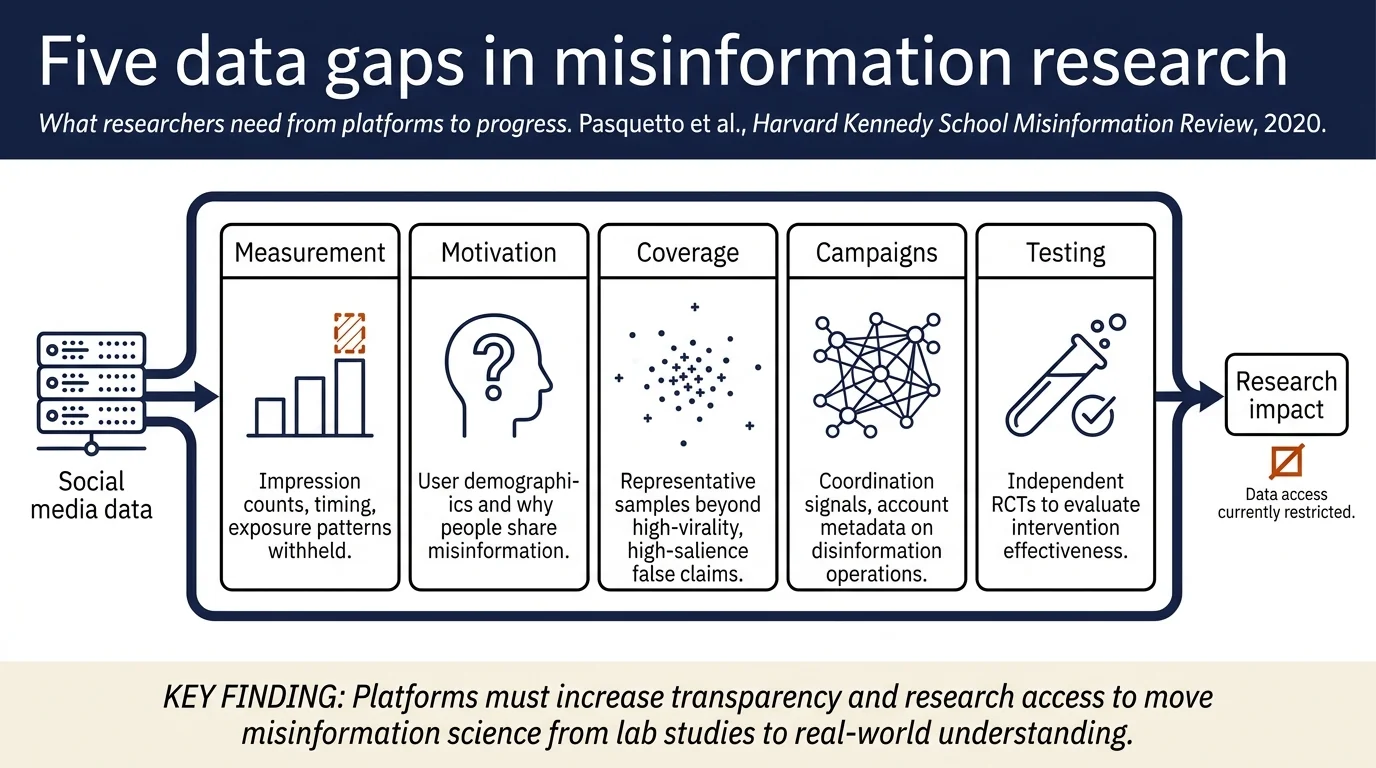
A core problem for misinformation research is the absence of impression data — metrics measuring how many people saw a piece of content. Platforms expose only "expressions" (engagements like shares and likes) while keeping impression counts hidden. Without impression data, researchers cannot accurately measure the true reach of misinformation or understand how widely a false claim spreads. This gap fundamentally limits the external validity of studies conducted with biased, partial data. Researchers need fine-grained temporal data on what content users are exposed to, when, and how often, to test realistic hypotheses about how misinformation propagates at scale.
Similarly, researchers lack access to randomized controlled trials (RCTs) on live platforms. Social media companies have largely prohibited external researchers from running randomized experiments directly on their platforms, despite RCTs being among the strongest tools in a researcher's methodological toolkit. When researchers are allowed to conduct platform-based experiments, they face stringent internal company controls and limits on the scope of inquiry. Independent access to run RCTs would significantly enhance understanding of which interventions are most effective at reducing an individual's propensity to share misinformation.
Who engages with misinformation and why
Understanding motivation and engagement patterns requires individual-level data that platforms withhold. Misinformation researchers know that people share false information for many reasons — belief, entertainment, sarcasm, or deliberately as a challenge — but lack data to study motivations at scale. Older adults share false political news more frequently than other age groups, yet researchers cannot access the demographic composition of networks, the relationship structure between sharers and receivers, or the temporal frequency of viewing to study why elderly users are uniquely vulnerable. Such data would illuminate factors driving susceptibility and enable targeted, effective interventions.
Emotional context is another critical gap. False, emotionally evocative content clicks on and diffuses widely; yet the degree to which emotion influences exposure, engagement, belief, and sharing remains poorly understood due to lack of open data. Research questions about how emotional falsehoods drive polarization, acceptance of conspiracy theories, and behavioral change require transparent access to both the emotional features of viral content and the conditions under which people encounter it.
Rich datasets with improved validity
Much misinformation research focuses on high-diffusion, high-salience claims — dramatic falsehoods that circulate widely — introducing significant selection bias. This emphasis overlooks important but less-viral falsehoods, variant claims that circulate in niche communities, and the structural differences between popular and unpopular false narratives. Researchers need access to stratified, representative datasets capturing obscure falsehoods alongside viral ones, and the characteristics of populations that encounter and share each type. Additionally, WhatsApp data access remains critical — the platform has been a known vector for election-related misinformation in Brazil and India, yet its encrypted, private-group architecture makes external research nearly impossible. Platforms should disclose aggregate usage statistics, virality metrics, and metadata on group dynamics to enable misinformation research at scale.
Disinformation campaigns and coordinated inauthentic behavior
Understanding state-sponsored and coordinated manipulation campaigns requires temporal, network-level, and account-level data that platforms restrict. Researchers cannot determine the true impact of Russian interference operations or any coordinated campaign without access to: historical timelines of content, metadata on content removal, account suspension patterns, and signals of coordinated activity (e.g., timing, messaging alignment). Platforms should establish standing data-sharing protocols to provide researchers with consistent, real-time access to statistics on content deletion, account changes, and abuse reports, with appropriate privacy protections and ethical oversight (similar to IRB review for human-subjects research).
Intervention evaluation and testing
The effectiveness of fact-checking labels, warning prompts, and accuracy nudges remains incompletely understood at scale. Researchers need platform-based experiments to test: whether different designs of fact-check warnings reduce belief in false headlines; whether exposure to warning labels alongside misinformation affects subsequent engagement with false claims; and whether laypeople accuracy-rating systems (crowdsourced labeling) can reliably identify misinformation. These questions can only be answered through large-sample experiments with heterogeneous participant pools, measuring both short-term belief changes and long-term behavioral effects.
Notes
This multidisciplinary consensus commentary from 43 researchers across communication, computer science, psychology, and information science represents a rare alignment on what data access would most accelerate misinformation research. Its strength lies in moving beyond abstract complaints about data scarcity to identify concrete research questions that require specific data types: impression data, temporal dynamics, demographic context, historical timelines, and cross-platform coordination signals. The piece acknowledges the genuine tensions between research transparency and user privacy, platform brand protection, and legal liability — but argues that these challenges are surmountable through dedicated data-sharing agreements and ethical oversight.
The article also reflects the field's methodological moment circa 2020: much published misinformation research relies on small samples, laboratory conditions, or platform-provided aggregate data, limiting generalizability. The authors document how this constraint has warped the research agenda itself — researchers study high-diffusion falsehoods, lab-tested interventions, and observable network metrics rather than the ecological dynamics of misinformation in the wild. For the field to mature beyond these limitations and produce evidence actionable for platforms and policymakers, platform data access must improve.