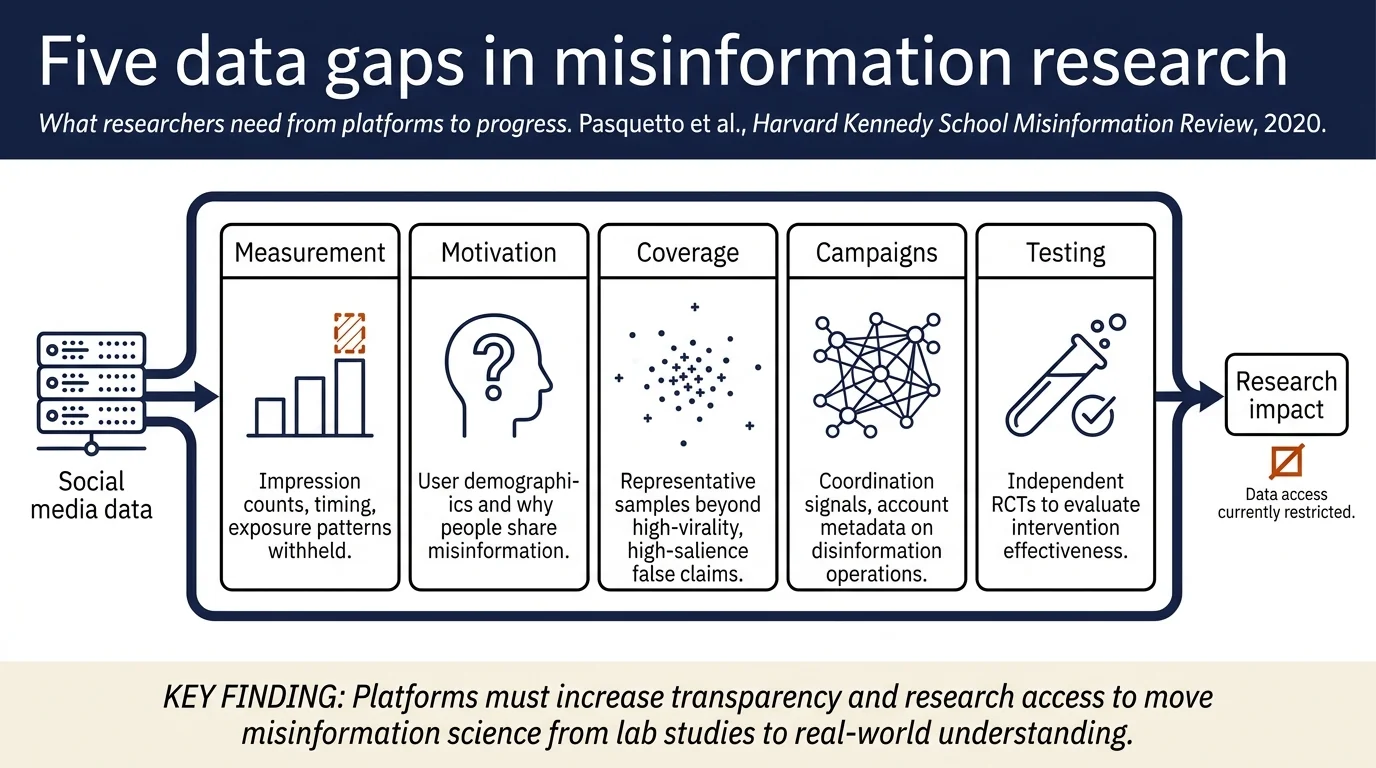
Misinformation researchers face persistent barriers to accessing the data they need to study information dynamics at scale. Social media platforms control large volumes of data about user behavior, content spread, and algorithmic curation, but restrict external researchers' access through terms of service, legal concerns, and competitive interests. This restricts the field to small-scale laboratory studies, limited to publicly available aggregate data, or proprietary datasets controlled by platform research teams with internal constraints.
Why data access matters
Understanding misinformation in real-world contexts requires fine-grained data: user demographics and network structure, temporal exposure patterns (impression data, not just engagements), longitudinal behavioral traces, and information about coordinated campaigns and account manipulations. Without such access, researchers cannot accurately measure misinformation reach, test intervention effectiveness at scale, evaluate the role of platform algorithms, or study the mechanisms by which false information spreads. The absence of open data has led researchers to study high-salience, high-diffusion claims while overlooking obscure falsehoods; to rely on small, non-representative samples; and to run experiments in laboratories divorced from the algorithmic and social contexts in which misinformation thrives in practice.
Current barriers
Platforms justify data restrictions by citing privacy concerns, brand protection, terms of service violations, and legal liability. While some of these concerns are legitimate, they can be addressed through dedicated data-sharing agreements, IRB-equivalent oversight mechanisms, anonymization and aggregation, and clear protocols for responsible use. Few platforms have established standing, transparent mechanisms by which independent researchers can access data at scale; most collaborations are ad-hoc, limited in scope, and weighted toward research that reflects platform interests.
Key papers
- Pasquetto et al. (2020) — Tackling misinformation: What researchers could do with social media data — Multidisciplinary consensus identifying five priority data types platforms should provide: impression data, longitudinal behavioral records, fine-grained demographic context, metadata on coordinated inauthentic behavior, and temporal data on content removal and account changes.
- Lazer et al. (2020) — Computational Social Science: Obstacles and Opportunities — Review of data access as a critical bottleneck in computational social science; discusses ethical frameworks for data sharing and proposes mechanisms for researcher access to social media data.
Related topics
- Platform transparency — broader category of algorithmic and operational transparency
- misinformation research — research methods and study designs in this field
- Content moderation — policies and mechanisms for removing harmful content (which also require data access to study)