Explore everything
Filter by research area, year and venue. Every filter is in the address bar, so you can share a view as a link.
 Bots & coordinated campaignsDatasets & evaluation
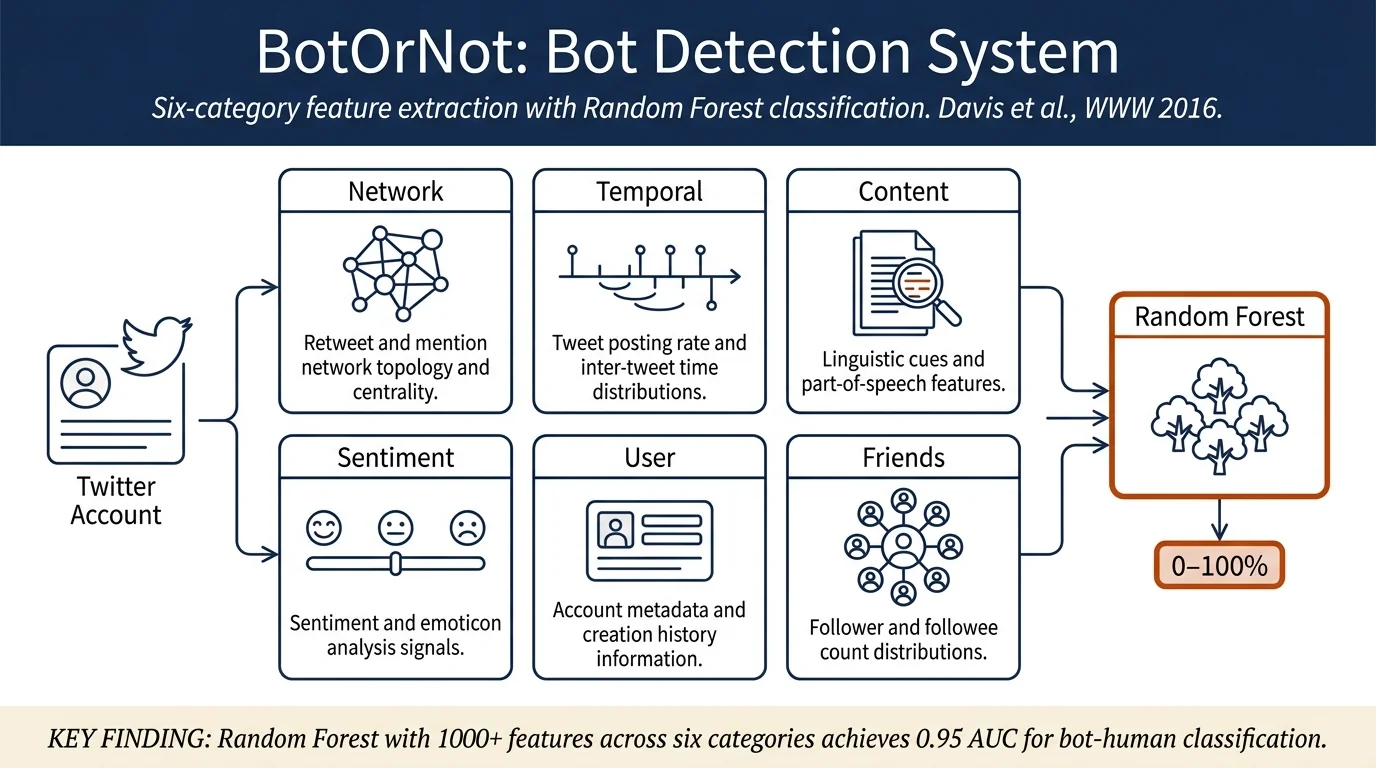
BotOrNot: A System to Evaluate Social BotsBotOrNot is a publicly available service and API that evaluates whether a Twitter account is controlled by a human or automated bot. Using 1,000+ features across six categories (network, user, friends, temporal, content, sentiment), the system applies Random Forest classification to achieve 0.95 AUC on a labeled dataset of 15k bots and…
 Bots & coordinated campaignsDetection methods
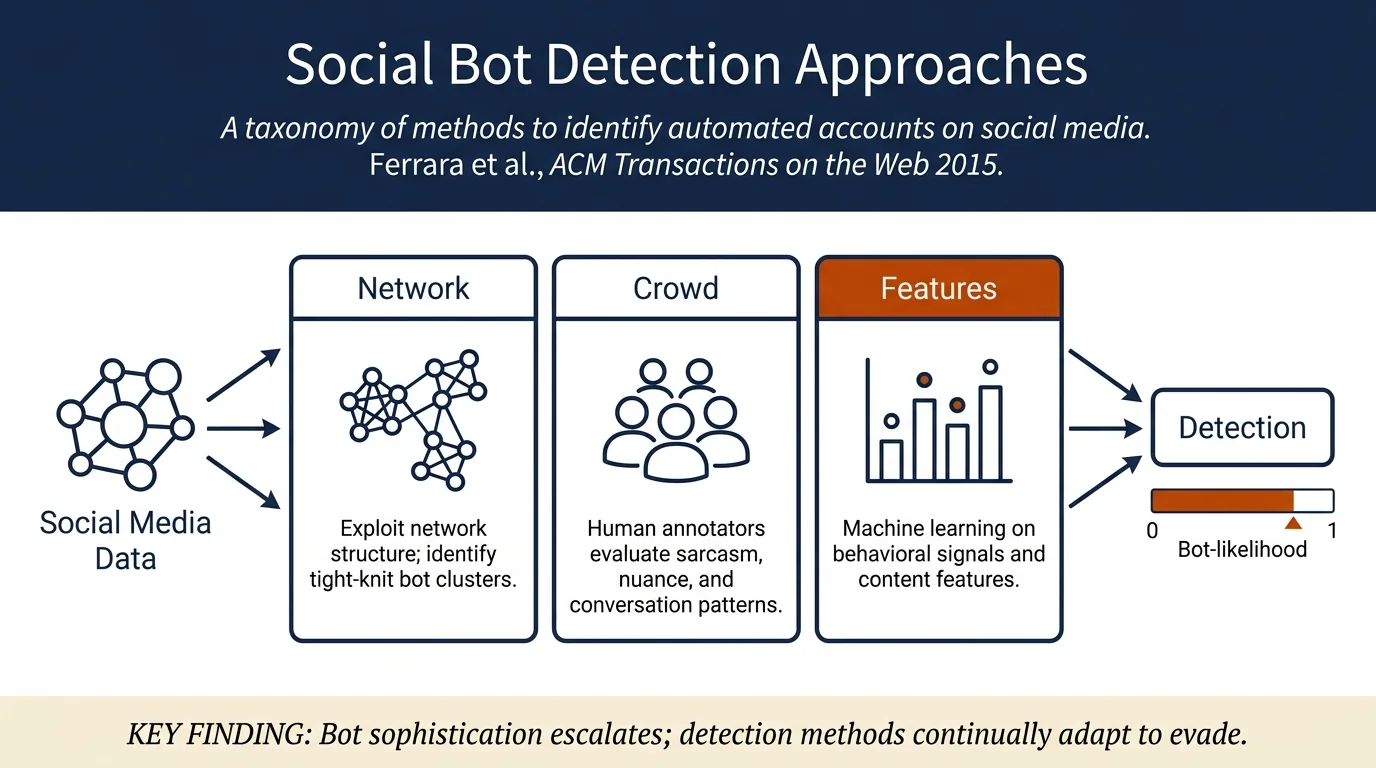
The Rise of Social BotsSocial bots—automated software agents in social media—are increasingly sophisticated and pose real threats including misinformation spread, trend manipulation, and election interference. This paper characterizes modern bot behavior, surveys detection challenges, and proposes a taxonomy of detection approaches: graph-based methods…
 Spread & networksBots & coordinated campaigns
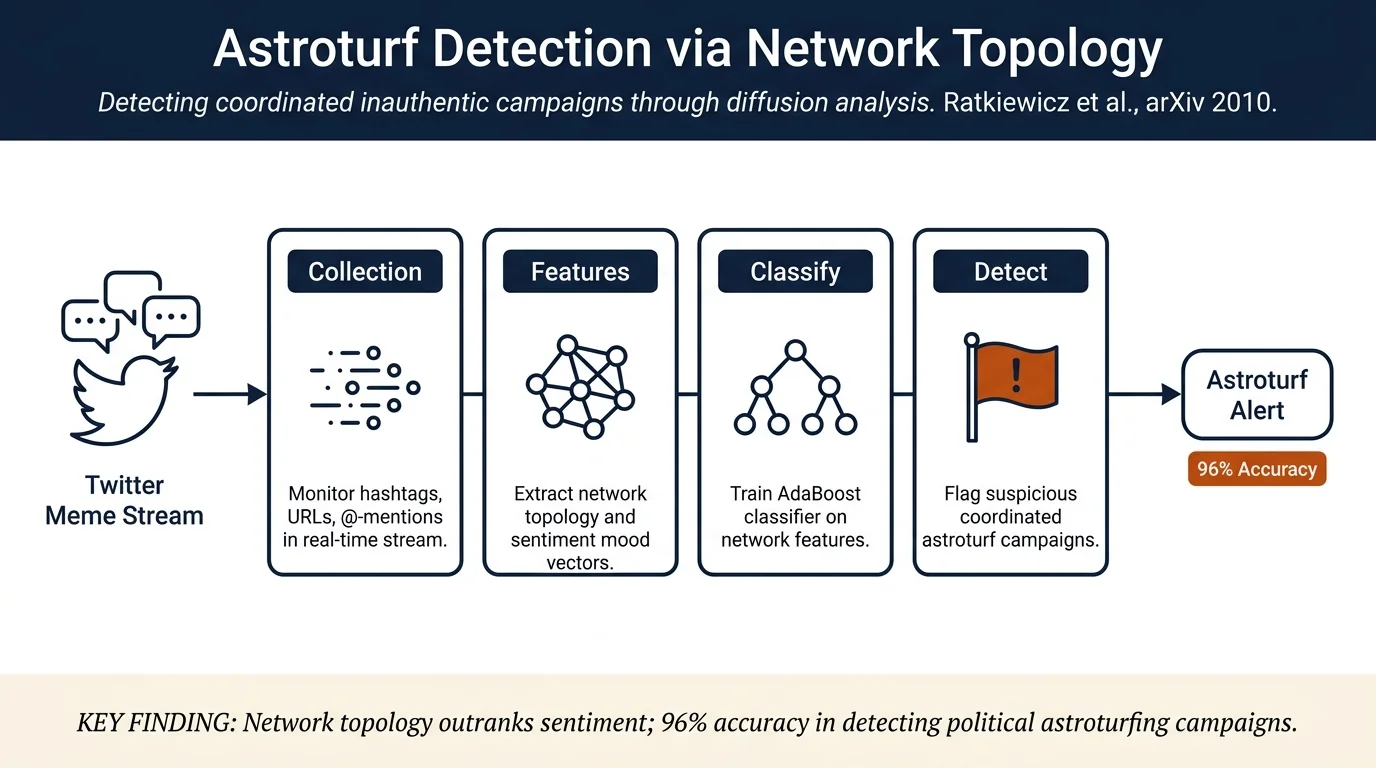
Detecting and Tracking the Spread of Astroturf Memes in Microblog StreamsPolitical campaigns increasingly use social media to amplify deceptive memes that mimic organic grassroots behavior—termed "astroturfing." This paper introduces the Truthy system, which analyzes meme diffusion networks on Twitter to detect orchestrated campaigns through network topology and sentiment analysis, achieving ~90%…
Platforms, policy & societyBots & coordinated campaigns
Partisanship, Propaganda, and Disinformation: Online Media and the 2016 U.S. Presidential ElectionThis large-scale analysis of mainstream and social media coverage during the 2016 U.S. presidential election documents asymmetric partisan structures: conservative media formed an insulated, hyperpartisan ecosystem centered on far-right outlets like Breitbart, while liberal media remained anchored in traditional journalistic practices.…
Bots & coordinated campaignsPlatforms, policy & society
The Global Disinformation Order: 2019 Global Inventory of Organised Social Media ManipulationA comprehensive inventory of government and political-party organized social media manipulation campaigns (cyber troops) across 70 countries. The report catalogs organizational structures, strategies, platforms, and resources deployed for computational propaganda; finds organized manipulation in 70 countries (up from 28 in 2017), with…
 Spread & networksBots & coordinated campaigns
The Spread of Misinformation in Social MediaMenczer presents a framework for understanding misinformation spread through social networks as an inevitable consequence of network structure and human cognitive limitations rather than platform design failures. He discusses how structural properties—scale-free topology, finite attention, information overload—create vulnerabilities…
Platforms, policy & societyBots & coordinated campaigns
How to Counter Russian Social Media Influence in Eastern EuropeRussia deploys sophisticated social media campaigns in Eastern Europe using state-funded media, coordinated troll and bot networks, fake hashtags, and nonattributed comments to sow dissent against neighboring governments and NATO. The RAND study analyzed social media data and expert interviews to identify counter-strategies: accelerating…
Spread & networksBots & coordinated campaigns
Media Manipulation and Disinformation OnlineInternet subcultures including trolls, gamergaters, white nationalists, and conspiracy theorists exploit online platforms' vulnerabilities—algorithmic amplification, engagement metrics, and participatory culture—to manipulate news frames and spread disinformation. These diverse groups employ coordinated tactics (memes, bots, strategic…